



You're standing in the entryway deciding what deserves a hanger, a hook, or a place by the door. The hat that slips, the scarf that pills, the bag that looked polished online but collapses after a season, those are expensive in the most irritating way. They ask for your money twice.
At Pandemonium, we've spent more than three decades working from the opposite direction. Leigh Young began the business in 1992 as a custom clothing design house, and that origin still shapes how we think about affordable luxury accessories today, hand-sewn in our Seattle studio, in small batches, by a dedicated team using faux fur as a signature material and paying real wages according to our published company story and brand profile on our designer biography page and home collection overview. When someone asks why one piece costs more than another, we don't start with trend language. We start with touch, fit, repair, and how often you'll reach for it.
That's the useful lens. Not “luxury” as distance or flash, but as a piece that feels velvety in the hand, sits right on the head, wears beautifully in bad weather, and still looks composed when the season turns again.
What Affordable Luxury Accessories Actually Mean in 2026
A wet sidewalk tells the truth quickly. On a Seattle morning, a hat either keeps its shape in the mist and looks sharp when you step into the office, or it gives up by the second crosswalk. In Chicago wind, a scarf either feels plush and substantial without becoming cumbersome, or it becomes one more thing you're adjusting all commute long. That's where affordable luxury accessories separate themselves from costume and impulse buys.
We define the category by what the piece does over time. It sits between throwaway fashion and old-guard luxury pricing. Bain & Company estimated the global personal luxury goods market at about €364 billion in 2024, after €369 billion in 2023, with a 2025 forecast of roughly €358 billion, a 2% decline at current exchange rates but broadly flat when currency effects are excluded. Bain also reported that the active global luxury client base fell from about 400 million in 2022 to around 330 million in 2025, a drop of about 70 million buyers, or roughly 17.5% of the 2022 base. At the same time, jewelry was forecast to grow 4% to 6% in 2025 and eyewear 2% to 4%, helped by personalization, emotional value, and versatility, all signals that buyers are becoming more selective, not indifferent to quality in Bain's luxury market analysis.
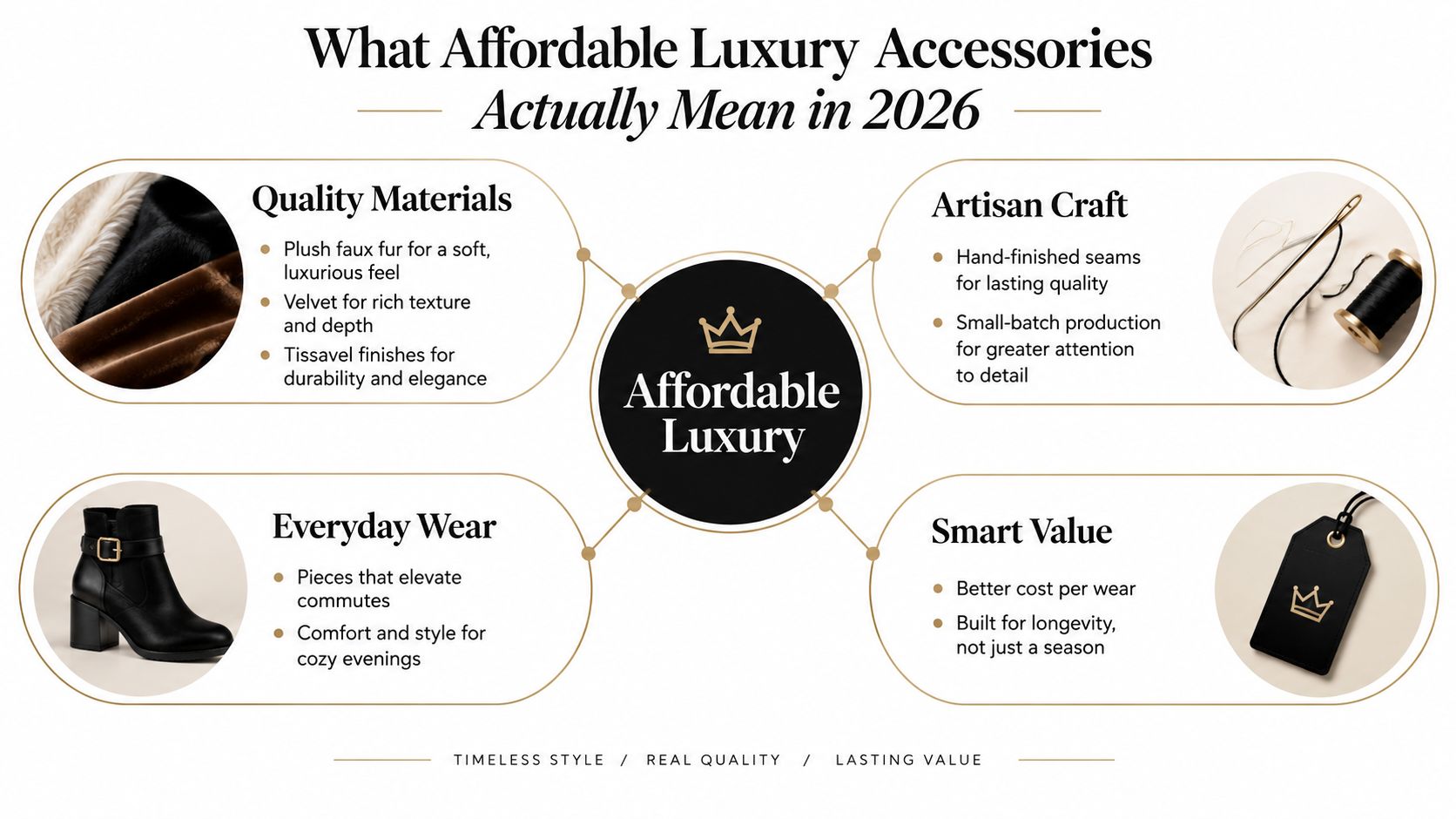
What the price should buy you
When a customer chooses a hand-sewn hat over a bargain bin substitute, the difference shouldn't be mystery. It should be visible and wearable.
- Verified materials: high-end faux fur, considered linings, and trims chosen for comfort and longevity.
- Bench-made construction: seams, edges, and stress points finished by people, not rushed through anonymous bulk production.
- Repairable design: components and construction choices that don't turn one damaged area into a total loss.
- A maker relationship: the option to ask fit questions, request custom sizing, and care for the piece properly.
Practical rule: Affordable luxury isn't the lowest price that looks expensive. It's the lowest price at which quality, ethics, and longevity are still intact.
A lot of style advice gets this right instinctively. If you want a useful outside perspective on how to dress expensively without designer prices, the most valuable takeaway is usually restraint, fabrication, and finish, not logos. That applies even more to millinery and tactile accessories, where the hand of the fabric gives the game away immediately.
We've written before about what makes responsible style worth buying in the first place, and our own thinking on that lives in our notes on sustainable luxury fashion. The short version is simple. If a piece is cruelty-free, hand-sewn, comfortable enough to wear often, and built to be maintained, the price gap often pays itself back in warmth, wear frequency, and calm.
Quality Markers We Stitch Into Every Piece
The quickest way to judge a luxury textile is still your hand. You stroke the pile once, then against the nap, and you learn a great deal. Dense faux fur has a silky resistance to it. It doesn't feel papery, brittle, or oddly flat. It has body, even when the silhouette is weightless on the head.
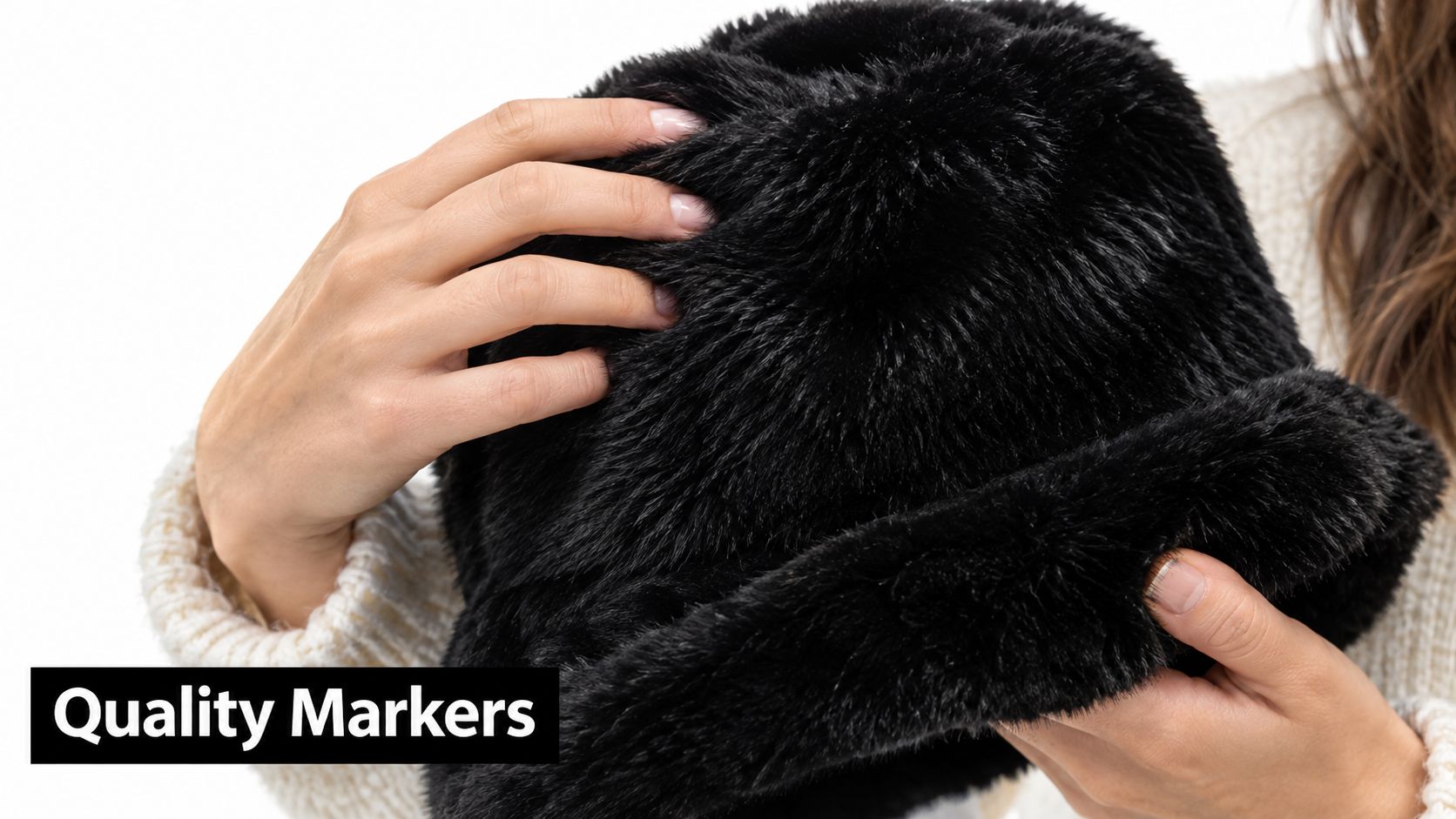
Start with the fabric hand
At the bench, we look for pile behavior before we look at color. A rich-toned faux fur with depth will catch light beautifully, but that's only half the story. We also want the fibers to recover after being pressed, worn under a hood, or handled all day.
For readers shopping online, ask better questions than “Is it soft?”
- Pile recovery: Does the fabric spring back after pressure?
- Surface depth: Does it look plush and dimensional, not shiny in a plastic way?
- Drape: Does it fall in clean lines, or sit stiffly and awkwardly?
- Purpose fit: Will this textile work for a commuter brim, a drawstring pouch, or a decorative wrap?
A good fabric guide in another category can sharpen your eye. The same way knit buyers learn to inspect fiber quality, loft, and finish in Cashmere Boutique's sweater guide, accessory buyers should train themselves to notice density, resilience, and edge performance, not just softness in a single glamour shot.
Lining, seams, and hidden structure
A lining is not an afterthought. Velvet and Tissavel finishes change how a piece feels against skin, how it slides over hair, and how it holds warmth without becoming clammy. In a well-made hat or hood, the lining is part of the architecture. It should support the outer textile, not fight it.
Seam work matters just as much. Stress shows up first at edges, openings, strap joins, and places where the hand returns again and again. We reinforce those areas because use always reveals the truth.
Here's a close look at the kind of visual clues worth studying before you buy.
Four checks we use in the studio
- Fabric behavior first: We want plush pile, controlled sheen, and a substantial hand that still moves easily.
- Lining with intention: Velvet gives a silky, breathable finish. Tissavel adds a lush, refined interior feel where drape matters.
- Stress-point reinforcement: Edges, bands, straps, and closures need hidden strength, not just pretty top surfaces.
- Finishing details: Hand-tacked hems, neatly set labels, and clean interior construction are signs that someone expected the piece to be turned inside out and inspected.
Some accessories are decorative. Others are engineered to survive being loved. You can usually tell from the inside first.
If you want a more technical read on visual and tactile clues, our article on how to tell high-quality faux fur from cheap breaks down what to inspect in product photos and in hand. For shopping, I would begin exploring real examples, from tactile faux fur hats to structured handbags and bags, because shape and finish reveal construction choices immediately.
A small sensory vocabulary helps here. Plush should mean dense and inviting, not bulky. Weightless should mean easy to wear, not flimsy. Architectural should mean the silhouette holds with elegance, not stiffness.
Ethical Materials and Cruelty-Free Trade-Offs
“Cruelty-free” is a meaningful phrase, but only when it's used sincerely. Faux fur and vegan fur can be an ethical alternative to animal fur on animal-welfare grounds, yet that doesn't make every version environmentally uncomplicated. We'd rather say the hard part plainly than hide it inside mood-board language.
What the studies actually tell us
One neutral summary from Grist reported that a Dutch cradle-to-grave life-cycle assessment found the climate impact of a natural mink coat to be at least six times greater than that of a faux-mink coat. The same piece also noted that faux fur can bring real environmental concerns because many versions are petroleum-based, don't readily decompose, and may release microfibers in Grist's fur comparison.
A different comparison summarized by Britannica reached the opposite conclusion in that particular study. It reported that the faux-fur coat had 300% greater ecosystem-damage risk, 169% greater resource-consumption impact, and 129% greater climate-change impact than the natural-fur coat in Britannica's fur debate overview.
Those two findings don't cancel each other out. They tell you the claim depends on study boundaries, material composition, manufacturing assumptions, use, and disposal. That's why we treat high-end faux fur as an animal-free choice, not as a magic material.
The trade-offs that matter in practice
The wider fashion system gives this more urgency. McKinsey and The Business of Fashion projected that apparel consumption could rise 63% by 2030, reaching 102 million tonnes. The same analysis found that 63% of fashion brands were behind their 2030 decarbonization goals, while only 18% of fashion executives named sustainability among their three biggest growth risks in 2025, down from 29% in 2024. UNEP also reported roughly 92 million tonnes of textile waste globally each year in The State of Fashion 2025.
Another concern is shedding. A 2025 environmental-fashion report states that synthetic textiles account for about 70% of textiles produced and roughly 35% of microplastics released into oceans in Seas At Risk's microplastics report.
So what works?
- Choose for longevity: A durable piece worn often is better than a parade of forgettable trend buys.
- Prefer repair-first construction: Replace what fails, don't discard what can still serve.
- Wash less, wash gently: Low-shed care matters.
- Be precise with claims: Animal welfare, climate impact, and circularity are related, but they're not the same question.
We've published our own position on labeling and standards in our notes on cruelty-free certification. The useful conclusion is modest and strong at the same time. Ethical luxury has to be qualified. It should be verifiable, animal-free, durable, and maintained for a long life.
Matching Pieces to the Way You Actually Live
The right accessory isn't the one with the most dramatic photo. It's the one that fits the rhythm of your day. A train platform, a reading chair, a holiday gift box, and a dog bed beside the sofa all ask different things from fabric and construction.
Choosing Affordable Luxury Accessories by Use Case
| Use Case | Best Material | Construction Focus | Styling Cue |
|---|---|---|---|
| Commuter dressing | Dense faux fur with stable lining | Secure fit, reinforced edges, comfortable interior | Polished, architectural, city-ready |
| Home and hygge | Plush faux fur, Tissavel, soft velvet accents | Drape, softness, easy reshaping after use | Rich-toned, cozy, layered texture |
| Gifting | Versatile faux fur or knit with customization options | Flexible sizing, elegant finishing, presentation | Classic with a personal twist |
| Pet household | Durable faux fur and sturdy closures | Easy-on design, seam strength, practical care | Coordinated, tailored, playful but refined |
For the office, train, and weather map
If you spend real time outdoors between buildings, station platforms, or parking lots, prioritize secure fit and surfaces that hold up to repeated handling. A commuter hat needs stronger edge behavior than a piece used mostly for event dressing. A lined silhouette, a proper band, and reliable structure matter more than theatrical volume in this setting.
ASTM notes that abrasion should be tested with a recognized method rather than guessed from softness or price. ASTM D4966 measures textile abrasion with a Martindale tester, and ISO 12947-based methods use circular specimens under controlled loads of about 9 or 12 kPa, with results reported as abrasion cycles. The endpoint may be thread breakage, hole formation, weight loss, worn pile, or visible appearance change. ASTM also warns that lab abrasion results alone should not be used to predict real-world wear unless that relationship has been validated for the intended end use in the ASTM D4966 standard overview.
That means a commuter handbag or hat should be judged comparatively. We look at high-contact zones separately, then combine lab evidence with real handling, seam flexing, moisture exposure, and repeated wear. If you're shopping, a structured winter hat collection or an elegant scarves collection makes sense when your wardrobe has to move from sleet to lobby without apology.
For home, gifting, and pet life
At home, drape takes over from abrasion. A throw should settle generously across a sofa arm and still look lush when folded at the foot of a bed. A rich throws collection earns its keep through touch and atmosphere as much as warmth.
Gift buyers need a different kind of reliability. They want confidence without guesswork. That's where adjustable details, classic palettes, and monogram or fit options help. For the household that includes a very beloved dog, style often extends all the way down to the floor, which is why coordinated pet accessories and beds can feel less frivolous than they sound. If the item is used daily and suits the room, it stops being novelty and becomes part of the house.
Buy for the life you have, not the fantasy closet. Accessories worn often always look more luxurious than accessories admired from storage.
Care, Repair, and True Cost Per Wear
The smartest accessory owners aren't always the ones who buy the least. They're the ones who know how to keep a piece beautiful. Faux fur, velvet, and well-made millinery repay gentle handling. Neglect makes even a good textile look tired long before its time. After twenty-five years at the bench, I can tell you the difference between a hat that ages gracefully and one that doesn't usually comes down to a handful of small habits.
Care that preserves the hand
A few routines make an outsized difference.
- Brush the pile lightly: A wire pet brush can help maintain faux fur direction and loft when used with restraint.
- Steam, don't crush: Velvet linings respond better to careful steaming than hard pressing.
- Dry with patience: Cold-air drying helps preserve texture after spot care.
- Store with shape: Use shaped forms, tissue support, or breathable bags so brims, crowns, and pile don't flatten unnecessarily.
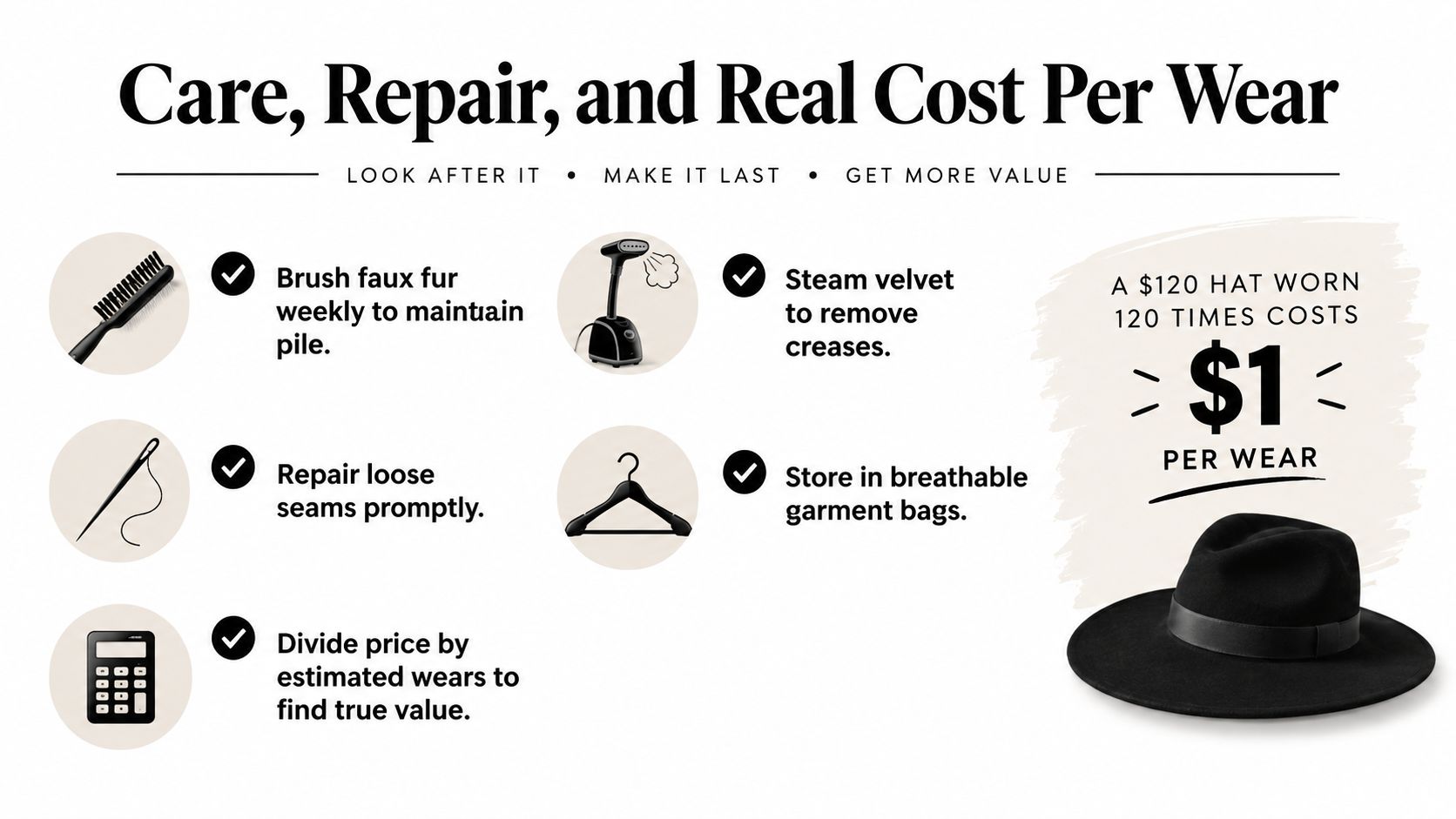
Repair is part of value
A durable accessory is designed for maintenance, not just admiration. Research summarized in sustainability literature notes that repair services can support product durability and customer loyalty by positioning luxury goods as long-term investments rather than short-cycle purchases. That has practical consequences. Replaceable hatbands, removable linings, bag straps, closures, and retained seam allowances all make later adjustment possible. The same research also stresses that laboratory abrasion performance alone doesn't predict actual wear in a specific application, so a practical quality protocol combines standardized abrasion testing with simulated use, then inspects pile distortion, lining failure, color transfer, and hardware loosening in the Business Ethics, the Environment & Responsibility article on repair and durability.
Here's the part shoppers often miss. Repairability lowers risk, especially for hard-to-fit customers. If one component can be replaced, the whole piece doesn't become dead weight. That's why we build our pieces with serviceable seams and swappable parts wherever the design allows.
A simple cost-per-wear example
A $180 faux-fur hat worn three times a week across a roughly 26-week cold season, five winters in a row, becomes 180 dollars divided by 780 wears, or about $0.23 per wear. That's a far more useful number than the ticket price alone.
A piece can be indulgent at checkout and economical in the closet.
If you need practical cleaning guidance for outer layers and plush textiles, our care notes on how to clean a faux fur coat are a good place to start. For everyday use, I'd much rather own one beautifully kept velvet-lined hat and one dependable cold-weather accessory than a drawer full of unraveling substitutes.
Customization and Gifting for the Hard-to-Fit and the Hard-to-Buy-For
Fit changes everything. A hat that's slightly wrong gets left at home. A bag strap that lands awkwardly never feels fully yours. A gift that's lovely but generic may be admired, then sidelined. Customization is the engine of value in affordable luxury accessories.
Why personalization matters
PwC's 2025 luxury fashion survey found that personalization was considered very important by 32% of respondents overall and by 39% of Gen Z respondents, based on a survey of 268 consumers across Italy, Germany, the United Kingdom, France, and Spain in PwC's luxury fashion survey. That tracks with what we see at the bench. When fit is right, wear frequency follows, and a piece that gets worn is a piece that earns its price.
At Pandemonium Millinery, one option among many in the category is a bespoke approach built around custom sizing and a "your fabric, our expertise" service, which matters most for shoppers with hard-to-fit measurements, gifting uncertainty, or a clear design point of view. Custom isn't automatically responsible, of course. A personalized piece that never leaves the closet is still a poor decision, and I'd rather talk a customer out of a commission than watch it gather dust.
What to send when ordering custom
If you're commissioning rather than browsing, send specifics.
- Head or body measurements: Exact circumference matters more than "small" or "large."
- How you'll wear it: Over styled hair, with a coat collar, indoors only, or on a daily commute.
- Color and texture cues: Rich-toned, classic, shimmering, architectural, understated.
- What can change later: Ask which adjustments are reversible and which are structural.
For gift-givers, personalization is often more memorable than excess. A custom band, a thoughtful lining, or a refined sleeve adjustment carries more emotional weight than spending more. I've watched a monogrammed piece become someone's daily companion while a pricier generic gift sat in its box. If you're balancing gift ideas beyond apparel, the same logic appears in beauty and wellness, where a polished, personal experience often wins over a generic item. That's part of why ideas like treat yourself to a beauty voucher resonate. They remove friction and add intention.
If monogramming is part of the appeal, our guide to monogrammed faux fur accessories gives a useful sense of what personal detail can do without tipping into novelty. And if you're ready for a giftable, tactile direction with softness and polish built in, explore the Cozy Cable collection. It's an easy place to land when you want warmth, texture, and a piece that feels chosen rather than merely purchased.
Bringing It All Together in the Pandemonium Studio
A piece earns its keep at the worktable long before it earns a place in your closet. You feel it in the way a faux fur has body without stiffness, in a seam that lies flat instead of twisting, in a lining that glides over hair and collars rather than catching. Affordable luxury starts there. It starts with materials you can verify, construction you can inspect, and a shape worth repairing when years of wear finally ask for care.
Our Seattle studio has worked that way since Leigh Young began the business in 1992. That history matters because it keeps our standards practical. Hand-sewn in the USA. Small-batch production. Faux fur as a signature material. Real wages. Custom roots instead of mass output. Those are the mechanics behind an accessory that feels generous in the hand and sensible in the long run.
Price always involves trade-offs. The cheapest option often asks you to pay again soon, either because the fit was off, the fabric tired quickly, or the piece never became part of your daily life. A better purchase usually comes down to a few plain checks.
- Choose fewer pieces: buy what you will wear, gift, or reach for often.
- Verify the build: materials, stitching, and finish should be easy to read.
- Care for what you own: maintenance belongs in the luxury equation.
- Use customization wisely: better fit and function can lower cost per wear over time.
We like sharing what is on the bench and why certain choices make the cut. Join The Crowd for 15% off and first access to new textures, seasonal runs, and studio updates. If bold pattern, plush structure, and hand-sewn Seattle character sound right, start with the Fractal Collection. Bring us your measurements, your fabric ideas, and your impossible gift list.
If you're looking for affordable luxury accessories that feel considered rather than generic, Pandemonium Millinery offers hand-sewn faux fur hats, scarves, apparel, home pieces, and custom options shaped by Seattle craftsmanship and Leigh Young's long design legacy.


