



You're waiting for a Seattle bus in sideways drizzle, holding your coat closed while the crossover of your dress lifts in the wind. Later, under office heating, that same outfit feels stifling. A winter wrap dress needs more than a cozy surface: it needs the right fabric, a dependable overlap, and layers you can remove without dismantling the outfit.
We would choose the dress for the commute first, then refine the look for the destination. A velvety finish is lovely, but it won't compensate for an exposed neckline or a waist tie that slips when you sit.
Pick the Right Fabric for Your Climate
Winter wrap dress fabrics by climate
| Fabric | Feel | Moisture handling | Best climate |
|---|---|---|---|
| Wool-blend jersey | Cozy and weightless | Wool fibre absorbs moisture; blend performance follows its composition | Damp mild cold, commuting |
| Lined wool crepe | Substantial and structured | Wool buffers moisture; a breathable lining helps sweat escape | Rain and office days, beneath a weather-resistant coat |
| Heavy double-knit | Plush and dense | Moderate, with fibre content determining drying behavior | Dry cold, outdoor waits |
| Crushed velvet (polyester) | Plush and rich-toned | Low absorption; generally dries quickly | Heated indoor spaces, evenings |
| Cotton jersey | Light and soft | Absorbs moisture and stays clammy when damp | Cool dry days only |
| Silk-blend crepe | Silky and fluid | Moderate; avoid prolonged dampness | Layered over a fine knit, low wind |
Fabric has to manage warmth and moisture together. The Woolmark moisture-buffering factsheet reports that wool can absorb up to 35% of its weight in moisture without feeling wet. That's useful when a brisk walk warms your back before you reach a damp bus stop, but it isn't a waterproofing claim or a guarantee for every wool blend.
Wool-blend jersey offers forgiving movement and a soft waist knot. Lined wool crepe gives a cleaner, more architectural silhouette, although its lining must leave room across the shoulders and hips.
Read the cloth with your hands
A luxury textile should feel comfortable in motion, not merely impressive on the hanger. Test the actual garment rather than choosing by fabric name alone.
- Hold it toward the light. Widely spaced stitches can admit drafts, even when the yarn looks substantial.
- Fold the crossover together. Feel the combined bulk where the bodice, skirt, and tie meet. A dense knot can become uncomfortable beneath a coat.
- Stretch and release. Jersey should recover without leaving ripples around the waist.
- Rub the inner surface gently against your wrist. A scratchy finish won't become more pleasant during a long workday.
Fabric rule: Choose enough body to drape securely, not so much bulk that the wrap becomes a padded belt.
A plush velvet-look fabric is especially satisfying in dry indoor heat. For wet streets, protect its pile beneath a shell rather than treating its rich appearance as evidence of weather resistance.
For Cozy Cable knits or any cable-textured option, check the fibre label before assuming it contains wool. To distinguish decorative pile from practical insulation, explore the guide to types of faux fur fabric before selecting a trim or coordinating layer.
Layer the Dress for Wind, Rain and Indoor Heat
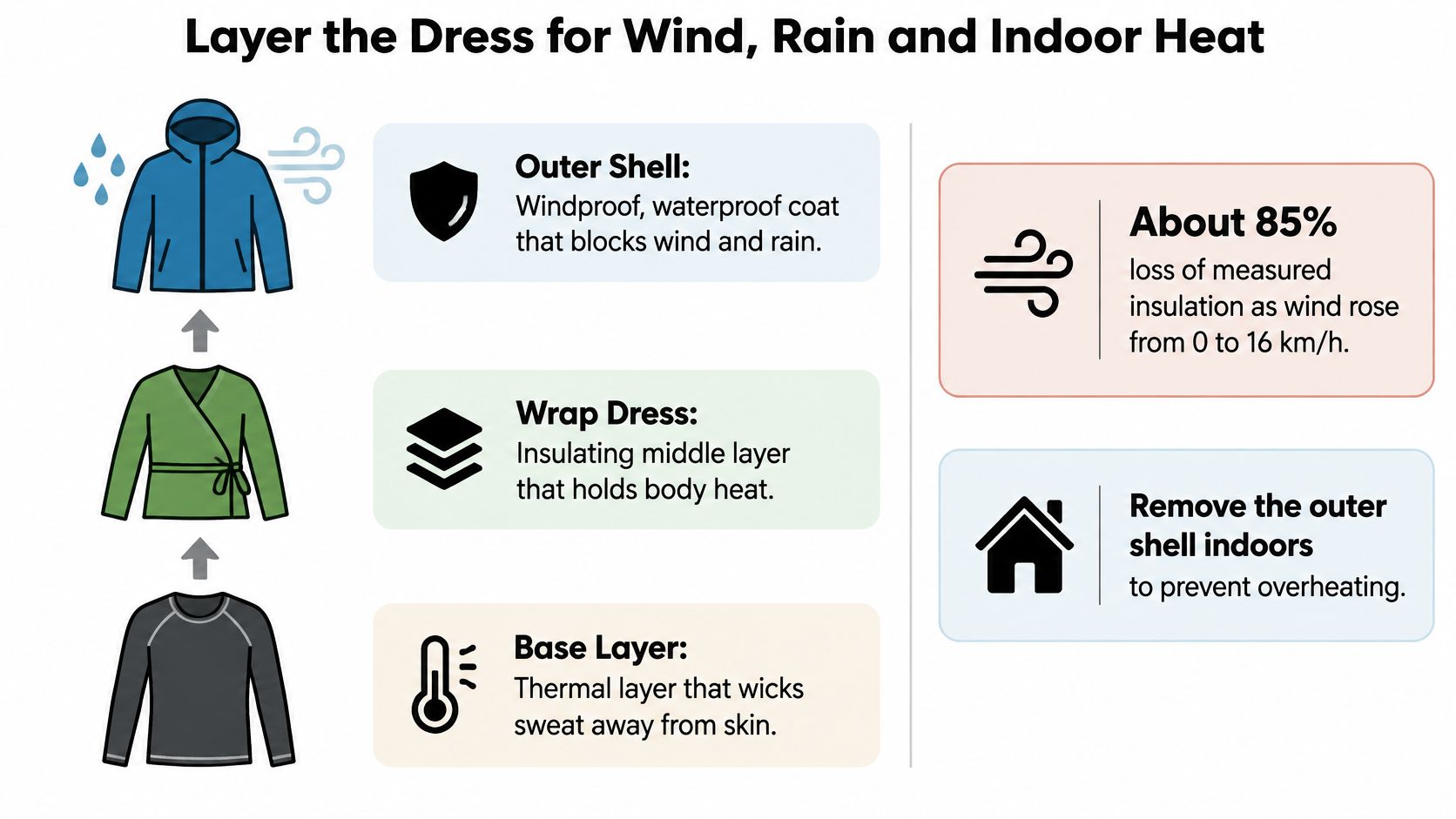
Wind strips warmth from clothing quickly, so blocking drafts matters more than adding bulk. A wrap dress stays comfortable through changing conditions when its base layer lies flat, its outer layer blocks wind or rain, and each layer can be adjusted indoors.
Layering stacks by cold scenario
These combinations are starting points, not tested temperature ratings.
| Scenario | Base layer | Wrap dress | Outer layer |
|---|---|---|---|
| Dry cold, below freezing | Thermal knit base | Lined wool-blend wrap, tie snug | Insulated coat with high collar |
| Wet cold, around freezing through chilly above-freezing weather | Moisture-wicking base | Wool-blend jersey wrap | Waterproof shell with hood |
| Windy transit, any temperature | Close-fitting base | Lined wrap, secure waist knot | Windproof shell with adjustable cuffs |
| Heated office, mild outdoors | Light knit or none | Lightweight wrap | Open light coat or faux fur hoodie vest |
| Rain with indoor overheating | Thin base layer | Jersey wrap | Waterproof shell with an adjustable neckline |
For dry cold, cover your legs as well as your torso. Thermal tights and boots with enough shaft coverage help when the skirt shifts around the knees; an extra scarf cannot close that gap.
For wet cold, choose a hood and a shell long enough to cover the crossover. On windy journeys, fasten the cuffs and collar, then check that the layers still allow a full stride. A shell that blocks rain but pulls across the hips can restrict movement and tug the dress out of place.
At the office, make the removable layer the warmest one. A faux fur hoodie vest can sit beneath a roomy coat, but it does not replace a rain shell. Check that its pile does not press the dress sleeves flat, and remove or open the outer layer before the room feels too warm.
Use this diagram to check the order of your layers.
Keep the waist uncomplicated
- Fit the base closely. Smooth sleeves and a flat hem prevent ridges beneath the crossover.
- Choose a knit slip. It adds coverage without the gathered bulk of a substantial petticoat.
- Move bulky knitwear outward. Tie the dress over a fine base, then wear the sweater or vest over it.
- Vent before you sweat. Open or remove the shell indoors, before the base layer feels damp.
For a day that moves between outdoor waits and overheated rooms, use this cold-weather layering guide to plan layers you can take off without disturbing the dress.
Fit the Wrap So It Stays Closed All Day
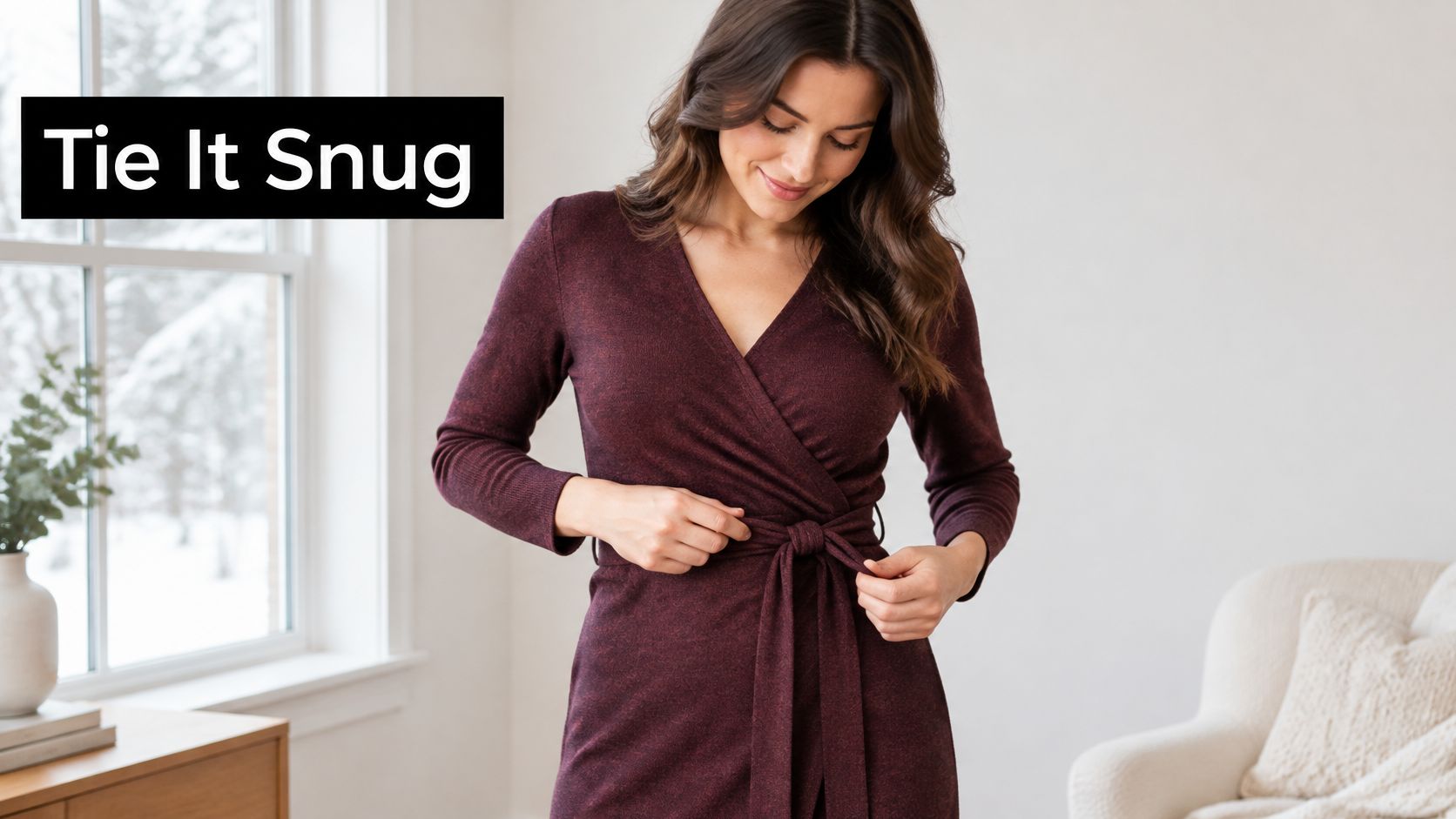
A true wrap has overlapping front panels held by ties rather than a permanently stitched crossover. The waist tie adjusts the fit, but tightening it harder isn't the answer to every opening neckline.
Watch how the fabric lies around the knot, not just how neatly the bow sits.
The clothing-insulation paper available through PubMed Central discusses how clothing layers, mass, and the clothing microclimate affect insulation. In a fitting, that means we need room for the intended layers without creating loose openings that admit drafts.
Test the dress in motion
Wear your intended base layer and use a flexible dressmaker's tape. Keep a note of what opens, pulls, or twists rather than relying on a flattering standing view.
- Measure the working dimensions. Record bust, waist, hip, back length, upper-arm circumference, and preferred sleeve length. Keep the tape level and comfortably against the body.
- Cross and raise your arms. Watch the neckline and shoulder seams. The bodice shouldn't drag upward or expose the base layer unexpectedly.
- Take a full walking stride. Check the front in a mirror, then turn sideways to inspect how far the skirt separates.
- Sit normally. Let your waist and hips settle into the chair. Don't hold your stomach in to make the overlap behave.
- Inspect the hidden closure. Check whether the inner tie migrates and whether the hem stays adequately covered.
- Open and retie the dress repeatedly. Look for pulling stitches, twisting anchors, or a knot that loosens with movement.
A broad, low-profile inner tie distributes pressure more comfortably than a narrow cord. An outer anchor needs reinforcement at the seam, not merely stitching through the face fabric.
For a visual demonstration of handling the wrap closure, use the video alongside your mirror checks.
If you're comparing relaxed silhouettes, Cedar & Lily Clothier's guide to comfortable wrap dresses for weekends offers another useful starting point. Still run the movement test with your own layers.
Before ordering, review the inclusive sizing options and ask about overlap, sleeve room, and petite or tall hem adjustments. A larger waist allowance alone won't fix a tight armhole.
Style Workplace and Weekend Looks Side by Side
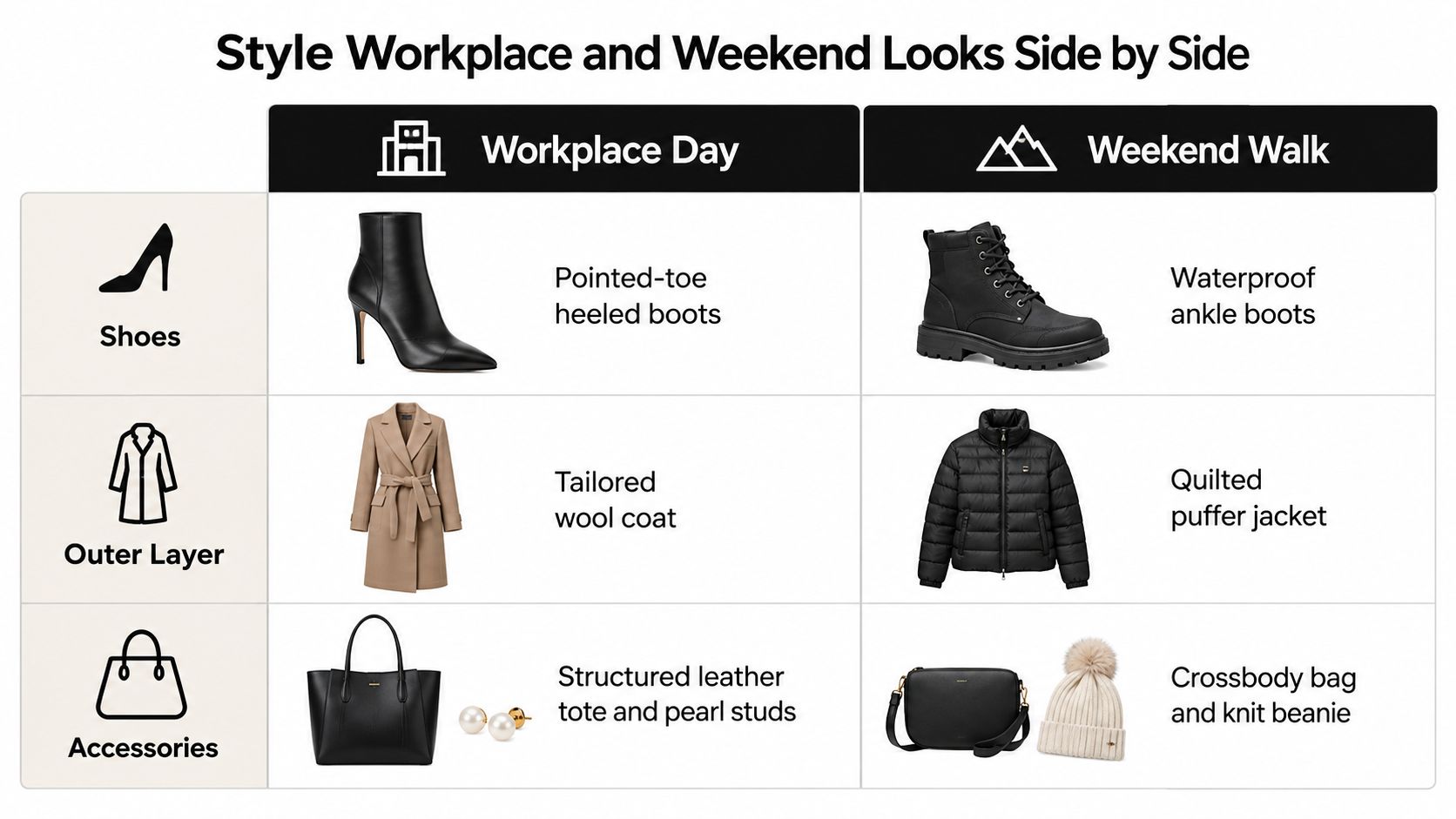
Workplace versus weekend styling for one winter wrap dress
| Element | Workplace | Weekend |
|---|---|---|
| Wrap fabric | Lined wool crepe or fine knit | Plush velvet or heavy double-knit |
| Footwear | Closed-toe ankle boots or pumps | Flat boots or lined sneakers |
| Outer layer | Structured wool coat | Faux fur trimmed topper or puffer |
| Bag | Structured tote | Crossbody or faux fur handbag |
| Headwear or scarf | Sleek scarf in a rich tone | Velvet-lined hat or statement scarf |
| Hosiery | Opaque tights in a matching tone | Textured tights, or none for brief mild-weather outings |
| Jewelry | Small, polished pieces | Chunky or tactile pieces |
The same wrap can carry a workplace day or a weekend walk when the shoes, outer layer, and accessories change. The fabric row shows alternatives when shopping, not a reason to purchase a separate dress for every setting.
For work, a tonal combination keeps the crossover from looking busy. A rich-toned wrap, matching tights, and sleek ankle boots give a continuous line beneath a classic structured coat.
A weekend outfit can be softer and more tactile. A velvet-lined hat feels inviting around the forehead, while a vibrant scarf brings interest without adding another knot at the waist.
This comparison offers a visual starting point, but choose footwear for the pavement before choosing it for the silhouette.
Change the mood without replacing the dress
- Swap the hat. Keep a sleek shape for work and a more expressive piece of millinery for leisure.
- Change the scarf texture. A smooth scarf sits neatly beneath lapels; a statement scarf looks best when the coat has room around the collar.
- Use a belt carefully. A decorative belt can cover the tie, but it shouldn't replace the inner fastening or force the waist into uncomfortable compression.
- Try a faux fur boot topper. Keep it clear of zippers and walking surfaces, and make sure the boot shaft still closes comfortably.
Dress for the walk you'll actually take, not just the doorway where someone will see the outfit.
A faux fur trimmed topper gives visual softness, but exposed pile isn't a substitute for a weather-resistant outer layer. Save lined sneakers for conditions their soles and uppers can handle; wet paving calls for dependable grip.
Use the business-casual winter guide to refine proportions around coat hems, boots, and accessories. The most convincing outfit is usually the one you can move through the day without adjusting.
Care for Faux Fur Trims and Linings Over Many Winters
A faux fur trim and a wool-blend wrap may need entirely different treatment. Heat and unsuitable immersion can damage pile, shrink cloth, or make the lining pull against the outer fabric.
Care by component for a winter wrap dress
Use these as conservative starting points; a garment label that prohibits washing takes precedence.
| Component | Wash | Dry | Store | Warning sign |
|---|---|---|---|---|
| Wool-blend jersey wrap | Cold hand wash with wool detergent if washable | Dry flat, away from heat | Folded, not hung | Stretched shoulders |
| Lined wool crepe | Professional dry cleaning; spot clean lining cautiously | Air on a padded hanger after treatment | Hung with shoulder space | Lining pilling at armholes |
| Faux fur trim | Spot clean unless label allows washing | Air dry; gently comb pile | Loosely supported, breathable cover | Matting at neckline |
| Crushed velvet | Spot clean; steam only after testing | Hang dry if construction permits | Hung without crushing | Flattened pile |
| Satin or silk inner ties | Cold hand wash only if washable and detachable | Lay flat | Loosely rolled when detached | Fraying at anchors |
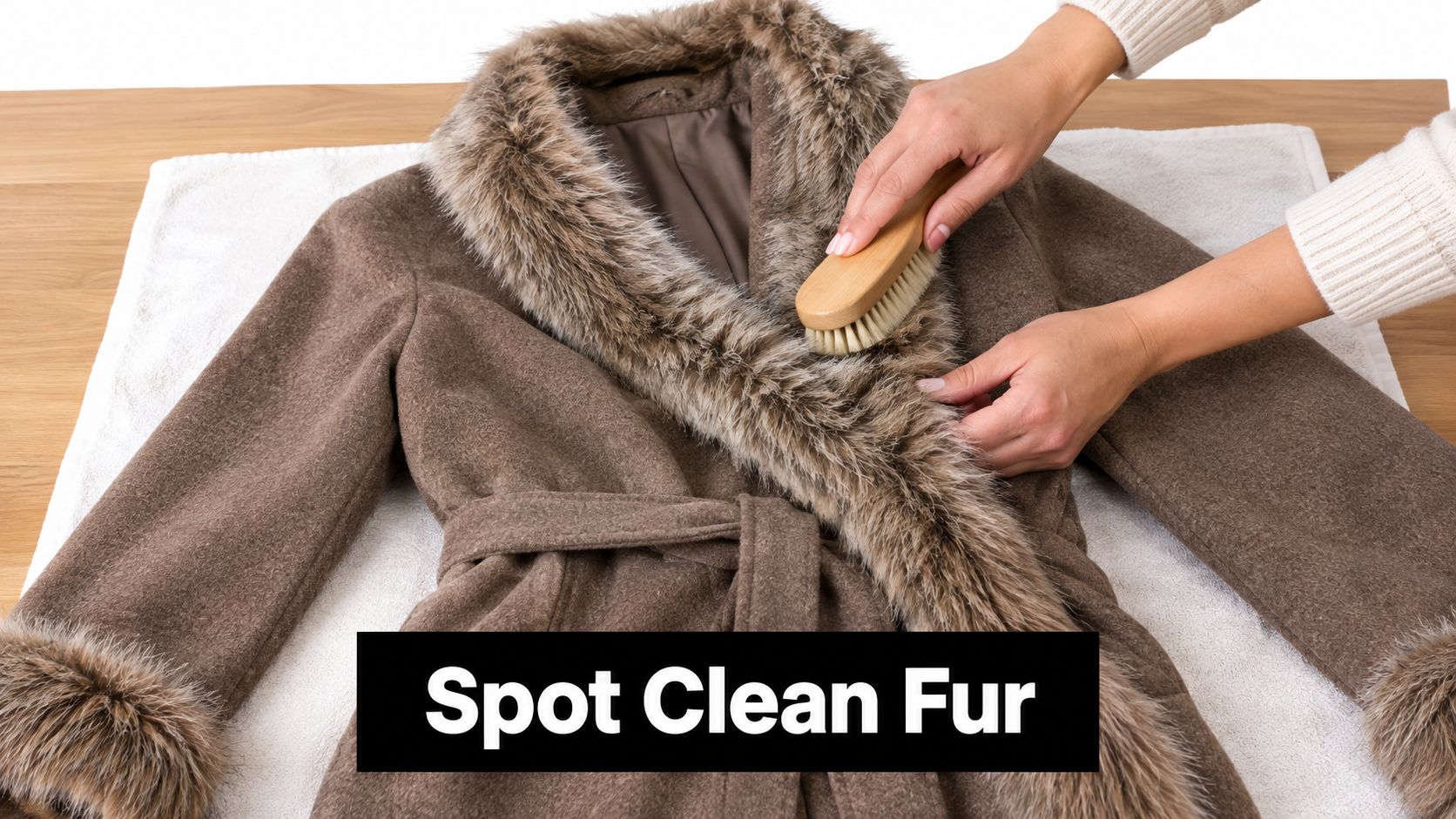
Refresh pile gently
Use light pressure and support the backing rather than dragging a comb through a tangle.
- Let the piece dry fully. Wet pile is harder to separate without pulling.
- Comb with the nap. Use a wide-tooth comb or fur comb, starting at the tips.
- Spot clean residue. Dab with a barely damp cloth and mild soap, then remove soap with a clean damp cloth.
- Air dry loosely. Keep the piece away from radiators and direct heat.
Re-anchor a loose tie with small hand stitches into sound seam allowance before fraying spreads. For flattened velvet, test gentle steaming from the reverse without touching the pile with an iron; unsuitable steam can mark some finishes.
For an unfamiliar stain on a mixed-material garment, consult CleanOnline, North York's Premium Dry Cleaners, on stain removal with wet and dry cleaning before choosing a treatment.
Durability matters alongside animal welfare. Vogue's account of Textile Exchange figures reports that global fibre production rose from 125 million tonnes in 2023 to 132 million tonnes in 2024, with polyester reaching 59% of total fibre production. Recycled or vegan labels alone don't settle environmental performance; consider shedding, repairability, care, and useful life.
Explore the faux fur care guide before refreshing a treasured trim. Store clean pieces only once they're fully dry.
Choose Your Winter Wrap Dress and Request Custom Sizing
Choose a dress that fits your actual week and care routine. In wind, a loose crossover can gape; in an overheated office, a heavy base layer can quickly feel uncomfortable. Fabric, closure, and layers need to work together.
Check before committing
- Match the climate. For damp commutes, prioritize moisture comfort; for exposed routes, plan a protective outer layer.
- Confirm the closure. Ask how the wrap overlaps and ties, and check that it stays closed when you move.
- Plan the complete outfit. Test coat sleeve clearance and room for the base layer you already own.
- Accept the care routine. Choose washable construction only if the lining and trim can also handle that care.
- Judge lasting usefulness. Accessible seams and replaceable ties make repairs easier. Choose a fabric you'll want to wear repeatedly, rather than relying on an ethical label alone.
Seattle's outerwear tradition includes the Seattle Woolen Company's water-repellent garments for woodsmen and fishermen, described in Nordstrom's historical account of regional clothing production. It offers a local context for choosing clothing suited to wet, demanding days.
Before ordering: Describe what fails in your current clothes, such as a neckline that lifts or upper sleeves that feel tight. Those details help a maker assess fit more clearly than a general request for extra room.
Discuss the overlap before cutting, along with sleeve length, waist placement, and hem coverage. Share your measurements and how you plan to layer, so the adjustments account for the whole outfit.
At Pandemonium Millinery, Leigh Young's Seattle studio produces hand-sewn pieces in small batches, including faux fur accessories and apparel. Ask the team about custom sizing and fitted adjustments for the overlap, sleeves, or hem, then explore The Fractal Collection for a finishing touch to your winter wrap dress.


