


You are standing in a cold station crowd, pulling your hat down against the wind, and every dark beanie around you looks the same. A monogrammed hat changes that moment. It keeps you warm, and it also says the hat is yours before you ever check a cloakroom ticket or a luggage bin.
That is why we treat a monogram as a fit and durability decision, not a last minute flourish. Pile, lining, thread weight and placement all change how crisp those letters look after a winter of commuting, rain and storage.
What a Monogrammed Hat Is and Why Initials Matter
A monogrammed hat carries initials or a short name mark, stitched, appliquéd or tonally embroidered onto the crown, brim, band or lining. The letters work as both decoration and identification.
Say you choose a single initial on a rich toned pillbox for the office. At a distance the hat reads as classic millinery. Up close, the letter marks it as personal, giftable and harder to confuse with someone else's.
Monograms have roots reaching back more than 2,300 years, with earliest known examples on Greek coins from approximately 350 BCE, according to 405 Magazine's history of monograms. Royal households later applied them to textiles, banners and documents, using letters to signal identity and belonging.
Hats have long carried that same public signal. Occasion, status and family connection can all sit in a visible mark, which is why initials feel at home on headwear.
At Pandemonium, founder Leigh Young has led our studio since 1992, bringing more than 25 years of design experience to pieces hand-sewn in small batches in Seattle. For readers who enjoy material history, we recommend our history reading on faux fur and its evolution alongside your hat choices. Four decisions now matter most, style and placement, lettering and thread, fit, and care.
Monogram Styles, Placement, Lettering and Thread
Start with visibility, then work backward to thread. A bold front crown initial and a private lining monogram solve different problems, even when they use the same letters.
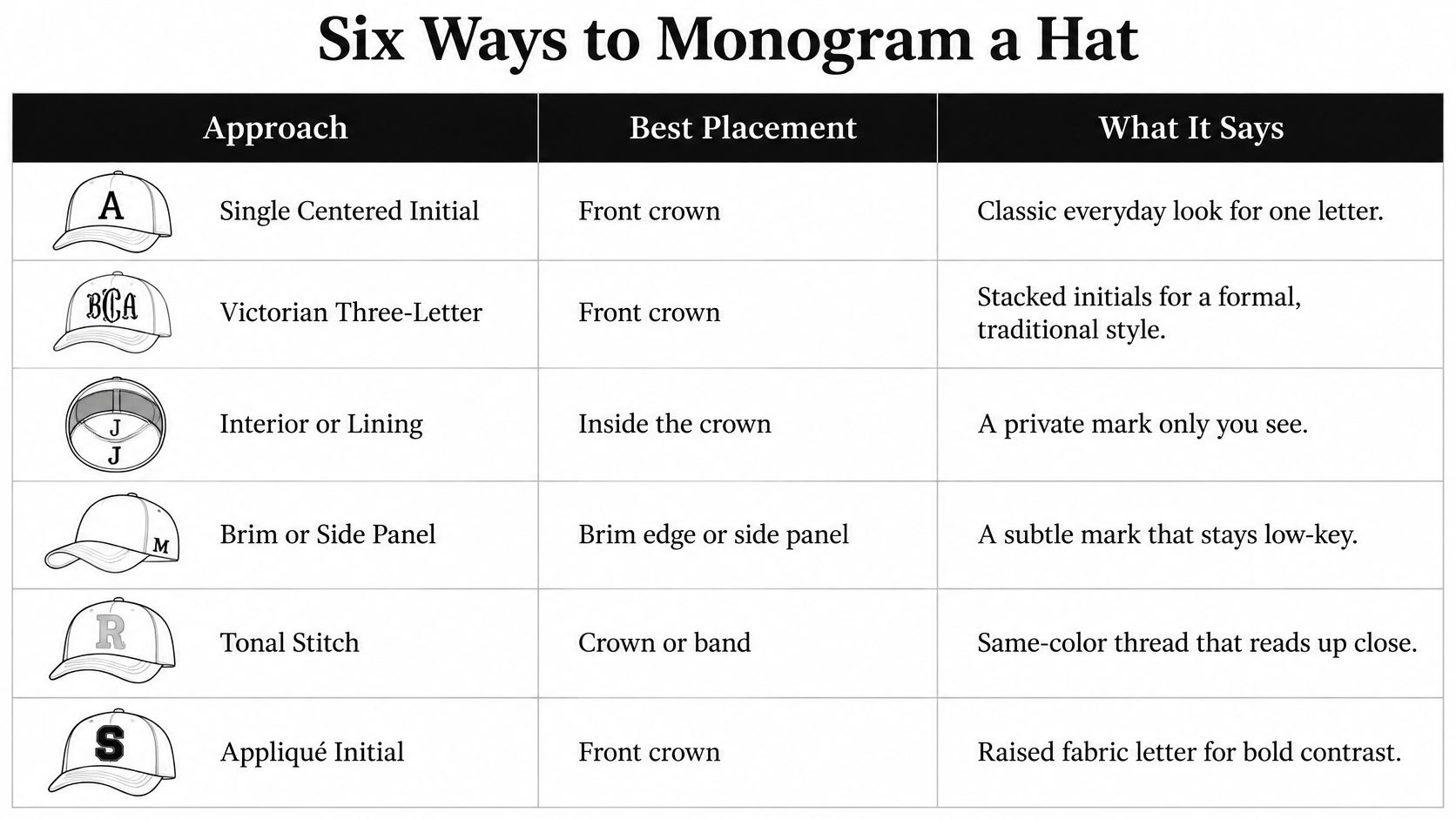
| Monogram style | Typical placement | Visibility | Best use |
|---|---|---|---|
| Single centered initial | Front crown or cuff, centered | High, bold | Gifts and statement hats |
| Victorian three-letter | Front crown, surname initial larger in center | High, classic | Heritage looks and family-style marks |
| Interior or lining monogram | Inside sweatband or lining | Private, seen only by the wearer | Gift-safe and discreet wear |
| Brim or side-panel monogram | Side of brim or fold-up edge | Medium | Commuters who want a subtle signature |
| Tonal stitch | Front band, thread matched to hat color | Low, understated | Minimalist, office-polished looks |
| Appliqué initial | Front crown, faux fur or velvet shape sewn on | Sculptural and plush | Faux fur and velvet hats where stitching would sink into the pile |
Placement rules we use in the studio
- Front crown: highest visibility and the strongest personal signal, best for one initial or a Victorian three letter mark.
- Cuff or band: a quiet, architectural mark that does not change the crown silhouette.
- Interior monograms: private and gift safe, useful when you do not want initials read on a platform or in a meeting.
- Brim or side panel: visible in profile, lower key from the front, and a good compromise for daily wear.
If you're comparing services and layouts, choosing monogram styles and placement is a helpful external reference for how placement changes the finished read.
Initial order, font and thread
Order rule: Confirm the exact letter order in writing before stitching. Do not let a studio guess across naming conventions.
Most English speaking customers use first, middle, last for a straight line. The Victorian layout puts the surname initial larger in the center, with given name initials on either side. That distinction looks small on an order form and very large on a forehead, so we spell it back to you.
Block serifs and simple sans letters read best at hat scale. Script looks velvety and romantic on paper, but its thin strokes break down when they're small, curved and fighting pile. On a monogrammed hat, larger simplified characters usually win.
Thread weight has to match letter height. Technical embroidery construction guidance identifies 40-weight thread, approximately Tex 27, as a general purpose choice, while finer 60-weight thread, approximately Tex 16 to 18, is better suited to lettering below 6 mm in height. Heavier 30 weight suits bold decorative work where you want a substantial, raised letter.
Contrast needs the same discipline. Contrasting thread is easiest to read at distance. Tonal thread, one shade deeper than the base, relies on texture and light and suits understated, polished wear. A complementary thread can tie a hat to a scarf or coat lining, but test it against the actual base color, because a color that separates cleanly on navy can disappear on charcoal.
Material changes the answer
Pile direction on high-end faux fur or velvet can blur a technically correct embroidery file. Stitches sink, edges soften and a narrow counter inside an A or R fills in. We use three fixes, a cut-away backing for repeated wear, simplified letters with wider openings, or appliqué, where a velvet or faux fur letter sits cleanly on the plush surface instead of inside it.
Our Tissavel luxury textiles reward that care with a silky, rich toned pile, but they punish tiny detail. If you bring your own textile, we keep the promise simple, your fabric, our expertise, and we test before we commit.
Close every decision with a three point test.
- Sew a sample on the exact hat material, not a scrap of cotton.
- Check after washing for edge distortion, thread migration and loss of contrast.
- Check against the lining, where backing visibility or stiffness can affect comfort.
For bases that work well with that test, browse our guide to monogrammed faux fur accessories and note which velvet lined styles suit appliqué rather than fine stitching.
Sizing and Fit for Hard-to-Fit Heads
A monogram cannot rescue a hat that lifts in the wind or squeezes by noon. Fit controls warmth, balance and whether the lettering stays where we placed it.
Hat sizes by head circumference
| Size | Head circumference (in) | Best for |
|---|---|---|
| Small | 20 7/8 to 21 5/8 | Petite or close-cropped heads |
| Medium | 22 to 22 3/4 | Most adult heads |
| Large | 23 to 23 3/4 | Larger heads or thick, voluminous hair |
| Extra large or custom | 24 and above | Hard-to-fit heads needing bespoke sizing |
Measure with a soft tape, not a rigid ruler.
- Above the ears and brow: wrap the tape around the widest part, about 1 cm above the brow.
- Hair as worn: measure with your hair styled as you'll wear it under the hat.
- Twice, level: keep the tape level, snug but not tight, and record both readings.
For a visual walkthrough before you order, measure your head for hat sizing shows where the tape should sit.
Why fit is a warmth decision
Warmth lives in trapped air. Trapped air can contribute more than 60% of total clothing insulation in some configurations, with the most effective air gap commonly falling within approximately 5 to 20 mm, according to research on layered textile systems and air gaps. Too much space lets warm air move and escape. Too little compresses pile and lining, and on velvet or faux fur that flattened patch shows.
Wind strips warmth from a loose crown even faster, which is why we cut for a close but non-compressive fit with coverage around the ears and lower crown. A stable lining or sweatband keeps that insulating layer consistent, and it keeps a monogram from drifting off center as the hat shifts through the day.
Standard sizing frustrates many shoppers. The custom-made clothes market report cites consumer research finding 36% of consumers avoid apparel brands because of inconsistent sizing, and notes smartphone based measurement systems can differ from benchmark anthropometric data by approximately 20 to 30 millimeters. That gap is why we trust a tape over an app estimate.
We fit very small and very large heads, and we build crown volume for curly or thick hair without tightening the band. If you have comfort needs, such as a preference for soft seams or low pressure at a particular spot, contact the studio before ordering and use our detailed hat sizing guide to send us a clean measurement.
Personalization Ideas for Gifts, Home and Pets
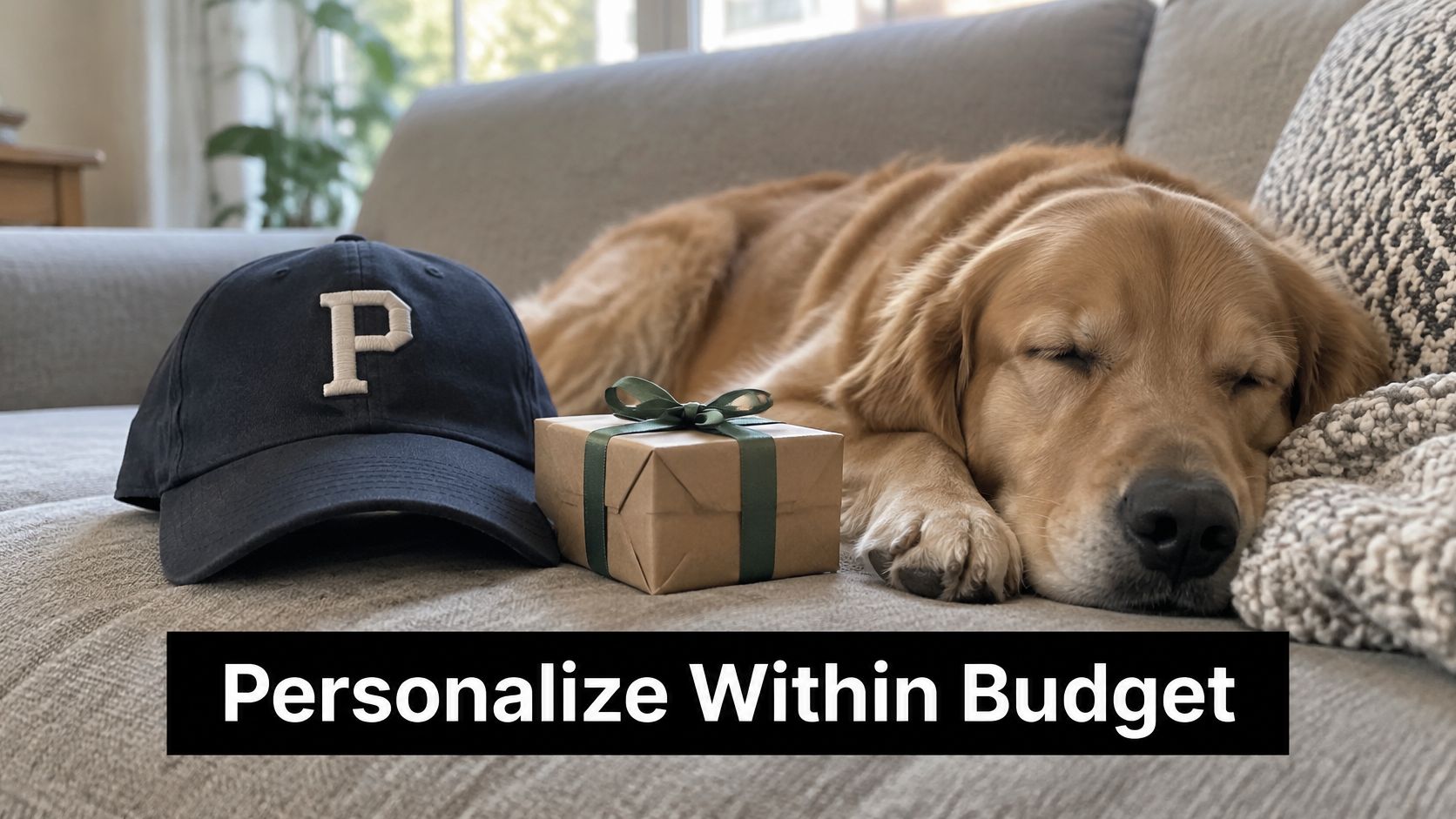
Set the budget before you fall for appliqué. A MarketIntelo hats market report claims customization premiums commonly add 25 to 40% to hat prices, so a larger, raised letter needs to earn its place.
For gifts. Milestone birthdays, anniversaries and holidays suit a monogrammed hat paired with a matching scarf. One initial is safer than guessing a three letter order, and an interior mark is safer still if the recipient prefers understatement. If you're shopping for men and want broader inspiration, thoughtful monogram gifts for men offers useful gift framing to adapt to millinery.
For home. Ask about an initial on the corner of a Tissavel faux fur throw. The plush, weightless texture draws the eye over a sofa, and a tonal letter reads as texture from across the room. It is personal without turning a living room into signage.
For pets. A monogrammed reversible coat or bolster bed treats a dog or cat as family and can match the owner's home palette. Keep lettering flat and away from straps or chewing edges, where abrasion is highest.
Privacy decides the final form. A full name, workplace or social handle on a hat is readable by strangers and reduces resale and regifting flexibility. Initials, an interior monogram or a removable option give the emotional value of belonging without broadcasting identity.
For pairing ideas with coats and sets, see our custom apparel gifts guide and ask our studio which gifting option fits your timeline at pandemoniumhats.com.
How Our Bespoke Hat Process Works
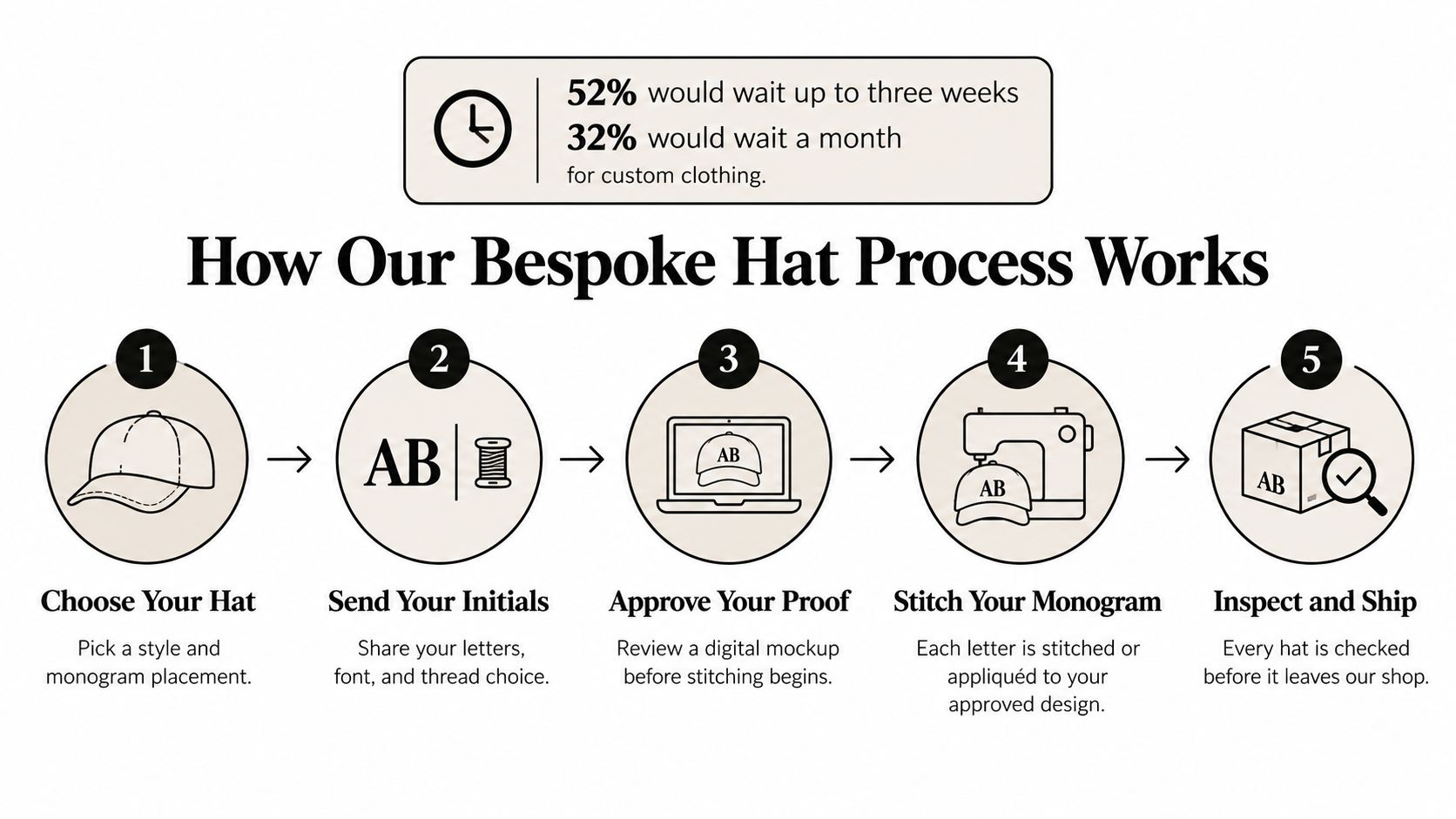
Custom work takes longer because your hat is built to order rather than pulled from a bin. A 2020 Balodana survey of consumers interested in custom clothing reported 52% would wait up to three weeks for custom clothing and 32% would wait a month. Buyers who want lettering that lasts accept that trade when the fit is right.
Seven steps stand between your brief and a finished hat. Each one protects either the fit or the monogram.
- Send your design brief. Give us initials, order, style and placement in writing.
- Choose the base. Pick a faux fur or velvet base from the textiles our studio works with, noting whether you want a velvety interior or a plush exterior letter. This choice is structural, not just visual. Embroidery sits differently in deep pile than on flat velvet, and a letter worked into long fur needs a denser stitch to stay legible once the pile moves.
- Measure or consult. Send a tape measurement or book a sizing consult, especially for voluminous hair or a sensitive fit. Fit decides how warm the hat wears and how the lettering balances on the crown.
- Approve proof and sample. Review a lettering proof and a sample stitched on the exact material, so a vibrant thread on screen does not disappoint in daylight.
- Hand-sewn construction. Our Seattle team stitches or appliqués each piece in small batches, with artisanal finishing you can feel at the band.
- Quality check. We inspect lettering edges, thread migration, backing and lining before the hat is shaped. Weak backing is where monograms start to pucker, so we catch it here rather than after your first season of wear.
- Pack and ship. Your hat leaves with care instructions matched to its textile and monogram method.
Current lead times are confirmed with the studio at order time, because small batch work and custom sizing do not move at warehouse speed.
That discipline comes from Leigh Young's 25 year design legacy and a boutique studio model built around one of a kind millinery. Read our bespoke and custom service overview to start a custom order at pandemoniumhats.com, and bring us your measurements, not just your letters.
Caring for Your Monogram Through Every Season
Washable doesn't mean low risk. A monogram can survive water and still lose to friction, color transfer or a hat body that dries out of shape.
Independent guidance in textile care advice for embroidered clothing recommends washing embroidered items gently and avoiding excessive friction, harsh detergents, high heat and direct ironing. Research discussed there on embroidered textile components found some constructions failing after 30 washes, which is a useful warning for commuters who clean often.
| Care method | Best for | Avoid | Effect on monogram |
|---|---|---|---|
| Cool hand wash | Velvet-lined and faux fur hats when the label allows | Wringing, hot water, harsh detergent | Keeps stitches flat and reduces fraying |
| Spot clean | Small marks on crown or lining | Soaking the whole hat | Protects lettering contrast |
| Steam from a distance | Restoring fur pile and shape | Direct iron contact on embroidery | Refreshes texture without flattening letters |
| Professional millinery cleaning | Structured, heavily soiled or shaped hats | Home dry cleaning of unknown finishes | Preserves hat body and monogram placement |
| Rain and snow care | Daily commuter wear | Drying near radiators or hair dryers | Prevents water spotting and distortion |
Rules for every monogrammed hat
- Read the care label first: finishing methods differ, so the label decides over general advice.
- No direct iron: never press straight onto embroidery or appliqué.
- Keep away from heat: radiators and hair dryers dry pile unevenly and can distort backing.
- Store with shape: use a hat form or a breathable bag away from direct sun, so a shimmering pile does not fade or crush.
After rain or snow, shake off moisture, blot with a clean towel and let the hat dry at room temperature. Brush faux fur gently in the direction of the pile once dry. Do not scrub at the letters to chase a water spot.
Repair early. A monogram that is lifting, fraying or migrating is worth studio repair before loose thread catches on a coat collar and pulls further. Replacing an appliqué letter is also easier than rebuilding distorted stitching.
For velvet specific routines, use our guide to caring for velvet and shop velvet lined styles at pandemoniumhats.com when you want a hat built for long wear life.
Confirm Your Monogram and Join The Crowd
A flat proof cannot show how a letter sits on a curved crown, or whether satin stitching will sink into deep faux fur pile. Approve nothing from a screen alone. Run this checklist aloud with the studio, letter by letter.
- Initials and order: spelled, confirmed and checked against your naming convention.
- Placement by use: front crown for a statement, band or brim for commuting, interior for a discreet gift or office wear.
- Letter height and method: matched to thread weight, or switched to appliqué where pile would swallow fine stitching.
- Head measurement: taken with a soft tape, hair worn as usual, recorded twice.
- Material and care routine: faux fur, velvet or a smoother textile chosen for how often you will clean, steam and store it.
- Privacy level: initials for public wear, a full name only when you are comfortable being identified by strangers.
- Lead time: confirmed with the studio before a birthday, holiday or trip deadline.
That checklist protects more than spelling. It protects balance on the head, warmth in wind and contrast after cleaning. A centered letter that reads perfectly on a proof can ride high once the crown curves, or press against a sensitive brow when the band and backing are wrong for your measurement. On faux fur, lettering needs enough height or an appliqué base to stay legible once the pile is brushed. On velvet, a lower profile keeps the nap from shadowing the initials.
For bespoke sizing or order questions, contact the studio at pandemoniumhats.com.
When you're ready to choose a base, explore The Fractal Collection at pandemoniumhats.com for bold, vibrant prints that carry a tonal or contrasting monogram beautifully. Ask us for custom adjustments and one of a kind millinery, with our closing promise kept plain: your fabric, our expertise.
Visit Pandemonium Millinery to order a monogrammed hat hand-sewn in our Seattle studio from high-end faux fur and luxury textiles, with custom sizing for hard to fit heads. Send us your initials, placement and tape measurement, approve a sample on your chosen material, and we will make a cozy, cruelty free piece built to keep its letters crisp season after season.


