



On a Seattle morning, you step into the drizzle with coffee in one hand and a hat in the other. A cable knit beanie should do more than finish the outfit: it should feel comfortable through the walk, the heated office, and the trip back outside, without losing its polish.
At Pandemonium, our Seattle studio brings more than 25 years of design experience to tactile accessories and small-batch craft. We believe a well-chosen beanie can feel plush yet weightless, with a considered fit and materials suited to your routine. The right choice comes down to more than appearance: fiber and lining influence comfort, cable structure changes the feel, and fit and care help a hat keep its shape.
What a Cable Knit Beanie Actually Is
A cable knit beanie is a knitted hat with raised, crossing stitch patterns that give the surface its distinctive sculptural texture. The cables may be bold and architectural or fine and understated. Either way, they add more than decoration: they change how the fabric stretches, sits against the head, and feels in the hand.
That's why two beanies that look similarly cozy on a shelf can wear quite differently. A close-fitting ribbed brim tends to look neat beneath a coat hood, while a deeper crown with a softer drape feels relaxed with a weekend jacket. Fiber, lining, and construction matter too, especially if you move between damp streets and warm indoor spaces.
At our Seattle studio, we think of a beanie as a small piece of millinery: its silhouette, texture, and materials should work together. A hat can look substantial without feeling cumbersome, and it can be plush without pressing uncomfortably against the scalp. When you're comparing options, notice how the brim recovers after you stretch it gently and whether the crown covers your ears when you move.
If you'd like to see another take on Aran-inspired texture, the Finlough Aran hat option from Kilts4Less offers a useful point of comparison for cable-patterned winter headwear. Look closely at the stitch scale and overall shape, then consider what you want your own hat to do: sit close, leave room for curls, or provide extra coverage on a commute.
The decisions ahead are practical as well as personal. Understanding the heritage behind the motif can help you appreciate the craft, while choosing fiber, fit, and care for your daily routine can make the beanie a more dependable part of your cold-weather wardrobe.
The Heritage Behind Cable Texture
Cable knitting carries a rich design history, but the familiar cable-patterned garment is a relatively modern development, not an ancient fisherman's uniform preserved unchanged. In Ireland, the Congested Districts Board was established in 1891 to support communities facing unemployment and food shortages. It encouraged weaving and knitting as cottage industries that could provide income.
During the early twentieth century, the Board trained knitters in more complex patterns and helped shift production toward thick, soft, undyed yarn. The resulting fabric had a substantial hand and a clear, raised surface. That tactile quality is part of cable knitting's appeal today: a dense cable feels architectural beneath the fingers, unlike a loose knit that drapes with a lighter, more weightless touch.
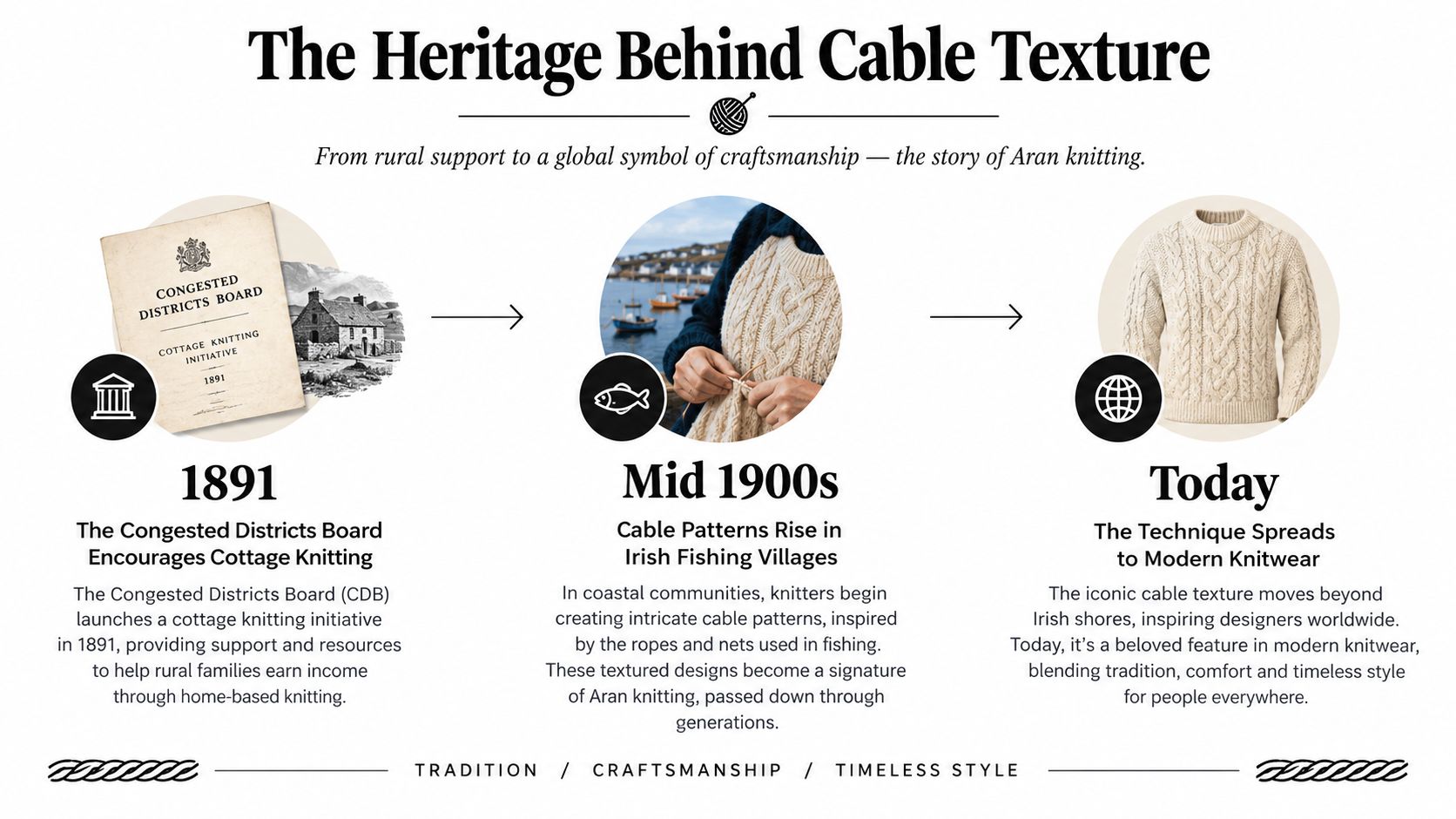
By the 1930s, Aran knitting was being sold to tourists in Dublin and had begun to reach international markets. Commercial production expanded in the late 1930s, and the National Museum of Ireland's earliest documented Aran sweater dates to 1937. The style gained major exposure in the United States when Vogue Knitting published an Aran pattern in 1956. These milestones tell a story of craft adapting and travelling, rather than a motif frozen in the distant past. The Victoria and Albert Museum's account of British knitting traditions provides further context for understanding that wider knitting history.
For a beanie, cable texture is best understood as heritage-inspired design. A contemporary hat can draw on the visual language of Aran knitting without claiming to reproduce centuries-old workwear. The stitch evokes a practical tradition while offering a rich, tactile surface for modern dressing.
We make our cable knits in small batches in Seattle, carrying that craft sensibility into a different place and time. For a closer look at how texture shapes the finished design, explore our guide to cable-knit texture. A thoughtfully made beanie can feel grounded in history while being designed for the routes, coats, and weather of everyday life now.
Fiber, Lining, and Yarn Choices That Matter
A beanie's fiber affects how it handles moisture, not just how soft it feels. Wool can absorb or release water vapor through its fiber interior while resisting liquid wetting at its exterior. Textile testing reports absorption of up to roughly one-third of fiber weight for wool, compared with less than 2% for polyester; moisture sorption also releases heat, and wool-containing fabrics showed temperature changes as large as 15°C (27°F) during absorption or desorption (textile research on wool's moisture and thermal behavior).
That buffering can matter on a stop-and-go commute. When you walk briskly, enter a heated office, then step back into the cold, moisture management helps shape how comfortable the hat feels between those temperature changes. The wool data aren't a promise that every wool beanie will feel the same, since yarn, knit structure, fit, and lining all influence the result. Our cold-weather hat guide offers another perspective on choosing headwear for chilly days.
Choose a lining for the way you wear it
An unlined beanie leaves the knit against your head, often making it a versatile choice for layering and indoor transitions. A fleece lining can feel soft and plush against the skin, but it may add warmth that's welcome outdoors and less comfortable in a heated office. A silk-blend lining can feel smooth and light, especially for people who find textured yarn irritating; check the care instructions, since different fibers may need different handling.
For ethical-luxury shoppers, the question is not whether a fiber is natural or animal-free. If you choose a cruelty-free, recycled, or vegan alternative, look for performance information rather than assuming that a warm hand feel means it manages moisture like wool. High-end faux fur and Tissavel are familiar luxury-textile choices in our wider accessory world, but a faux-fur finish does not establish how a knitted base layer will behave during exertion.
Practical rule: Test an unfamiliar yarn or lining against your own routine before relying on it for a full season. Wear it on a short walk, notice how it feels when you come indoors, and check whether the fit or surface changes after following the care label.
How to Find a Beanie That Fits
A beanie that stays put on a windy platform may feel restrictive once you step onto a warm train. Fit is part of its performance: you need secure ear coverage outdoors and a brim you can adjust or remove without fighting the fabric.
Start with a soft tape measure. Wrap it around the fullest part of your head, just above your ears and across the forehead where the beanie will sit. Keep it level and comfortably snug, then record the measurement. Measure with your usual hairstyle in place.
Cable stitches draw neighboring fabric inward, much like pleats gathering cloth. One published pattern specifies 20 stitches and 26 rows per 4 inches (10 cm), measured after blocking, and notes that one-half stitch per inch can change finished circumference by approximately 1.5 inches (cable-beanie pattern gauge and fit notes). It recommends measuring the base stockinette rather than the raised cable motif, which contracts the fabric and can distort the reading.
For a ready-made hat, ask for finished circumference and crown depth, plus the seller's intended head-size range. These measurements are a starting point for a fitting conversation. Yarn, stretch, cable density, and your preferred pressure all affect the result; a size label alone cannot describe them.
The brim should hold without squeezing.
Check crown depth with the hat sitting where you intend to wear it. A deeper crown can cover your ears and accommodate a ponytail or fuller hair; a shorter crown may sit more neatly beneath a hood. With glasses on, check that the brim leaves the frame arms undisturbed. For curls or styles you want to preserve, request room rather than depending on stretch. During stop-go commuting, check whether you can uncover your ears as you warm up, before the fit starts to feel clammy.
For custom sizing, share your measurement, hairstyle, and preferred ear coverage. Our hat sizing guide helps you prepare those details. We also offer “your fabric, our expertise” services, giving hard-to-fit shoppers a way to discuss circumference and depth. If you pair your beanie with vintage Tissavel styling, check the fit with that collar or hood in place so the layers do not crowd your neck or push the crown forward.
Care and Longevity That Keep Cables Defined
A cable knit keeps its character when you clean it gently and let it dry without being pulled out of shape. Begin with the care label, since fiber blends and linings can call for different methods. If hand washing is appropriate, use cool water and a wool-safe detergent, support the hat while it's wet, and avoid twisting or wringing the fabric.
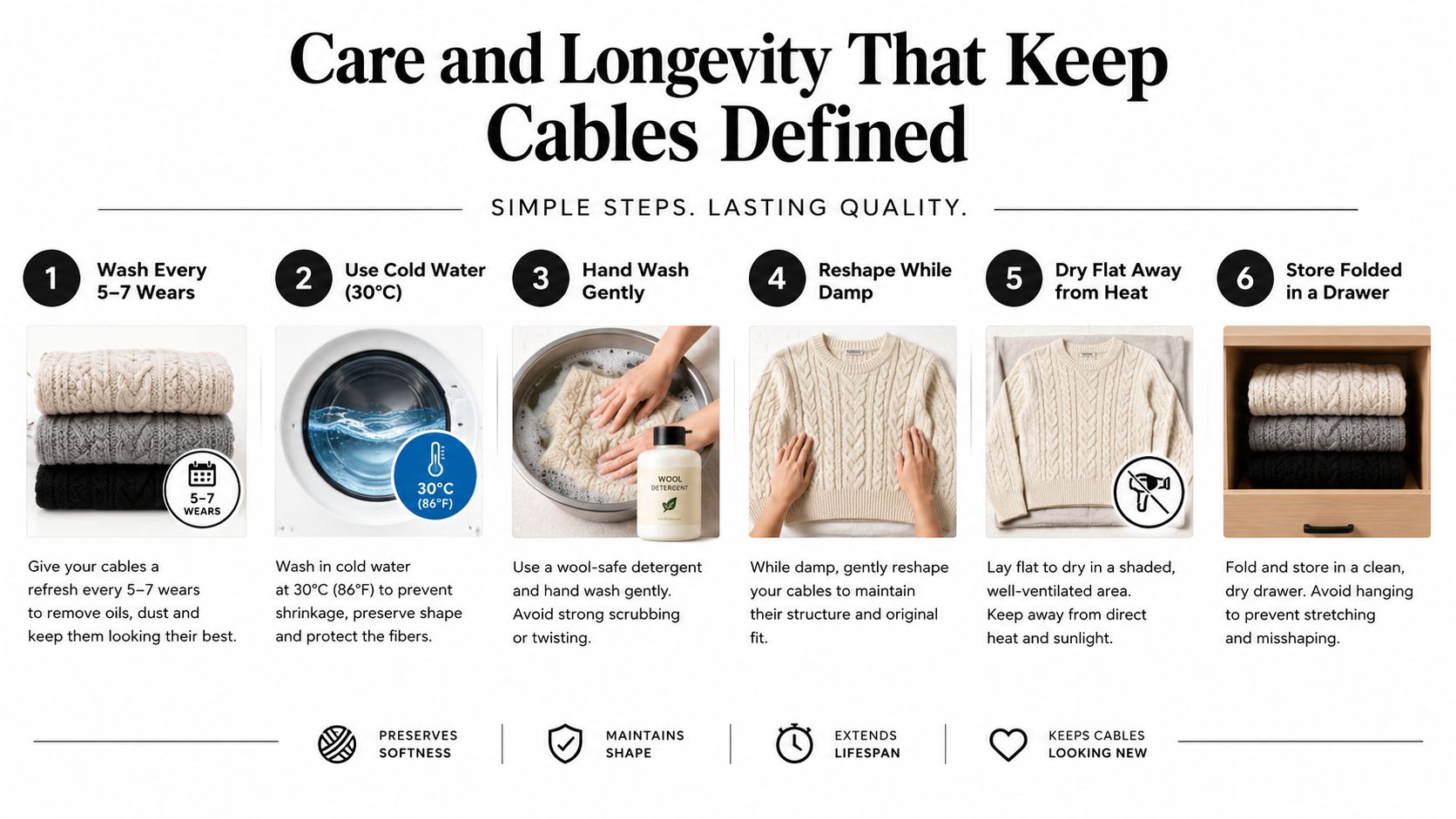
Press excess water out with a clean towel, then lay the beanie flat to dry, away from direct heat. Hanging a wet knit can stretch the crown; a radiator or hot dryer can affect both dimensions and texture. While the hat is damp, smooth the cables back into shape and ease the brim into an even circle. If it has stretched, gentle blocking may help restore its outline, but follow the fiber's care guidance rather than forcing it to a size.
Keep the surface tidy
Pilling is a normal wear concern, especially where a hat rubs against a coat, scarf, or bag. If small pills form, remove them cautiously with a fabric shaver designed for knitwear, keeping the surface flat and the tool moving lightly. Allowing a beanie to rest between wears can also give the fibers time to settle.
Durability can be assessed more systematically than by appearance alone. ASTM D3512 describes a random-tumble pilling test, while ASTM D3511 uses a brush tester; ASTM D4970 is also identified in textile-testing literature for knitted fabrics. A commonly used assessment runs from grade 5, strong resistance to pilling, to grade 1, very severe pilling, with grade 3 indicating moderate pilling (ASTM textile standards and testing methods). These methods help compare samples under controlled abrasion, but they can't guarantee that a particular hat will never pill.
If a beanie shrinks in a dryer, stop applying heat. You can try gently easing it toward its original dimensions while damp, but don't pull sharply on the cables or brim. If the brim has lost its snap or the crown no longer sits evenly, ask a milliner about reshaping before attempting more forceful stretching.
Styling a Cable Knit Beanie for Cold Commutes
The right styling depends on where the day takes you. For an office commute, a snug brim and clean crown pair neatly with a neutral coat and a statement scarf. Choose an unlined or light-lined option if you expect to move between cold streets and warm rooms, and take the hat off indoors if you start to overheat.

For weekend errands, a deeper, slouchier crown feels relaxed with a soft jacket and everyday layers. If your coat has a shimmering finish, a rich-toned beanie can add depth; if your scarf or jacket already has a maximalist texture, a classic neutral keeps the look composed.
On a brisk dog walk or a rainy Pacific Northwest commute, prioritize a fit that stays in place and a lining that feels comfortable once you're moving. A dense knit may feel cozy outside, but cable texture alone doesn't guarantee weather resistance or prevent overheating indoors. A reversible faux-fur accessory can echo the beanie's hand-sewn finish without competing with its cables. Browse The Fractal Collection for expressive texture, or compare it with the softer, classic mood of the Cozy Cable collection.
Style cue: Pair tactile pieces by giving one texture the lead. A sculptural cable knit can sit beautifully beside a silky scarf or plush faux fur when the colors stay in conversation rather than competing.
For more practical layering ideas, visit our guide to layering for cold weather. You can also look at the reversible Cozy Cable beanie as a cable-look option with custom sizing. Choose the silhouette that suits your coat and hairstyle, then consider whether your commute calls for a closer fit or a little more room.
How Pandemonium's Cable Knits Stand Apart
A thoughtfully made beanie depends on decisions you can feel: the yarn's hand, the cable's definition, the brim's recovery, and the way the crown sits over your ears. At Pandemonium, designer Leigh Young's 25+ years of design experience inform those choices, while our Seattle studio produces accessories in small batches.
Our work in faux fur and hand-sewn millinery also shapes how we think about texture. High-end faux fur and vegan fur offer an ethical alternative for people who value a plush, luxurious surface without animal fur. A cable knit belongs to a different textile tradition, but it can complement Tissavel accessories through considered color, touch, and proportion.
Custom fit, considered materials
Not every head fits a standard size range, and not every shopper wants the same crown depth or brim tension. We offer custom sizing and “your fabric, our expertise” services for people who want a more personal fit or a particular textile pairing. If you wear glasses, have curls or a ponytail, or find ordinary beanies too tight, sharing those details helps guide the conversation.
Our hand-sewn hats guide offers more insight into the care and craft behind millinery. We make pieces in Seattle for people who value local craftsmanship and a distinctive tactile finish, with the aim of creating accessories that feel at home across many winters. For a hard-to-fit shopper, a conversation about head measurement, hairstyle, and preferred fit can be more useful than guessing from a generic size label.
Choosing Yours and Caring for It
Three choices shape how a cable knit beanie feels in everyday life: fiber and lining for moisture comfort, fit and gauge for secure coverage, and care for preserving loft and cable definition. Start with the hours you'll wear it, not just the weather outside. A commute that moves between drizzle, brisk walking, and a heated office calls for different considerations than a short outdoor errand.
Join The Crowd, our email list, for 15% off and follow Pandemonium's continuing exploration of cruelty-free luxury, Seattle craftsmanship, and considered textiles. When you're ready to choose, browse the Cozy Cable knits collection for a tactile starting point, then ask us about custom sizing if standard proportions don't suit you. The right beanie should feel plush and substantial without feeling cumbersome, and unmistakably yours.
At Pandemonium Millinery, our Seattle studio creates small-batch accessories with a focus on local craft, bespoke options, and cruelty-free luxury. Explore Pandemonium Millinery to find a cable knit beanie that suits your fit, your wardrobe, and the weather you meet each day.


