



You've worn your favorite wool coat through rain, crowded commutes, café tables, and the occasional splash of street salt. Now it hangs over a chair, still handsome, but the lapel feels a little dull, the lining holds yesterday's city air, and you're wondering whether dry cleaning a wool coat is necessary or risky.
At Pandemonium, our Seattle studio has spent 25+ years working with wool, hand-sewn details, high-end faux fur, and other luxury textiles. We treat a coat as an architectural garment, not a disposable layer. The right care preserves its drape, velvety hand, substantial warmth, and polished finish, while the wrong combination of heat, moisture, and friction can change its shape permanently.
Recognizing Your Wool Coat's Care Needs
A cherished coat rarely announces trouble dramatically. More often, the signs appear through touch and scent. The nap looks less vibrant at the elbows, the collar feels slightly waxy from skin oils, or a faint odor remains after the garment has aired overnight.
One Seattle client once brought us a charcoal wool coat at the end of winter. It still looked elegant from across the room, but the shoulders had collected fine dust, the sleeve cuffs had a soft shine, and the lining carried the warm, enclosed smell of daily wear. Nothing called for panic. It needed a careful assessment, not an impulsive wash.

Read the fabric before choosing the treatment
Begin in bright, indirect light. Run clean fingertips over the lapel, cuffs, pocket edges, and collar. A wool coat that feels dry and springy may only need surface brushing and fresh air. A coat with oily patches, embedded grit, a lingering odor, or a visible stain deserves more deliberate care.
Look at the silhouette as well. If the shoulder line has softened, the hem hangs unevenly, or the lapels no longer roll cleanly, avoid experimenting with household washing. Structured wool often contains layers that respond differently to moisture, and a coat can lose its architectural balance even when the outer fabric appears intact.
- Dusty surface: Use a lint brush with light, consistent strokes.
- Fresh localized mark: Blot rather than rub, then identify the stain before applying anything.
- Persistent odor: Air the coat in a ventilated room. If the odor remains, ask a professional to inspect the lining and interlinings.
- Altered shape: Stop home treatment and seek a cleaner experienced with structured wool.
A useful distinction: A coat that looks tired may need brushing. A coat that feels oily, smells enclosed, or has changed shape needs evaluation.
Wool is durable when treated conservatively. Care guidance notes that a well-maintained wool coat can retain its structural integrity for 12–15 years (wool coat care guidance). That longevity depends less on frequent intervention than on choosing the least aggressive method that solves the actual problem.
Our related guide on caring for wool and fur coats also reflects a principle we use with every luxury garment: inspect the material, construction, and finish before you reach for a product. High-end faux fur trims and linings need the same respect. They may be plush and weather-resistant, but heat and rough handling can flatten the pile or disturb the backing.
Home Care versus Professional Dry Cleaning
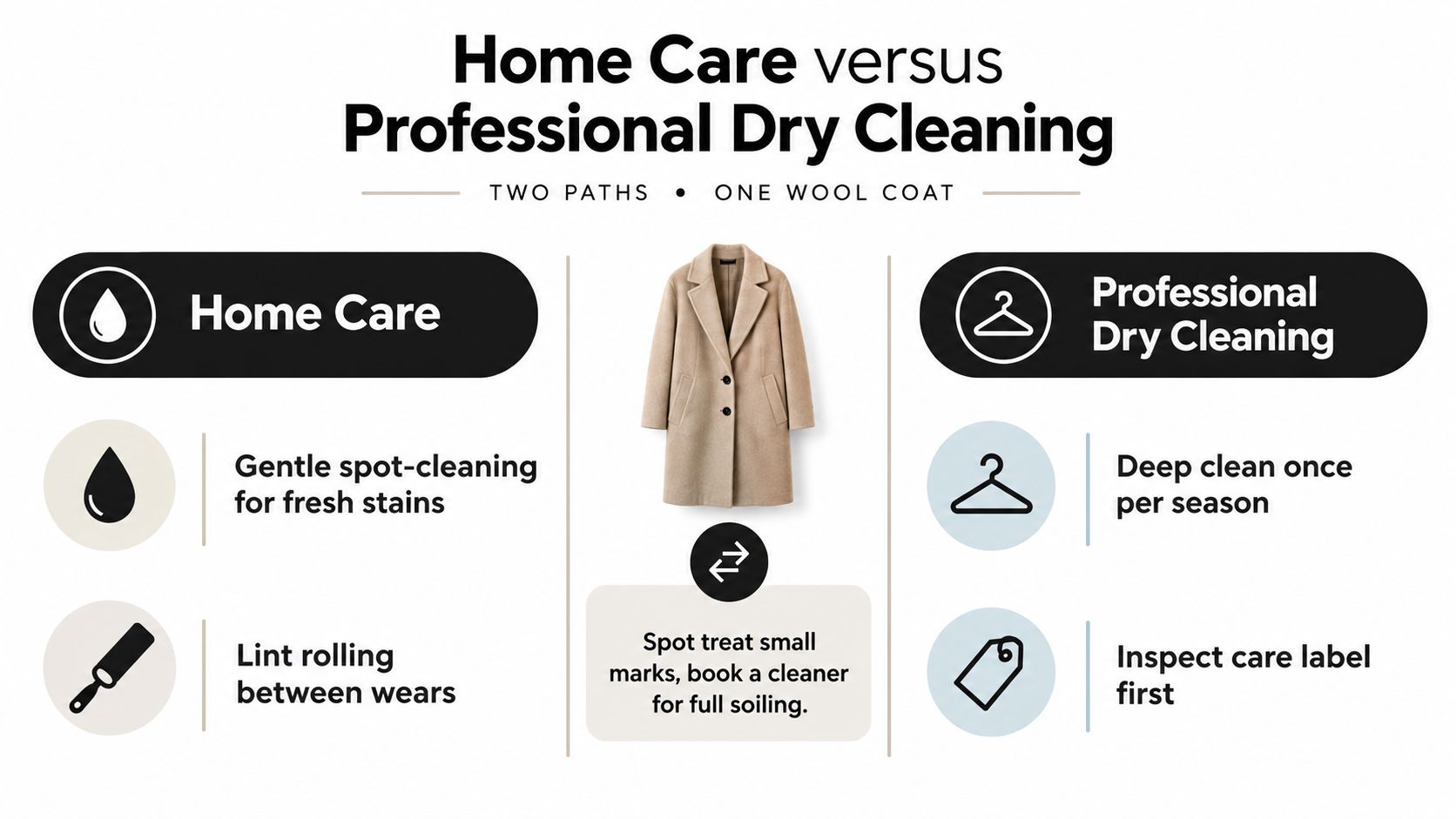
A wool coat can look clean after a quick brushing and still hold body oil, road grit, and moisture in its lining. Home care suits surface maintenance and limited spot treatment. Professional cleaning suits broader soiling, difficult stains, and structured coats whose labels require specialist handling.
Professional cleaning does not need to follow every outing. Textile-care guidance recommends about once or twice per season, with some advice placing cleaning at roughly six-month intervals before seasonal storage (wool cleaning care guidance). A commuter may therefore need only 1–2 professional cleanings through a full winter, depending on wear, staining, and odor.
What works safely at home
A lint brush lifts surface debris without saturating the cloth. For a small, fresh mark, apply a wool-safe, pH-neutral cleaner sparingly, after testing it in a hidden area. Blot with a clean cloth and light pressure. Stop immediately if dye transfers or the texture changes.
Heat creates the greatest risk. Wool-care guidance advises against blow dryers, radiators, strong sunlight, and tumble drying unless the care label permits them (wool care guidance). Heat can distort fibers, promote shrinkage, and contribute to felting. Rubbing can also roughen the surface and leave a fuzzy patch.
High-end faux fur needs the same restraint. A plush trim may conceal a backing or lining that reacts poorly to heat, soaking, or friction. Our faux fur coat cleaning guide explains why pile direction, backing, lining, and finish must be considered together in a cruelty-free luxury coat.
Why professional intervention has a place
A professional cleaner can review the label, lining, interfacing, trim, and stain history before selecting a process. Structured wool benefits from that assessment because uncontrolled home washing can cause shrinkage, felting, shoulder distortion, and uneven drying.
Hot machine washing and heated machine drying can cause approximately 10–25% shrinkage in length and 5–10% in width, according to this wool-care guide (wool care guidance). Such changes affect sleeve length, shoulder fit, hem balance, and the coat's silhouette.
The working rule: Spot-treat a small mark. Do not turn a tailored wool coat into a home laundry experiment.
The same caution applies to substantial household textiles. This explanation of DIY rug dry cleaning risks shows why domestic methods can fail when a material needs controlled chemistry, moisture, and drying. A coat is smaller, yet its construction deserves equal care.
Preparing Your Coat for a Trusted Cleaner
A cleaner can do better work when you provide a clear garment history. Before leaving home, empty every pocket, remove detachable accessories if the label permits, and inspect the coat from collar to hem under good light.
Prepare the garment in a calm sequence
- Empty the pockets completely. Coins, gloves, receipts, and keys add weight or transfer color. A loaded pocket can stretch the surrounding fabric and leave a hollow in the coat front.
- Brush away surface debris. Use a clean lint brush, moving in the direction of the wool's surface. Keep the motion gentle around seams, buttonholes, and faux fur trims. You're lifting grit, not sanding the cloth.
- Identify each mark. Note whether a spot appears oily, watery, colored, or adhesive. Oil-based stains need a different approach from coffee, wine, and other organic marks. Solvent pre-treatment may be appropriate for grease, while other stains can require different professional chemistry.
- Blot, don't scrub. Rubbing can spread color and roughen the fibers. Ink and dye transfer deserve particular caution. Home solvents may spread or set them, so flag these marks for the cleaner instead of trying to rescue them with improvisation.
- Photograph unusual details. If the coat has a custom lining, delicate buttons, hand-sewn trim, or an unusual finish, a quick photograph gives you a record of its condition before processing.
Oil-based marks deserve restraint. Some wool-care advice mentions nail polish remover or turpentine as possible solvents, but also warns that they can be harsh on wool and should be used sparingly (wool coat stain guidance). In practice, I prefer to identify the stain and communicate it clearly rather than risk a pale ring, spread color, or fuzzy surface.
Tell the cleaner what matters to the fit
Mention previous alterations, repaired seams, loose buttons, and any area that must retain its shape. If the coat has been made or adjusted for a particular shoulder, sleeve, or bust measurement, say so at drop-off. A cleaner should know that a garment's fit is part of its value.
Our approach to bespoke alterations follows the same principle. Your fabric, our expertise means the material and the person wearing it both guide the work. Ask whether the cleaner has experience with custom sizing, unusual fabrics, high-end faux fur, and lined wool garments.
Write down the requested finish. For example, you might ask for light pressing rather than a sharp, aggressive crease, or request that a plush trim be handled according to its care requirements. Clear communication protects the details that make a coat feel personal.
Selecting the Right Dry Cleaning Partner
A cleaner can accept “dry clean only” garments without understanding how a particular coat is built. Choose a partner who inspects the label, asks about stains and trims, and discusses the lining, structure, and finishing before taking the garment.
Start with the care label. A circle means dry cleaning is permitted. The solvent symbols set limits: a circle with a P allows perchloroethylene or a petroleum-based solvent, while a circle with an F allows only a petroleum-based solvent (care label symbols). Treat these markings as processing instructions, not decoration.
Compare the service, not just the price
| What to assess | A careful cleaner | A poor fit |
|---|---|---|
| Material experience | Discusses wool, structured coats, linings, and faux fur | Treats every garment as interchangeable |
| Stain process | Asks what caused each mark and records it | Applies a generic treatment without questions |
| Solvent choice | Checks the exact symbol and explains compatible options | Assumes every dry-cleaning method is equivalent |
| Finishing | Uses steaming or light pressing where appropriate | Presses aggressively and risks permanent creases |
| Communication | Notes repairs, trims, fit, and special requests | Offers no garment-specific discussion |
Some wool garments can be wet cleaned successfully, but professional wet cleaning or dry cleaning is generally preferred for structured pieces because uncontrolled home washing increases the risk of shrinkage and felting (professional wool cleaning guidance). Ask which process the cleaner recommends and why. A useful answer will address the coat's construction rather than repeat “dry clean.”
The cleaning method is only part of the service. Finishing determines whether the coat returns with its intended character. Wool should be steamed or lightly pressed, not attacked with hard ironing. Excessive pressure can flatten the surface or set permanent creases, while high-end faux fur trims may need separate handling to preserve their nap and softness.
Look for care that respects the whole garment
Our commitment to cruelty-free luxury includes high-end faux fur, linings, textiles, and finishes. Ask how each will be inspected and handled. A modern solvent may suit the wool, yet the coat still depends on careful treatment of its lining and plush trim.
Local relationships matter in textile work. Our perspective on supporting local business comes from working in a small-batch Seattle studio, where artisans can recognize the difference between a soft nap and a flattened one, or between a relaxed lapel and a damaged crease.
If you prefer locally made accessories, our Seattle studio produces hand-sewn pieces in materials like Tissavel. A cleaner who welcomes questions, records garment-specific instructions, and explains the finishing plan is more likely to protect the details that make a luxury coat worth maintaining.
Seasonal Storage and Ongoing Maintenance
Cleaning protects the coat before storage, but storage protects the results. A wool coat should be fully dry, supported by a broad hanger, and kept where air can move around it. Don't compress a structured garment into a crowded bin or seal it while the lining still feels cool or damp.
Build a gentle between-wears ritual
After a wet commute, hang the coat in a ventilated room away from direct heat. Let the surface dry naturally, then brush off grit once the fabric is dry. A light brush keeps dust from settling in and lets you notice changes before they become stubborn problems.
Use your senses during these checks:
- Touch: The wool should feel dry and resilient, not tacky at the collar or cuffs.
- Sight: Look for dull patches, salt traces, pulled threads, and flattened faux fur.
- Smell: A persistent enclosed odor can point to moisture or lining soil.
- Shape: Check the shoulder line, sleeve length, hem, and lapel roll.
At the end of the season, have the coat cleaned when its label and condition call for professional treatment. Then allow it to rest in a breathable garment bag or another suitable breathable covering. Avoid high heat, strong sunlight, and compression. Hanging a heavy wool coat while wet can stretch the shoulders, so reshape it only after the fabric has dried appropriately.
For broader pest-prevention context, this guide to moth-proofing tips is useful when planning seasonal storage. Cleanliness, airflow, and inspection work together. A sachet or cedar accessory can't replace proper cleaning or fix a coat that has already been packed away with body oils and moisture.
Choose durable pieces with care in mind
A rotating wardrobe reduces the pressure on any single coat and gives fibers time to air between wears. When we create a small-batch piece, we consider not only its first impression but also the way its texture, lining, and construction will live with its owner.
The Fractal Collection offers a vibrant, architectural direction for that kind of wardrobe. Its bold patterns can sit beside a classic wool coat, while a well-cared-for coat provides a substantial foundation for a shimmering accessory or plush faux fur layer.
Our summer storage guide for faux fur coats adds another practical reference for seasonal transitions. The same habits apply across wool and faux fur: clean before long storage, keep garments breathable, avoid crushing the pile, and inspect them before the next season begins.
Frequently Asked Questions About Wool Coat Care
Can I wash a wool coat at home?
Only when the care label clearly permits it. A coat with lining, interfacing, structured shoulders, or faux fur is safer in professional hands. Water, agitation, and uneven drying can change the coat's shape, surface, or internal construction. If the label is unclear, pause before treating the garment.
How often should I dry clean a wool coat?
Judge by condition rather than a fixed schedule. Look for visible soiling, lingering odors, flattened areas, or marks around the collar, cuffs, and pockets. A lightly worn coat may only need attention before storage, while a frequently worn commuter coat may require an earlier inspection. The guidance cited in the professional-cleaning section above offers broader timing context.
What should I do about an oil stain?
Blot the mark gently with a clean, absorbent cloth, then identify it for the cleaner. Oil-based soil often needs solvent-based treatment, while coffee, wine, and other organic stains may call for another process. Rubbing can spread the mark and disturb the nap. Avoid adding water or household stain remover to a visible panel.
Can I use a hair dryer after spot-cleaning?
Avoid it unless the care label specifically allows the method. Direct heat from a dryer, radiator, or strong sunlight can distort wool fibers and contribute to shrinkage or felting. Let the treated area dry naturally, away from heat, and keep the coat supported so the damp section does not pull the garment out of shape.
How should I care for a faux fur trim?
Brush a faux fur trim only when it is fully dry. Use a soft brush and light strokes in the direction of the pile, stopping if the fibers catch or mat. High-end faux fur has a pile and backing that can flatten or distort under heat, steam, or rough handling. Tell the cleaner whether the trim is hand-sewn, removable, or attached near a delicate lining. That detail affects how the coat should be protected during cleaning.
What should I tell a cleaner about a hand-sewn trim?
Point out every hand-finished area before the coat is accepted. Explain which trim pieces are removable, identify loose threads or delicate joins, and mention any previous repairs. A cleaner should also know if the lining has decorative stitching or if the faux fur has a directional pile. Written notes and photographs can help preserve the intended finish.
Can a cleaner preserve custom fit?
A careful cleaner can record fit-sensitive areas and finishing preferences, but those details must be discussed before processing. Mention custom sizing, unusual fabric, sleeve length, or areas that must retain their shape. At Pandemonium, our your fabric, our expertise approach reflects the importance of fit and material history in bespoke work.
Where can I find cruelty-free winter accessories?
High-end faux fur accessories add plush texture around a wool coat without using animal fur. For a coordinated finish, explore custom millinery services and discuss sizing, fabric, and the look you want.
Pandemonium Millinery brings 25+ years of Leigh Young's design experience to hand-sewn, small-batch luxury made in our Seattle studio, including high-end faux fur accessories and bespoke options shaped around your needs. Join The Crowd for 15% off, then visit Pandemonium Millinery to explore cruelty-free pieces that pair beautifully with a carefully maintained wool coat.


