



A commuter arrives at our Seattle studio with a familiar problem: her favorite knit hat feels warm and polished, but its tired pom pom has lost its shape. We replace it with a rich-toned faux fur version, and the simple crown suddenly looks architectural, plush, and ready for another winter.
The Timeless Appeal of Faux Fur Hat Pom Poms
There's an undeniable pleasure in touching a well-made faux fur hat pom pom. The fibers feel velvety beneath the fingertips, catch the light in shifting strands, and bring a soft, substantial finish to a knit crown without making the entire hat feel heavy.
At Pandemonium Millinery, we've seen this small detail change the character of an entire accessory. A quiet charcoal beanie becomes more expressive with a shimmering black pom. A classic cream crown gains warmth and dimension from a silky ivory finish. The pom isn't an afterthought. It's the tactile signature that tells the eye where the hat's design resolves.
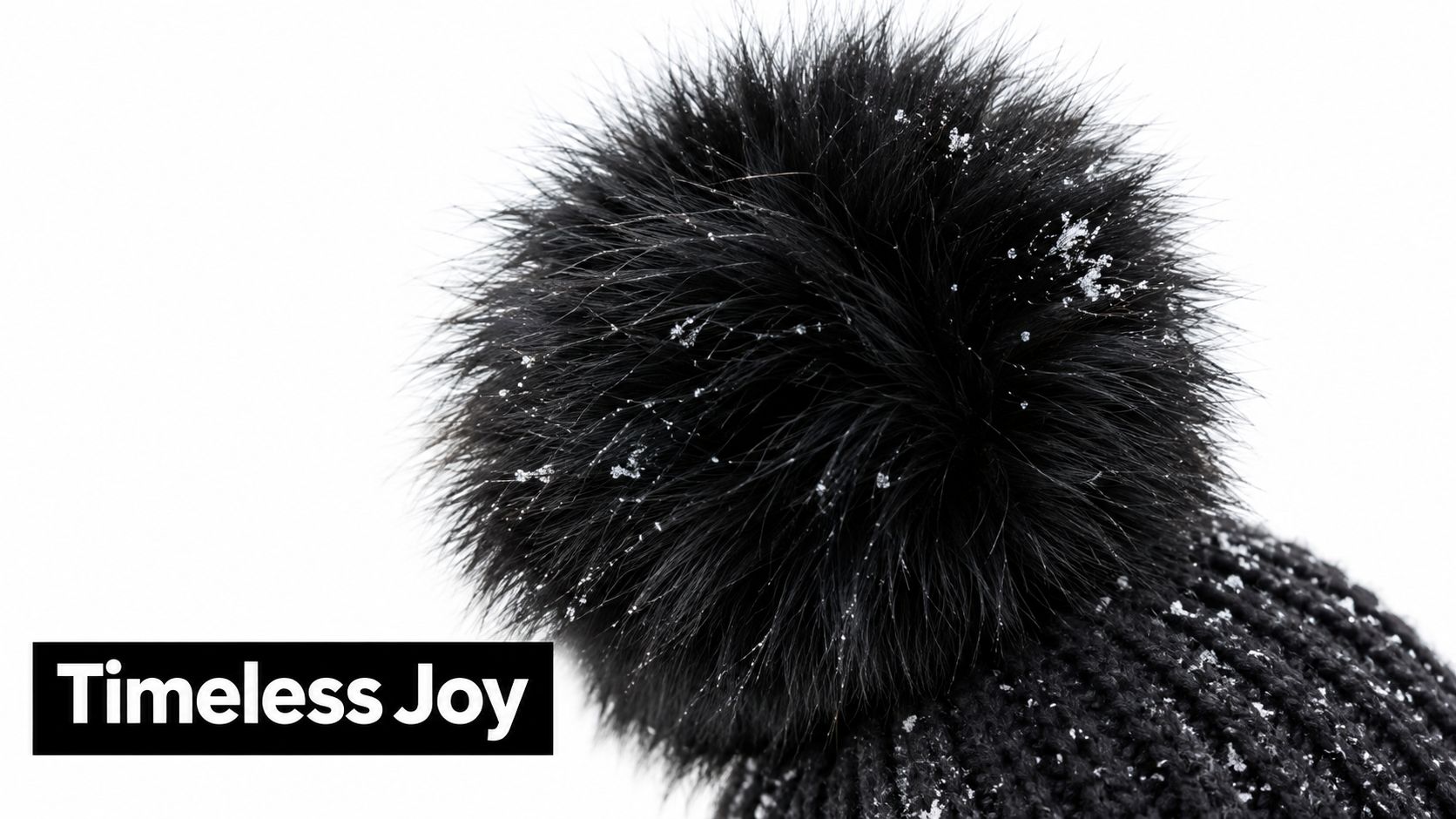
A small detail with visual authority
The best faux fur hat pom poms balance softness with proportion. A compact pom can keep a beanie refined, while a generous Fox Pom creates a more playful silhouette. Shape matters too. A round pom reads as familiar and cheerful, while a slightly elongated form can feel almost sculptural against a close-fitting crown.
That visual language has deep roots. The history of fur and faux fur garments helps explain why plush texture still carries such a strong association with winter luxury. Faux fur keeps the softness and volume people seek while offering a cruelty-free alternative to animal fur.
Our Seattle studio approaches each pom as part of the whole hat. We consider the knit, the crown height, the wearer's proportions, and the way the accessory will move while walking through rain or brushing against a wool coat. That attention is part of our 25+ years of design experience, shaped by Leigh Young's work in Seattle millinery.
For a polished starting point, explore the Faux Fur Fox Poms as an add-on for a favorite hat. For a softer, more understated effect, the Cuddly Faux Fur collection offers a plush finish that feels at home on everyday winter crowns.
From Viking Roots to Modern Seattle Craftsmanship
A pom pom can look playful, but its history is surprisingly serious. Historical accounts place pom-pom-like decoration on Scandinavian headwear as early as approximately 800–1066 CE, based partly on a Viking-era statue found on a Swedish farm in 1904. The detail that now tops a winter beanie once belonged to a much older visual vocabulary of headwear.
The word itself comes from the French pompon, associated with small decorative balls made from materials including fur, feathers, wool, ribbon, and string. By the 18th century, pom poms had entered European military dress. Hungarian-inspired shakos used prominent ornamental balls, Napoleon's infantry used pom-pom colors to distinguish companies, and Scottish Highland uniforms incorporated the toorie on a Balmoral cap. These examples connect the form with identification, ceremony, decoration, and practical dress.
The material changed, the language remained
Faux fur adds a modern chapter without erasing that heritage. An overview of artificial fur identifies 1929 as an early milestone for synthetic alternatives. Early versions used alpaca hair and didn't closely match natural fur in appearance or texture, but later textile development improved softness, surface character, and visual depth.
By 1957, manufacturers were attempting to imitate coats associated with mink, beaver, chinchilla, seal, raccoon, ermine, pony, and giraffe, as described in this history of the shift from fur to faux fur. Acrylic polymers and other synthetic fibers helped move faux fur from a utilitarian substitute toward a luxury textile suitable for accessories.
At Pandemonium, we bring that evolution into a distinctly Seattle setting. Our small-batch studio combines Leigh Young's 25+ years of design experience with contemporary materials such as Tissavel, creating faux fur hat pom poms that feel heritage-informed without being nostalgic. They're recognizable as winter accessories, yet their high-end faux fur construction speaks to current expectations around cruelty-free design.
Our handmade millinery in Seattle reflects that same balance. Each piece begins with the practical needs of a cold-weather wardrobe, then gains its character through proportion, hand-sewn finishing, and a careful choice of texture.
A pom pom now signals warmth, personality, and ethical alternative luxury. Its visual language is old. Its material possibilities are modern.
Understanding Materials and Pile Construction
A premium pom pom isn't defined by fiber type alone. Pile construction determines how the piece looks, how it moves, and how it settles on the hat after repeated wear.
In a controlled study of 100% polyester faux-fur knitted fabrics, increasing pile-yarn fineness from 200 to 400 denier increased fabric weight by approximately 75%, thickness by 78%, thermal resistance by 56%, and abrasion-related weight loss by 61%. These findings are reported in the study of faux-fur knitted fabric construction.
What those figures mean at the crown
A denser pile can create a fuller, cozier appearance and more visual depth. It can also add mass. On a knit hat, that extra weight affects how the pom sits, swings, and pulls at its attachment point as the wearer walks.
The study recorded a maximum measured thickness of 2.45 mm at an 8.37 mm pile-loop length, and it found that fabric thickness changed after three washing cycles. Those measurements describe fabric behavior, not a universal specification for every finished pom, so we look at the completed component rather than judging a loose swatch by touch alone.
A useful evaluation considers:
- Pile length: Longer fibers create movement and a more dramatic halo, while a shorter pile can look precise and controlled.
- Yarn fineness: Finer construction can change weight, thickness, and thermal resistance, so density needs to suit the crown.
- Backing: The foundation should support the pile without making the pom stiff or awkwardly weighty.
- Finished shape: A beautifully plush material still needs balanced stuffing and even distribution to avoid a lopsided silhouette.
Practical rule: Specify pile length and yarn count together, then evaluate the finished pom after laundering and abrasion testing.
For readers comparing textures, our guide to types of faux fur fabric offers a useful vocabulary for discussing pile and finish. At our studio, we also consider how the pom will meet the crown seam, because visual fullness should never come at the cost of a stretched or distorted hat.
Sizing, Shape, and Attachment Methods
A pom pom can be gorgeous on its own and still be wrong for a particular hat. The right choice depends on the crown's scale, the knit's structure, the wearer's proportions, and how much movement the finished accessory can accommodate.
Start with the crown. A close-fitting beanie usually benefits from a pom that feels proportionate rather than overwhelming. A taller or more relaxed silhouette can carry a more substantial shape. Classic spheres are versatile, while teardrop or slightly architectural forms give a boutique hat a more directional profile.
A simple selection process
- Read the crown first. Match a delicate knit with a lighter, moderately dense pom. A substantial crown can support more volume.
- Consider movement. A pom that swings while commuting creates repeated loading at the attachment point. It needs a secure connection, not just a visually pleasing one.
- Choose the shape deliberately. A round pom feels traditional and approachable. A fuller Fox Pom makes a stronger statement. A compact Cuddly Faux Fur option can keep the finish quieter.
- Inspect the inside. The most practical configuration for a bespoke hat is a cord or reinforced fabric loop sewn through the crown seam, with multiple passes and a secure knot concealed inside the lining.
Adhesive alone isn't a sound choice for a component that will be tugged, brushed against coats, or lifted by the crown. Threading the attachment cord through the hat with a needle transfers the load through the structure and makes later replacement or adjustment possible.
For makers and buyers who are also thinking about display, proportion, or how accessories sit on a form, this guide to compare clothing mannequin types provides helpful context. A mannequin can show silhouette, but only hands-on inspection reveals whether the crown stretches around the attachment.
Think about the wearer
Adult fashion hats and children's products require different care. Children's clothing guidance identifies head and neck areas as requiring particular attention because of choking hazards, advises against cords in those areas, and warns that threads should not be easy to pull from pom poms or faux fur. U.S. Consumer Product Safety Commission guidance also defines a small part by whether it fits entirely inside a prescribed cylinder and applies specific restrictions to products intended for children under three.
A removable pom can simplify cleaning and seasonal styling, but it can also introduce a detachable small-part risk for young children. For adult hats, replaceability is often a useful design feature. For children's wear, never assume an adult accessory is infant-safe without product-specific testing.
Our beanies with poms show how the finishing detail can be integrated into the overall crown rather than treated as an isolated decoration.
Comparing Attachment Durability and Style
Attachment methods create different experiences. A sewn-through pom feels integrated into the hat, while a snap-on version offers flexibility for someone who wants to change color or remove the accessory before care.
We prioritize sewn-through construction for high-end millinery because the cord can pass through the crown seam, distribute tension across existing structural layers, and remain concealed inside the lining. A single point sewn only into a loose knit loop can pull outward as the pom swings, especially when the wearer handles the hat by its crown.
Snap-on systems have their place. They can make seasonal styling simple and allow a wearer to coordinate a hat with different coats. Their convenience depends on the quality of the snap, the reinforcement around it, and the amount of dynamic loading the finished hat will experience.
| Method | Durability | Versatility | Best For |
|---|---|---|---|
| Sewn-through cord or reinforced loop | Strong when secured through a crown seam with multiple passes | Replaceable and adjustable with suitable construction | Bespoke hats, frequent commuting, substantial poms |
| Snap-on attachment | Convenient, with durability dependent on reinforcement and use | Easy to remove or change | Seasonal styling and adult fashion hats |
| Adhesive-only attachment | Vulnerable to repeated pulling and flexing | Limited once applied | Not recommended as the sole structural method |
Test the finished attachment
Quality control should include a manual pull test, repeated flexing of the crown, and inspection for local stretching or yarn breakage. There isn't a universal tensile standard for adult hat pom poms, so a maker should document an internal acceptance threshold and testing method rather than presenting an unsupported industry benchmark.
A secure attachment does two jobs. It keeps the pom in place today and makes repair possible later.
For an adult accessory, a detachable design can support cleaning and replacement. For a gift, ask whether replacement poms are available and whether the attachment can be inspected after friction, wet weather, or regular handling. Those answers tell you as much about the product's longevity as the surface texture does.
Caring for Your Cruelty-Free Luxury
A faux fur pom can handle winter weather beautifully, but it isn't maintenance-free. Rain, coat friction, packed storage, and enthusiastic handling can flatten the pile or disturb its shape.
We recommend a gentle routine:
- Spot-clean first: Use a damp cloth and mild soap rather than laundering the entire hat whenever possible.
- Air-dry completely: Keep the pom away from direct heat while it dries, then gently lift the fibers with your fingers.
- Store with breathing room: Avoid compressing the pom beneath other garments for long periods.
- Remove when appropriate: A detachable adult hat pom can be taken off before cleaning the crown.
Our guide to steaming faux fur accessories explains why heat and moisture need a careful approach. The aim is to refresh the accessory without flattening its silky surface or stressing its backing.
Cruelty-free doesn't mean impact-free
Faux fur is often made from acrylic, polyester, or modacrylic fibers derived from petrochemicals. A 2025 report estimated average microfiber release at 0.58 grams per kilogram during washing, 0.54 grams during dyeing, and 0.53 grams during finishing, as reported in this overview of faux fur's ethical and environmental trade-offs.
That evidence doesn't make faux fur equivalent to real fur ethically. It does mean responsible luxury should include lifecycle transparency. The available evidence doesn't establish a hat-specific shedding rate, so we shouldn't pretend that a particular pom has a verified release figure.
A lower-wash approach is practical. Spot cleaning, cold water when washing is unavoidable, a laundry filter, and repair before replacement can all support longer use. Ask whether the pom is removable, what its fiber composition is, and how the maker recommends dealing with wear.
We also distinguish virgin from recycled polyester. Polyester represented 54% of the total fiber market in 2022, while 14.8% of polyester was recycled, according to Textile Exchange's Materials Market Report. Those figures make composition worth disclosing, not assuming.
The Ethical and Bespoke Advantage
A customer choosing faux fur often knows exactly what she wants to avoid. She wants the plush look, the rich surface, and the old-world feeling of fur, but she doesn't want animal fur in her wardrobe. That makes high-end faux fur an ethical alternative, but honest luxury should go further than the label.
Textile Exchange defines a preferred fiber or material as one that produces improved environmental or social sustainability outcomes compared with conventional production. The comparison matters. A recycled-polyester pom may be a more preferred option than one made from virgin fossil-based polyester when sourcing or certification information supports that claim, as explained in Textile Exchange's preferred materials framework.
Small-batch craft makes room for better decisions
At our Seattle studio, small-batch production lets us pay attention to the things a generic accessory can overlook:
- Custom sizing for different head shapes and proportions.
- Hand-sewn finishing that supports repair and adjustment.
- Your fabric, our expertise services for clients bringing a meaningful textile.
- Replaceable details that can extend the life of a cherished hat.
- Thoughtful gifting for someone who values local craftsmanship and tactile design.
For a Seattle commuter, that may mean a plush pom secured to a weather-ready beanie. For a thoughtful gift-giver, it may mean choosing a classic color that works with an existing winter wardrobe. For a client with a hard-to-fit head size, customization can turn a beautiful idea into a comfortable daily accessory.
Our labeling also matters. In the United States, most textile products must disclose fiber content, country of origin, and the identity of the manufacturer or responsible business under Federal Trade Commission requirements. Animal-fur products have separate disclosure requirements under the Fur Products Labeling Act, including the animal species, seller or manufacturer, fur origin, and treatments such as dyeing or bleaching, as outlined in the FTC guidance on fur product labeling. Clear textile information helps distinguish a faux fur accessory from regulated animal fur.
A faux fur hat pom pom can be joyful, polished, and tactile. It can also be made with enough care that the wearer understands what it is, how to maintain it, and how to keep using it.
Pandemonium Millinery creates hand-sewn faux fur hat pom poms and bespoke millinery in our Seattle studio, with custom sizing and “your fabric, our expertise” services for a more personal fit. Join The Crowd for 15% off, then explore the Faux Fur Fox Poms to find a plush, cruelty-free finish for your next winter hat.


