



You're standing in front of a roll of faux fur, trying to decide whether its plush surface belongs on a winter hat, a sofa throw, or a beloved dog's bed. One fabric looks wonderfully deep, another feels silky and close-cropped, and a third has a rippling curl that catches the light. Without a little textile vocabulary, the choice can feel like guesswork.
After 25+ years of design experience, our team has learned that the best types of faux fur fabric aren't selected by appearance alone. Pile height, density, fiber type, backing, and intended use all shape how a piece feels, wears, drapes, and holds its form. We'll walk through each decision in the warm, practical spirit of our Seattle millinery studio, where cruelty-free luxury has always been a tactile craft.
Walking Into Our Seattle Studio
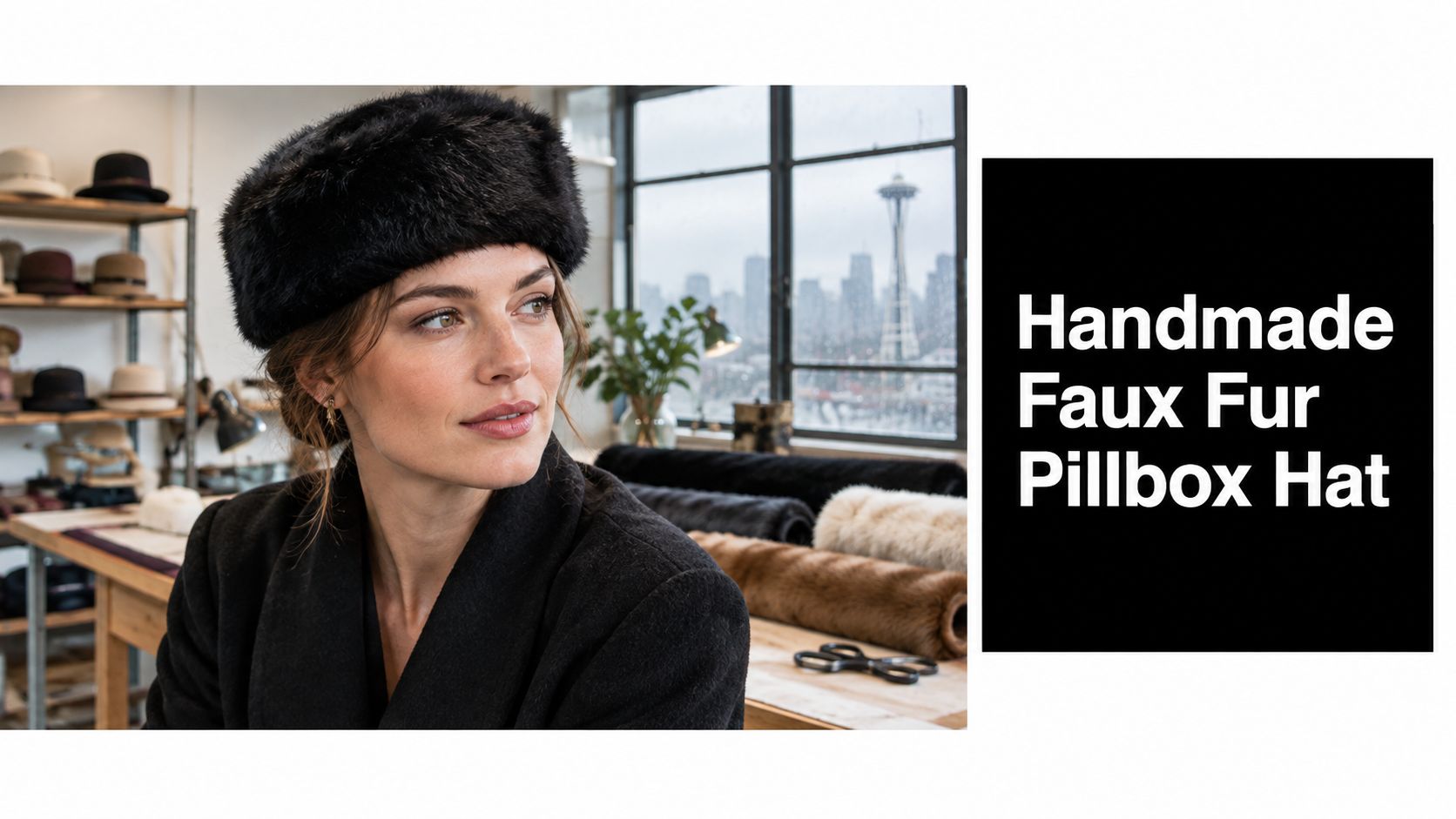
On a damp Seattle afternoon, the studio windows turn silver with rain. Bolts of faux fur sit along the long cutting bench, their edges tucked neatly beneath paper labels, while the scent of steamed wool drifts over from the pressing table. Here, we judge a textile before it becomes a hand-sewn hat, a scarf, or a small-batch home piece.
I reach first for a deep-pile Minky swatch. It sinks beneath the fingers with a velvety softness, then rises slowly when released. Beside it, a low-pile Velboa feels smoother and more compact. It has less of that cloudlike crush, but it springs back neatly and reveals the shape of the backing more clearly.
That contrast tells us something important. Faux fur isn't one fabric with a few color options. It's a family of constructions, and each type behaves like a different tool in a maker's kit.
The rolls we reach for most often
- Short-pile Velboa has a tidy, smooth face that suits structured pieces and projects needing easy handling.
- Medium-pile Minky feels plush and substantial without overwhelming a hat crown or garment edge.
- Long-pile shag creates movement, drama, and cozy visual volume.
- Curly Mongolian-style fur brings a lively, cloudlike texture with a more irregular surface.
- Specialty animal-prints use color, markings, and directional pile to create a classic or expressive pelt effect without using animal fur.
The fiber system changes the experience, too. Polyester generally supports durability, colorfastness, and shape retention, while acrylic offers a softer, wool-like hand. Modacrylic adds flame resistance and can create a more realistic appearance in premium applications, as described in this faux fur sustainability and construction guide.
At our Seattle studio, we treat these differences as design decisions, not technical trivia. The right cloth can help a pillbox keep its architectural line, let a coverup drape over the shoulders, or give a throw the generous, plush surface you want on a rainy evening.
For more of our workshop approach, you can visit Behind the Scenes of Fashion. By the end of this guide, you'll be able to name a faux fur, predict how it will behave, and match it confidently to a hat, throw, garment, or piece of pet gear.
The Anatomy of a Faux Fur Fabric
A faux fur fabric is easiest to understand as a layered textile. Picture a small terrain: the visible fibers are the grass, the backing is the soil, and the way everything is arranged determines whether the surface feels like a meadow, a dense forest, or a neatly clipped lawn.
Start with the visible surface
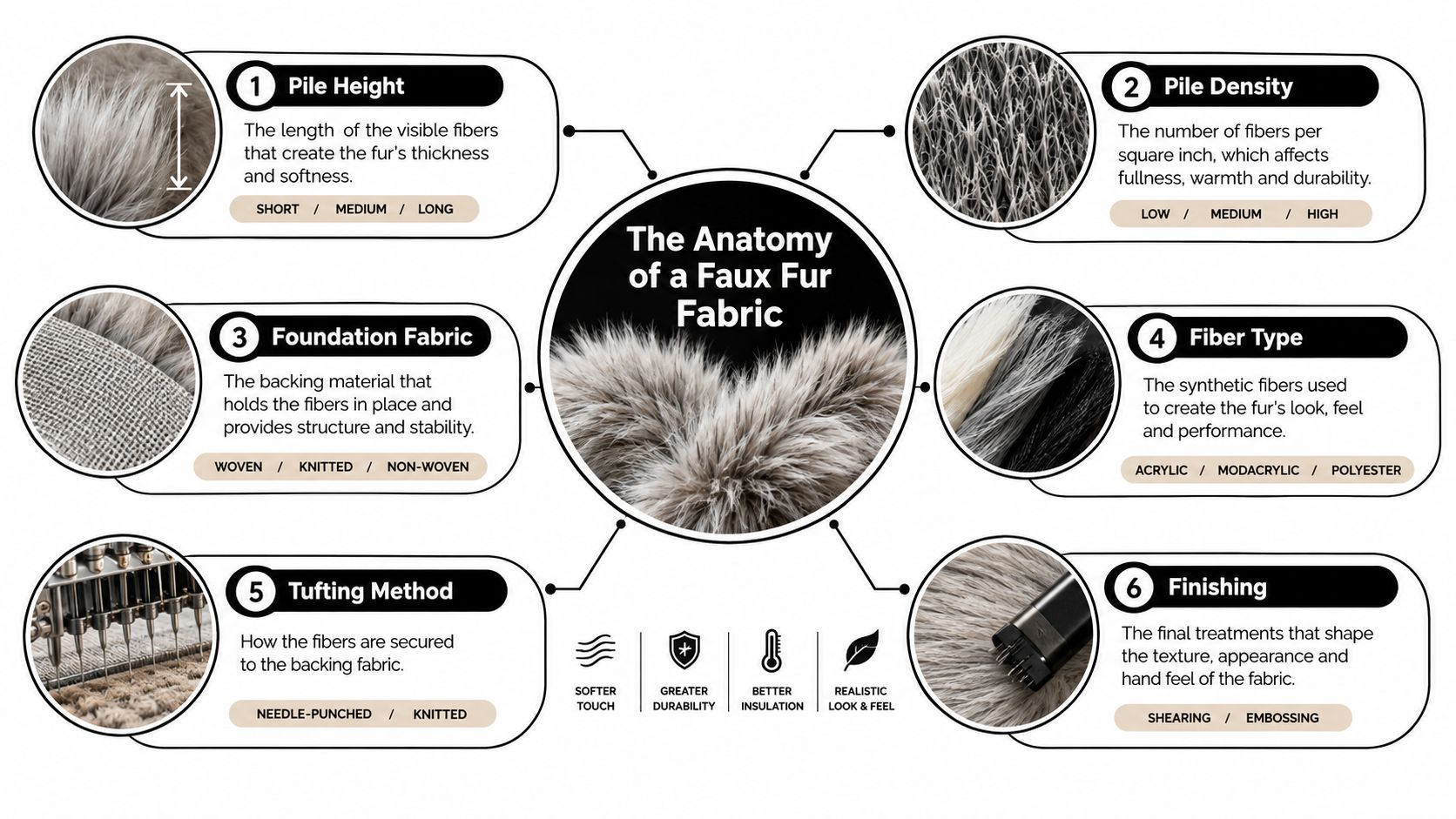
Pile height is the length of the visible fiber. Short pile lies close to the base, while long pile creates more movement, warmth, and visual volume. A longer surface can look gloriously rich on a dramatic brim or throw, but it may need more grooming and can mat if the construction underneath isn't dense enough.
Pile density describes how closely the fibers are packed. A sparse pile behaves like a meadow, with more space between stems. A dense pile resembles a forest, giving the surface better loft, coverage, and resistance to flattening. Industry buying guidance places low-density piles below about 300 g/m², while high-density constructions around 380 to 550 g/m² are described as more resistant to matting and better at holding shape. Premium apparel-grade faux fur is often cited around 450 to 750 g/m² in this style and care guide to faux fur.
The face fiber is the individual strand you touch. Acrylic, modacrylic, and polyester each create a different hand and performance profile, so two fabrics with identical pile height can still feel entirely different.
Look underneath the fur
The backing, or ground fabric, is the canvas beneath a painting. It gives the pile stability and affects cutting, sewing, stretch, and drape. Faux fur is typically made as a pile textile on a knitted or woven backing, so don't judge the face alone. Turn the swatch over and inspect whether the foundation feels firm, flexible, open, or tightly constructed.
Nap is the direction in which the fibers naturally lie. Brush against it and the surface may look lighter, fuller, or more ruffled. Brush with it and the fur settles into a smoother, richer field. We account for nap when cutting pattern pieces because reversing the direction can make adjoining panels appear to be different colors.
Finishing also matters. Shearing can make a surface more even, embossing can add pattern, and graded pile construction can place shorter guard hairs over longer underfur. That layered effect creates depth and a more convincing fur visual, while a single-level pile may look flatter or more synthetic.
If you're comparing surface softness with other cozy textiles for a blanket or home project, this fleece vs sherpa vs woven guide offers useful terminology. For faux fur specifically, our guide to telling high-quality faux fur from cheap focuses on the visual and tactile clues we use at the cutting table.
Acrylic, Modacrylic, and Polyester Compared
Fiber choice is where a beautiful swatch becomes a practical material. The three dominant face fibers each bring a different balance of softness, durability, appearance, and care.
Acrylic has a soft, wool-like hand and can give a hat or collar a gentle, natural feel. It's widely used for budget-friendly faux fur and often suits high-touch fashion pieces where softness and drape matter more than the lowest possible cost. It can shed somewhat more than polyester, so we consider the finished edge and expected handling before choosing it for a hard-wearing item.
Modacrylic is a specialty fiber engineered for faux fur applications. It offers softness, strong color retention, resistance to pilling and matting, and flame resistance. That combination makes it a thoughtful choice for premium hats, throws, and pieces where a realistic surface and long-term polish matter. The guide to acrylic faux fur is useful if you'd like to explore why acrylic remains such a popular choice despite its trade-offs.
Polyester is the workhorse of the group. It generally improves durability, colorfastness, moisture resistance, and shape retention, and it tends to be easier to care for. Polyester-heavy faux fur is particularly practical for trims, linings, accessories, costume pieces, and pet gear that will encounter regular handling.
| Property | Acrylic | Modacrylic | Polyester |
|---|---|---|---|
| Hand-feel | Soft and wool-like | Soft, plush, and realistic | Smooth to plush, depending on construction |
| Shape and wear | Good softness and drape | Strong resistance to pilling and matting | Strong durability and shape retention |
| Appearance | Can create a warm, natural surface | Well suited to refined, realistic fur effects | Reliable color and consistent finish |
| Special performance | Often chosen for touch and loft | Adds flame resistance | Moisture-resistant and generally easy to care for |
| Best fit | Fashion pieces, soft collars, expressive coverups | Premium hats, throws, luxury applications | Everyday garments, accessories, pet gear, linings |
Choose by the project
For a structured millinery crown, acrylic can provide a soft surface without making the shape feel harsh. For a premium hat or decorative throw, modacrylic may offer the most balanced combination of tactile luxury and resistance to matting. For a washable garment, costume, or pet accessory, polyester is often the sensible starting point.
No fiber wins every category. Our team looks at the hand, the backing, the pile, and the life the finished item will lead before recommending a fabric.
Pile Length and Density in Plain English
At our Seattle studio, a roll of faux fur can suggest its purpose before it reaches the cutting table. A short pile sits close to a hat crown, keeping the outline crisp. A medium pile brings a soft cushion to a collar or cuff. Long pile creates a lively halo, useful when a throw or coverup needs theatrical presence.
Pile length sets the visual character, while density determines how well that character holds up. A sparse surface can flatten under elbows, hands, or repeated wear, revealing more of the backing. For a hat that must keep its shape, a throw that will be handled, or pet gear that will be rubbed and tugged, we inspect the backing as carefully as the fibers.
| Pile Length | Typical Weight (g/m²) | Density | Best Uses |
|---|---|---|---|
| Short | 250 to 350 | A close, even surface helps keep the backing from showing | Structured hats, hat bands, pet collars, durable trims |
| Medium | 350 to 550 | Medium to high density adds plushness without excessive bulk | Cuffs, collars, pillow covers, mid-length fashion |
| Long | 500 to 750 | High density helps the loft recover after compression | Statement throws, coverups, dramatic trims, decorative pieces |
These ranges guide selection rather than replace handling. At Pandemonium Millinery, our 25 years of Seattle craftsmanship have taught us to match the roll to the finished piece, not just choose the softest swatch. A light short fur may keep a hat comfortable. A fuller long pile can make a brim feel heavy and crowded, even when its surface looks luxurious. For a throw or coverup, that extra body may be exactly what gives the piece warmth and visual depth.
What your fingers can tell you
Run your palm with the nap, then against it. Short pile feels sleek and orderly. Medium pile gives a gentle cushion. Long pile feels more animated, with strands that separate, catch the light, and settle back into place.
Pinch a small area and look down to the foundation. If the backing appears immediately or the fibers divide into wide gaps, reserve that fur for a low-contact trim or lining. A denser construction feels substantial without needing to feel stiff, and it usually recovers more convincingly after compression. For a pet collar or frequently handled accessory, this quick test can prevent an attractive fabric choice from becoming a disappointing one.
Weight changes the finished experience as much as appearance does. Density can support loft retention, drape, and coziness, while adding bulk and cost. Two fabrics with the same visible pile length may behave differently because their fiber system, backing, and construction differ. For broader style and handling guidance, see this faux fur style and care reference.
Caring for Faux Fur Without Ruining It
The most beautiful faux fur still needs a gentle routine. At our Seattle studio, we treat the nap as a surface to be guided, not scrubbed into submission.
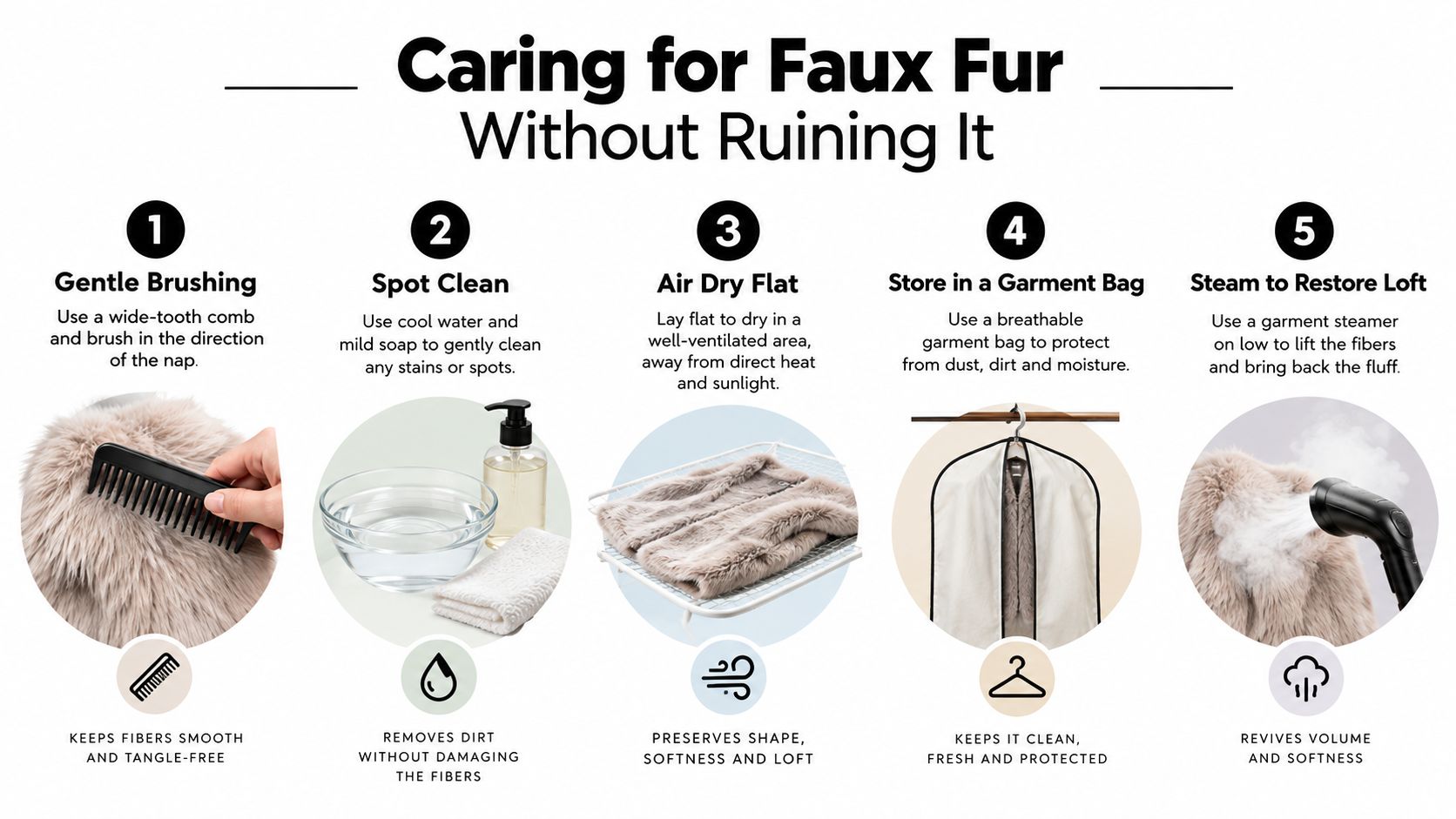
Begin with a wide-tooth comb or a soft-bristled brush. Work in the direction of the nap, starting at the ends and moving gradually toward the backing. Small, patient strokes restore loft without pulling aggressively on the face fibers.
For a small mark, use cool water and a mild detergent on a clean cloth. Dab the spot rather than soaking the entire piece, and test an inconspicuous area first. The backing may respond differently from the pile, so excess water can distort the shape even when the surface looks unharmed.
Steam, don't press
Steam can help relax crushed fibers and restore a plush surface. Keep the steamer moving and avoid pressing the hot plate directly onto the fur. Direct heat and pressure can glaze the fibers, leaving a flattened or shiny patch that brushing won't always reverse.
Lay the piece flat to air-dry away from radiators, vents, fireplaces, and direct sun. Don't tumble-dry it, and don't use high-heat pressing as a shortcut. For garment-specific guidance, our faux fur coat cleaning guide provides a useful companion to the studio routine.
A short demonstration can make the sequence easier to remember:
Storage mistakes to avoid
- Folded stacks: Repeated pressure can crush the pile, especially through a long warm season.
- Tight plastic bags: Faux fur needs breathable storage rather than sealed compression.
- Loose cedar contact: Cedar blocks can be useful in storage, but they shouldn't press directly against the pile.
- Vigorous scrubbing: Friction accelerates shedding and encourages matting.
- Machine washing: Agitation can disturb both the fibers and the backing.
- Tumble drying: High movement and heat can damage loft and shape.
Studio card: Brush with the nap, spot-clean with cool water and mild soap, steam from a distance, air-dry flat, and store in a breathable garment bag without compression.
Sustainability and Ethics of Modern Faux Fur
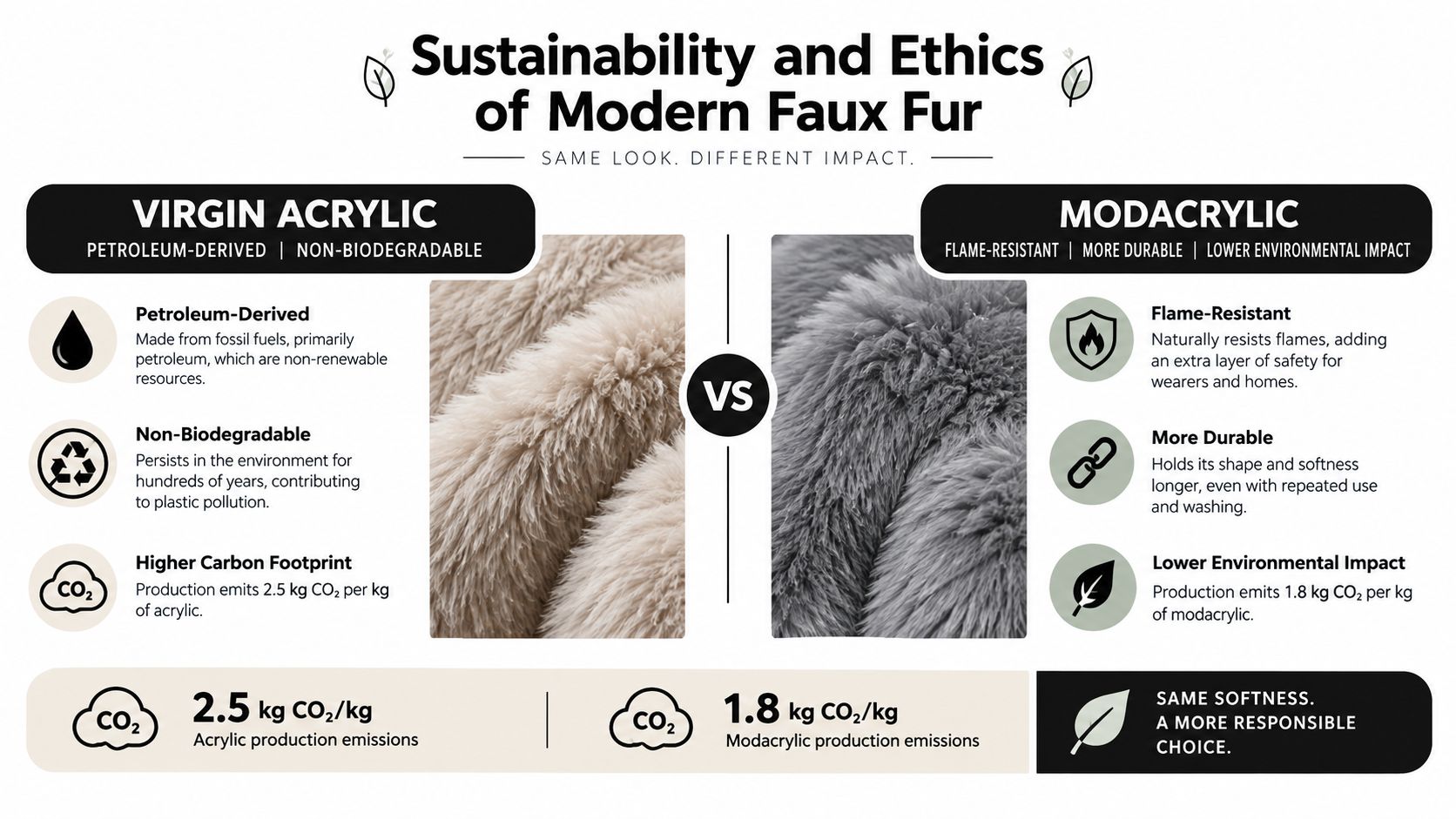
The ethical conversation around fur deserves more nuance than a simple real-versus-faux argument. Faux fur can be an ethical alternative to animal fur, but it's still a luxury textile made from manufactured fibers, and its environmental profile depends on fiber origin, durability, production, and care.
Virgin acrylic and modacrylic are petroleum-derived materials that require industrial processing. Polyester also has an environmental cost, yet recycled polyester offers a different starting point by using post-consumer material. One market report states that polyester faux fur represents 41.3% of revenue and that 28% of polyester production is sourced from post-consumer plastics, while emerging bio-based synthetic materials account for 4.8% of the market. These figures appear in the current faux fur market overview.
Recycled content doesn't make a textile impact-free. Recycled polyester can still shed microfibers, and acrylic production and dyeing still require energy, water, and chemicals. Bio-based options are promising, but their availability, price, hand, and performance can vary. No faux fur should be described as fully biodegradable just because it feels natural.
Use longevity as part of the calculation
A fabric that loses its shape quickly may demand replacement sooner than a durable fabric that stays beautiful through years of wear. That makes durability, repair, and care meaningful sustainability choices alongside recycled content.
Our team receives faux fur on rolls and inspects each material for quality before it enters small-batch production. That careful selection helps us avoid treating a textile as disposable. The conversation also becomes more complicated when comparing animal and synthetic materials. Scientific research referenced in the market coverage has found that real mink fur can have a worse climate impact than cotton, polyester, wool, and acrylic on most measures.
For a considered purchase, ask:
- What is the fiber origin? Look for clear information rather than assuming every faux fur has the same profile.
- Will the piece be used often? A durable hat or throw can offer more value than a fragile novelty item.
- Can it be repaired? Hand-sewn construction and accessible makers make maintenance more realistic.
- Can you care for it gently? Proper brushing, steaming, and storage extend the useful life of the surface.
Our perspective on the wider ethical question appears in faux fur versus real fur, where material choice is considered alongside animal welfare, longevity, and responsible buying.
Matching the Right Faux Fur to the Right Piece
A practical selection begins with the finished object, not the fabric label. Ask how close the surface will sit to the body, how much abrasion it will meet, whether it must hold a firm shape, and how much visual drama the design can carry.
| Project | Best Fiber | Pile Length | Weight (g/m²) | Backing | Key Trait |
|---|---|---|---|---|---|
| Structured top hat or fedora | Acrylic or modacrylic | Short | Light to moderate, depending on construction | Stable knitted or woven base | Clean silhouette and controlled nap |
| Throw or pillow cover | Polyester or modacrylic blend | Medium | Around 380 to 550, or heavier when a fuller surface is wanted | Flexible, stable foundation | Plush drape and loft retention |
| Vest or coverup | Acrylic or modacrylic | Long or medium-long | Apparel-grade constructions are often around 450 to 750 | Flexible backing with good recovery | Soft movement and a natural pelt appearance |
| Pet bed or collar | Polyester or dense blend | Short to medium | Dense construction preferred | Firm, durable backing | Abrasion resistance and easier maintenance |
The ranges above come from industry buying guidance, but they aren't a substitute for handling the roll. A dense long pile can feel luxurious while adding bulk and weight to a hat brim. A thin short pile may sew cleanly and drape neatly, but it won't offer the same plush warmth.
For top hats and fedoras, we'd start with a structured short-pile fabric, especially when the crown needs to keep an architectural line. For throws and pillow covers, a plush medium-pile polyester or modacrylic blend gives the room a substantial, cozy surface without the unruly movement of the longest shag.
For vests and coverups, long-pile acrylic can create a soft, shimmering frame around the body. Look for graded pile when you want depth and a more natural appearance. For pet beds and collars, prioritize a dense, low-shed surface with a backing that can handle regular contact. If you're comparing shapes and support before selecting a fur cover, this guide to dog bed types and features can help clarify the difference between a bolster, cushion, and more structured bed.
At our local studio, we apply the same judgment to Tissavel and other refined constructions, including short-pile, long-pile, and curly options. Short-pile Tissavel-style fabrics can be especially useful for upholstery and home décor, while a curlier surface brings more character to an accessory.
You can see these decisions in finished work through The Fractal Collection, where expressive textures and prints are treated as part of the design rather than added decoration. For a softer, more relaxed direction, explore Cozy Cable, a useful reference point for balancing warmth, texture, and everyday wear.
Our your fabric, our expertise service also makes room for custom sizing and custom adjustments, whether you need a different head size, sleeve length, or proportion. We offer bespoke work, hand-sewn accessories, and small-batch pieces from our Seattle studio, so the fabric can be chosen around your life instead of forcing your life around a standard size.
With over 25 years of Leigh Young's design legacy behind our work, Pandemonium Millinery offers cruelty-free luxury in hand-sewn hats, scarves, coverups, home décor, and pet essentials, with custom sizing available through our your fabric, our expertise approach. Join The Crowd for 15% off, then visit Pandemonium Millinery to explore the Fractal Collection and find the faux fur piece that feels right for your wardrobe or home.


