



You step off a chilly train, coat collar turned up, and the wind finds the one gap your outerwear missed. By the time you reach the office, your scarf has shifted, your neck feels damp, and the beautiful accessory you chose that morning looks more like a tangled afterthought than part of your outfit.
We've spent 25+ years working with texture, proportion, and cold-weather accessories at our Seattle studio. Our view is simple: the best winter scarves women choose today should feel cozy, polished, versatile, and ethically considered. Warmth matters, but so do drape, breathability, skin comfort, and the ability to move from wet pavement to a heated boardroom without losing shape.
Redefining the Best Winter Scarves Women Need Today
On a freezing commute, the right scarf protects your neck outdoors, then settles neatly over a coat once you reach the office. It can soften a polished silhouette, add structure to a plain sweater, or become a shawl, belt, or travel wrap as the day changes.
The category now serves styling as much as insulation. Browse Target's winter scarf selection, and you will see the range clearly: compact wraps, oversized knits, polished solids, and statement textures. That variety makes selection more demanding. A scarf must suit your climate, clothing, and movement, not just look impressive on a product page.
The four tests we use in our studio
A winter scarf earns regular wear when it passes four practical tests:
- Warmth: It must retain useful insulation through wind, damp air, and repeated use.
- Drape: It should fall cleanly instead of ballooning beneath a coat.
- Versatility: It should work at the neck, over the shoulders, and sometimes at the waist.
- Ethical integrity: It should provide a luxurious tactile experience without animal fur.
Trend reports may highlight oversized proportions, triangle shapes, scarf belts, relaxed placement, and faux-fur finishes. Those ideas become useful only when the silhouette holds its shape during a commute and still looks composed indoors. Our perspective on sustainable luxury fashion starts with daily function, then builds in visual pleasure.
In our Seattle studio, we test each scarf through a full wet commute before it enters a collection. We examine how the fabric folds, whether the edge frames the face, and how the piece feels after hours of wear. That hands-on test separates an accessory that photographs well from one you will reach for every winter morning.
Our Seattle rule: Choose the scarf you can style three ways, not the one that only looks right in one photograph.
For an ethical luxury wardrobe, high-end faux fur is a strong starting point. Its dense, velvety surface can provide substance and visual richness without animal fur. Choose a piece that protects you outside, folds or settles neatly indoors, and keeps its shape as your day moves from pavement to office.
Comparing Luxury Textiles and Cruelty-Free Alternatives
A scarf that carries you from a freezing commute into a polished office needs more than thickness. Construction controls warmth, drape, and how easily the piece settles indoors. Fine fibers can form dense structures that hold air, while loft gives that trapped air room to insulate. Independent comparisons suggest that a well-made 2-ply cashmere scarf at around 195 g/m² can outperform much bulkier knits on insulation per gram, as discussed in this technical comparison of women's scarves. The useful takeaway is simple: choose efficient structure over excessive bulk.
Wool's natural crimp traps air, and natural fibers absorb moisture without losing insulation as quickly. Acrylic is widely used for affordability, yet it is generally less insulative at an equivalent weight. A winter scarf material guide compares acrylic and cotton with warmer winter materials, reinforcing a practical point: a soft hand feel in a shop does not guarantee dependable warmth outdoors.
What changes when you choose faux fur
Faux fur is a pile textile designed to imitate animal fur. It is commonly made from acrylics or modacrylics, with a backing that may also contain silk, wool, or cotton. Dense fibers trap air, and this overview of faux fur construction explains why a well-made pile can provide substantial warmth across many climates.
For ethical luxury, I favor high-end faux fur with a silky pile, a flat backing, and an edge that holds its silhouette. Tissavel is one material name worth knowing if you want a refined, fur-like surface. The strongest vegan options feel plush, velvety, and weather-resistant, not merely fluffy. That distinction matters at the office, where a limp or overly shiny finish can make an otherwise elegant coat look unfinished.
| Material | Warmth-to-Weight | Ethical Profile | Tactile Feel |
|---|---|---|---|
| Cashmere | Excellent when fineness and loft are optimized | Animal fiber, not cruelty-free | Silky, light, exceptionally soft |
| Merino wool | Strong warmth with useful breathability | Animal fiber | Springy, soft, gently textured |
| Wool | Reliable warmth and durability | Animal fiber | Substantial, resilient, naturally crimped |
| Faux fur | Strong when the pile is dense and airy | Cruelty-free, vegan alternative | Plush, velvety, expressive |
| Acrylic | Variable, often less insulative by weight | Animal-free | Soft, but may feel less breathable |
| Cotton | Limited for severe winter insulation | Animal-free | Smooth, familiar, less lofty |
Our material verdict
For a damp commute, I favor a tightly made yet airy wool or cashmere construction around 140–200 g when animal fibers suit the wearer. Warmth-to-weight matters more than thickness alone. For a cruelty-free wardrobe, choose a dense faux-fur pile or carefully made vegan blend with enough loft to retain warmth without becoming cumbersome.
Sensitive skin belongs in the decision. Wool can feel scratchy for some wearers, while a silky faux-fur surface offers plush comfort without direct fiber irritation. This acrylic faux-fur material discussion shows why construction and finish deserve as much attention as the fiber label. A scarf that feels luxurious against the skin, protects you outside, and folds neatly inside earns its place in a hardworking winter wardrobe.
Mastering Silhouette and Versatile Styling Techniques
The scarf shape determines how much styling freedom you have. A narrow pull-through shape gives a clean neckline under a coat, while a wide rectangle creates a shawl-like layer. A long, fluid scarf gives you movement, but too much length can catch on buttons, bags, and bicycle handlebars during a busy commute.
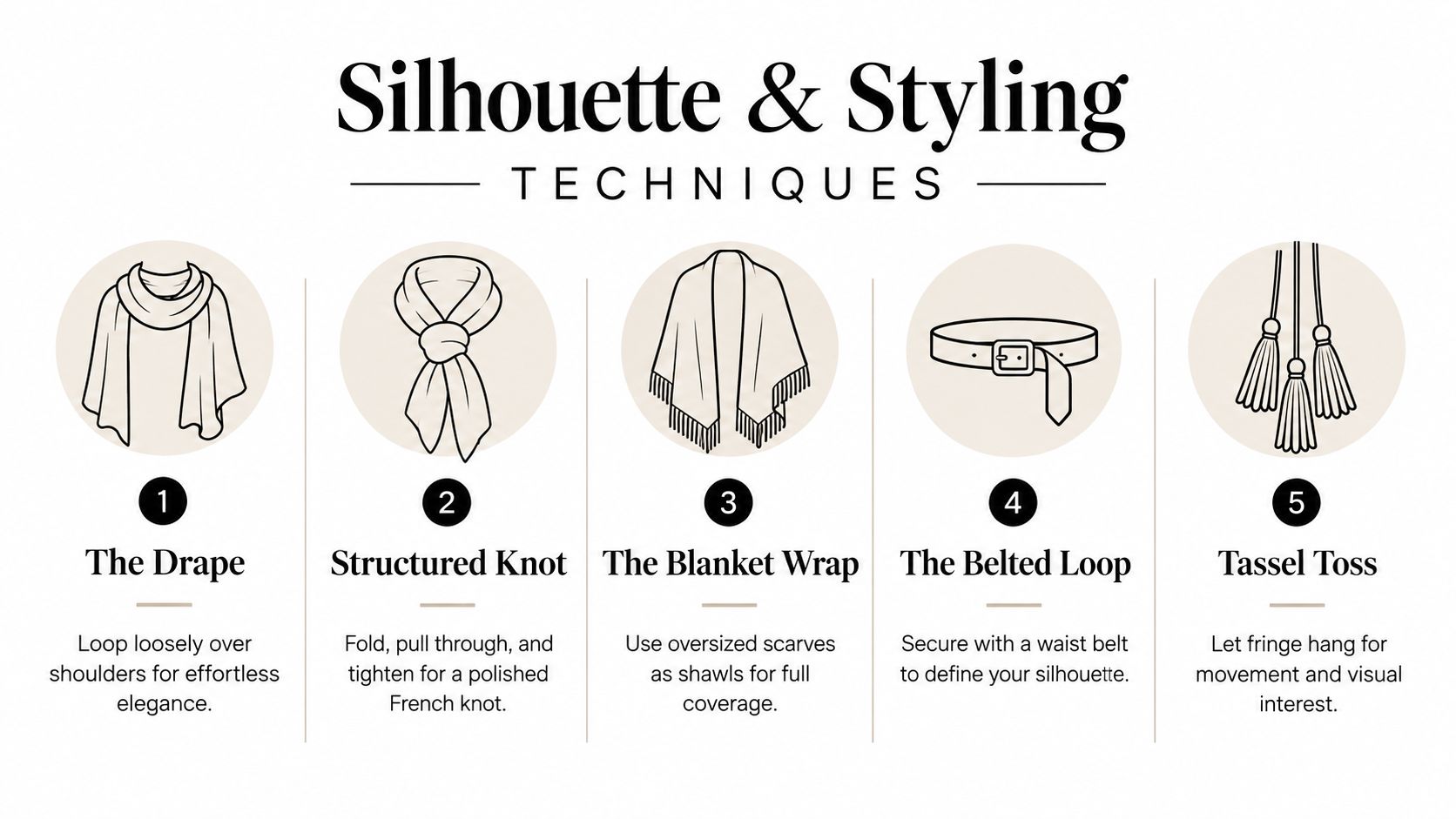
Five placements that work beyond the neck
The drape is the easiest place to begin. Lay the scarf over your shoulders and let both ends fall naturally beneath an open coat. This creates a long vertical line and lets a rich-toned or shimmering surface become the focal point without adding a knot at the throat.
The structured knot suits office dressing. Fold the scarf lengthwise, place it around your neck, and pull the loose ends through the folded loop. Tighten it gently, then flatten the front so the knot looks deliberate rather than bulky.
The blanket wrap works best with a wide, substantial scarf. Wear it over the shoulders like a shawl when you're moving through a cold lobby or waiting outdoors, then fold it into a narrower layer once you're inside.
The belted loop turns a large scarf into an architectural layer. Drape it across the shoulders, allow the ends to fall evenly, and secure the waist with a slim belt. Keep the belt visible enough to define the shape, but don't cinch so tightly that the fabric loses its fluidity.
The tassel toss is for movement. Let fringe fall over one shoulder or swing loosely at the side, especially with a simple coat and quiet accessories. The effect feels expressive without requiring a complicated tie.
Office proportion: If your coat has a broad lapel or a dramatic collar, use a slimmer scarf placement. If the coat is minimal, a plush oversized wrap can supply the needed shape.
A scrunchy scarf adds a different kind of volume. Wear it close to the neck with a smooth wool coat, or let it sit slightly lower over denim and a substantial knit. For a polished finish that doesn't need knots or pins, explore Pandemonium's pull-thru scarf collection.
The key is controlled contrast. Pair a velvety scarf with a crisp coat, a substantial knit with a silky blouse, or a vibrant pattern with quiet tailoring. Our guide to statement scarf styling is useful when you want the accessory to lead the outfit rather than blend into it.
For a piece designed to make an entrance, browse The Fractal Collection. Its bold visual language works especially well when the rest of your winter outfit stays classic.
Selecting the Perfect Scarf for Your Climate and Occasion
Seattle weather teaches you to respect moisture. A scarf that feels warm in dry indoor air can become clammy when rain, breath, and wind meet at the collar. For a damp Pacific Northwest commute, choose a fabric with useful loft and a surface that keeps its shape when worn beneath a coat hood or over a water-resistant shell.
Dry, bitter cold demands a slightly different strategy. Prioritize coverage at the neck and upper chest, then choose a construction that remains comfortable when you move between heated interiors and cold streets. A very bulky scarf may feel wonderful outside but become oppressive at a desk, so a lighter, airy structure often serves a full day better than maximum volume.
Match construction to the day
- Daily transit: Choose a medium-width scarf with a stable edge, enough length for one secure wrap, and a surface that won't snag easily on a coat zipper.
- Office hours: Favor a smooth drape, restrained volume, and a color that works with tailoring. A structured knot gives polish without crowding a collar.
- Evening events: Select a plush or shimmering finish that can rest over the shoulders as an accessory rather than looking strictly functional.
- Travel: Look for a generous wrap that can serve as a shawl on a train, plane, or chilly restaurant. Readers comparing packable layers may also find these stylish travel wrap fabrics helpful for evaluating drape and versatility.
Fit matters more than shoppers expect
A scarf can be luxurious and still be wrong for your proportions. A petite wearer may prefer a narrower silhouette that doesn't swallow the face, while someone with a broad coat shoulder or a taller frame may need extra width for balanced coverage.
We offer custom sizing and adjustments through our bespoke service. Bring us your measurements, your preferred coat shapes, or a fabric you already love. Our principle is “your fabric, our expertise,” which allows us to adjust length, width, and finishing details for a scarf that behaves properly on your body.
For practical layering ideas across damp commutes and indoor-outdoor transitions, read our guide to layering for cold weather. A well-fitted scarf should sit comfortably under a collar, release easily indoors, and return to shape without constant adjustment.
At our local studio, we produce small batches rather than chase uniformity at scale. That lets our team inspect the edge, test the drape, and make considered decisions about how a piece will be worn.
Caring for Your Handcrafted Winter Accessories
Luxury textiles reward a gentle routine. Dust, rain, friction from a shoulder bag, and repeated compression beneath a coat can flatten a plush surface or weaken its drape. Care isn't a chore added after the purchase. It's how you preserve the tactile character that made the scarf worth choosing.
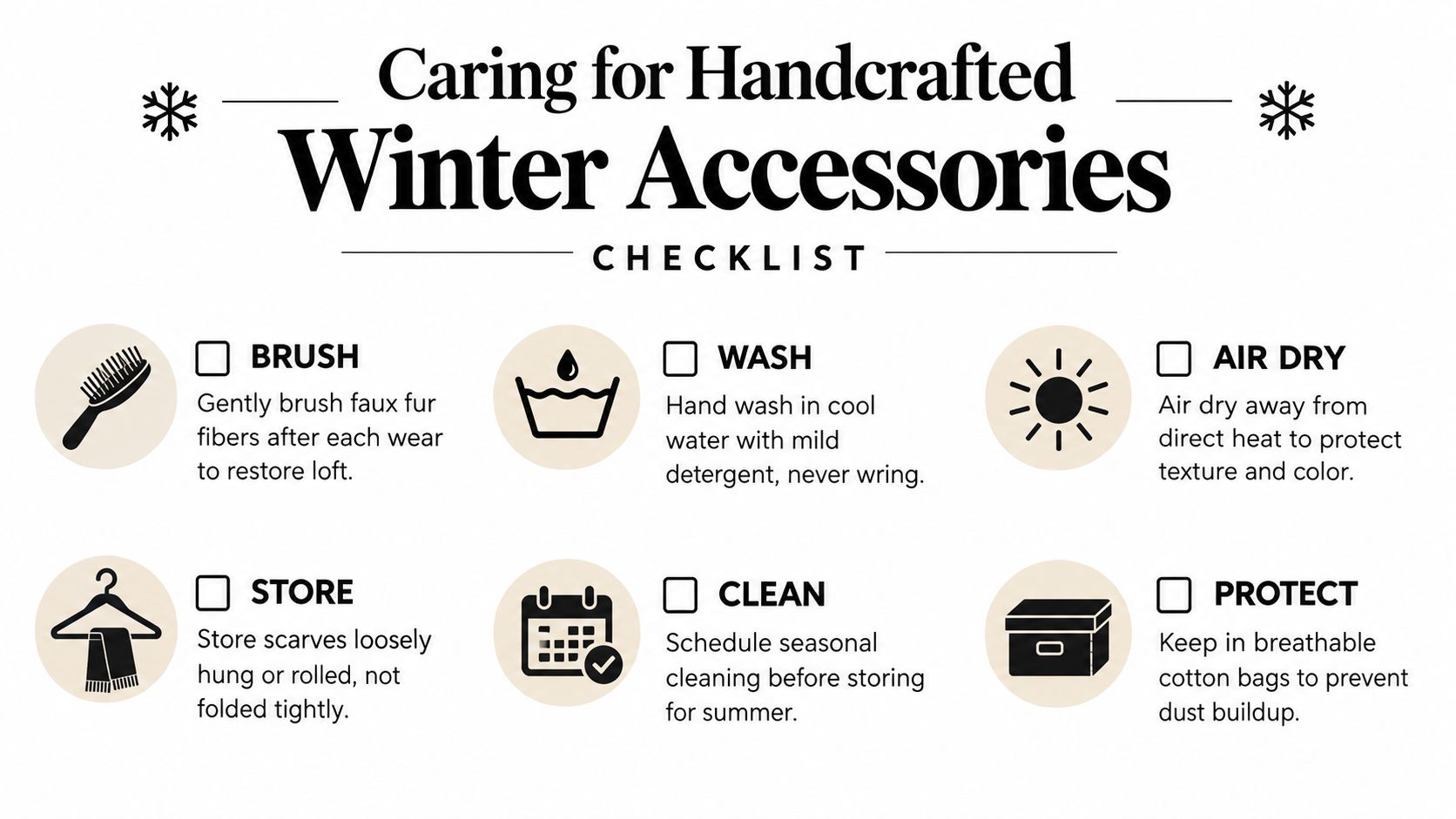
Restore the surface after wear
After wearing faux fur, use a soft brush to lift the fibers gently. Brush in the direction of the pile, not against it, and avoid aggressive strokes that can roughen the finish or pull at the backing.
Natural blends need restraint. Follow the maker's care label, keep them away from unnecessary friction, and don't use heat to speed drying. High temperatures can alter texture, shrink some fibers, or diminish color.
Clean without flattening the fabric
- Spot clean first: Blot moisture or a small mark with a clean cloth. Rubbing spreads the stain and disturbs the pile.
- Hand wash only when appropriate: Use cool water and mild detergent if the care instructions allow it. Never wring, twist, or scrub a handcrafted piece.
- Dry with patience: Press water out gently with a towel, reshape the scarf, and air dry away from radiators, hair dryers, and direct sun.
- Preserve the drape: Don't hang a saturated scarf by one end. Support it evenly while it dries so the length doesn't stretch.
Storage principle: Give the fibers room to breathe. Tight folding compresses plush surfaces and can leave permanent-looking creases.
Before storing for the warmer season, clean the scarf according to its material instructions and let it dry completely. Roll it loosely or hang it with enough space around it, then place it in a breathable cotton bag to protect it from dust without trapping unwanted moisture.
Avoid plastic garment bags for long-term storage. They can restrict airflow, especially when a scarf enters storage with even slight residual dampness. Keep accessories away from direct heat and strong sunlight, both of which can affect rich colors and delicate finishes.
A carefully maintained scarf becomes a dependable wardrobe companion rather than a disposable seasonal purchase. That longevity is central to our slow-fashion practice and to the value of small-batch, hand-sewn work.
Gifting Ethical Luxury and Joining Our Community
The best winter scarf gift feels personal before it's even unwrapped. It should suit the recipient's coat, coloring, daily routine, and values. A hand-sewn vegan-fur scarf from a Seattle studio offers a tactile experience that a generic accessory can't provide, especially for someone who wants high-end faux fur without animal fur.
We see scarves given for birthdays, anniversaries, holidays, and the quiet occasions when a thoughtful object says more than a standard gift card. A classic black or rich-toned piece suits a restrained wardrobe, while a vibrant pattern gives a confident dresser an easy focal point. A pull-through style is practical for someone who dislikes complicated knots, while a generous wrap suits a frequent traveler or a person who works in drafty spaces.
Give something made for the wearer
Customization makes the gift more meaningful. We can discuss preferred proportions, coat styles, fabric hand, and the amount of volume the recipient enjoys. Our “your fabric, our expertise” service is particularly useful when the wearer has specific sizing needs or wants a scarf that coordinates with an existing wardrobe.
Our team's work carries the perspective of designer Leigh Young, whose 25+ years of design experience have shaped Pandemonium's approach to boutique millinery and cruelty-free luxury. Every piece reflects attention to construction, touch, and proportion. You can learn more about the possibilities through our guide to custom winter scarves.
A scarf also makes a generous entry point into a broader ethical wardrobe. It can introduce someone to vegan fur, artisanal production, and the pleasure of buying fewer pieces with more intention. For shoppers drawn to tactile interiors, the same sensibility extends to plush home accessories and other small-batch designs.
We invite you to join The Crowd, our email community, for 15% off and updates from the studio. You'll receive a closer look at new textures, seasonal designs, and bespoke possibilities while staying connected to the people behind the work.
Pandemonium Millinery creates hand-sewn, small-batch faux-fur scarves and custom accessories in our Seattle studio, with a focus on cruelty-free luxury, warmth, and versatile winter styling. Join The Crowd for 15% off, then explore Pandemonium Millinery to find a plush winter companion or begin a custom design with our expertise.


