


You're standing in front of a hat that looks beautifully American. The fabric is rich, the stitching appears neat, and the product page uses phrases such as “American-made” or “finished in the USA.” But was the hat actually built here, or did an imported blank receive its decoration here?
That question matters beyond patriotism. It touches craftsmanship, fit, material sourcing, repairability, and trust. After more than 25 years of design experience, we've learned at our Seattle studio that a hat's story lives in the details you can touch, inspect, and ask about. This guide will help you read those details with a practiced eye, whether you're shopping for an everyday cap, a weather-resistant winter style, or an ethical luxury piece in high-end faux fur.
What Made in the USA Hats Actually Mean for Shoppers
A shopper looking for made in the USA hats is often balancing three desires at once. You may want a polished silhouette, a responsible purchase, and a clear answer about where the hat came from. Those priorities overlap, but the label alone doesn't always explain how they do.
Start with three questions:
- What does the claim legally mean? A product labeled “Made in USA” must meet the Federal Trade Commission's “all or virtually all” standard.
- What was constructed here? Cutting and sewing a hat from fabric is different from embroidering an imported blank.
- What does small-batch production change? A local maker may offer closer attention to fit, material choice, adjustments, and repairs.
The difference can feel as noticeable as an old favorite in your closet beside a new import. One hat may have softened around your head, held its shape through damp commutes, and gathered a few honest signs of wear. The other may be attractive but generic, with sizing and construction determined far away from the person who'll wear it.
A domestic hat can also be part of a broader support-local decision. If you're commissioning branded headwear for a creative business, community group, or studio, resources such as find custom tattoo shop hats can help you compare custom decoration services with true hat construction. The distinction is useful because decoration, embroidery, and construction are separate stages.
At Pandemonium, our local studio works in small batches, with a focus on hand-sewn millinery and cruelty-free luxury. That means we pay attention to proportion, texture, and the way a hat settles on the wearer rather than treating every head as the same shape. Our perspective on local production is also rooted in the practical value of keeping skilled work visible, a principle explored in supporting local business.
How the Federal Trade Standard Defines Made in the USA
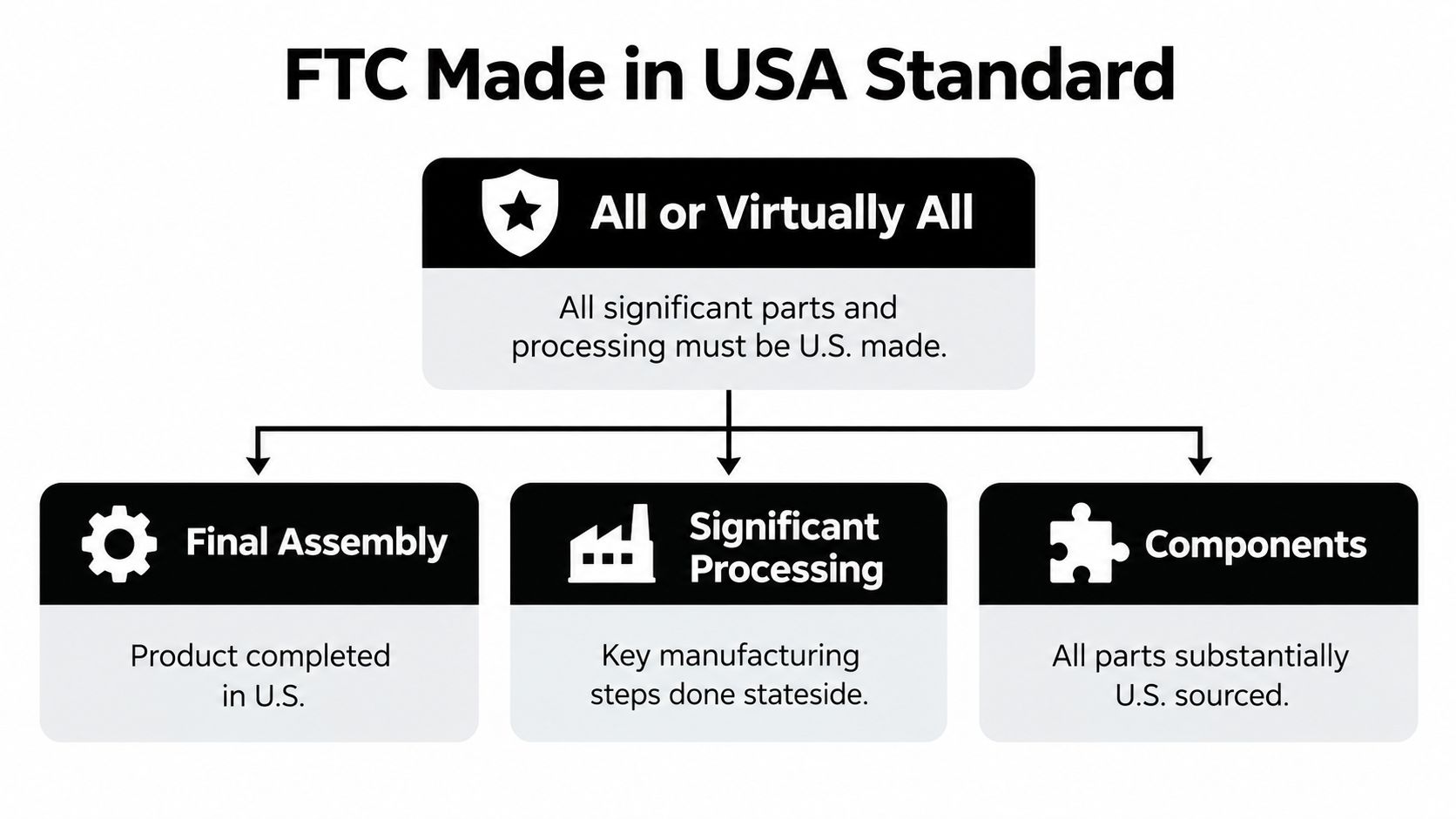
The federal yardstick is the phrase “all or virtually all.” The FTC's Made in USA Labeling Rule, finalized in August 2021, says an unqualified claim requires the product's final assembly or processing to happen in the United States, significant processing to occur here, and all or virtually all ingredients or components to be made and sourced domestically.
For a hat, those words have a tactile meaning. Consider the body, lining, sweatband, trim, label, brim, and closure. If a maker cuts American fabric, shapes the crown, sews the panels, installs the interior components, and completes the hat domestically, the claim has a stronger foundation than it would for a finished imported blank receiving a patch.
The three parts to inspect
Final assembly means the hat is completed in the United States. Sewing on a final label or adding a decorative element isn't automatically enough, especially if the substantial hat construction already happened overseas.
Significant processing refers to the important manufacturing work. For headwear, that can include cutting fabric, sewing the crown, shaping the brim, attaching a sweatband, and forming the finished silhouette. A baseball cap finished in Texas may still fail an unqualified claim if its crown was sewn overseas.
Components include the materials and parts that make the hat function. The FTC's Enforcement Policy Statement says there's no single bright-line test, but brands need a reasonable basis when making the claim. The agency may consider U.S. manufacturing costs, materials, direct labor, overhead, and how remote the foreign content is.
Practical rule: “Made in the USA” isn't a mood or a color palette. It's a claim that requires evidence about the hat's parts and processing.
Unqualified claims with false support can expose brands to civil penalties when they appear on labels, catalogs, or online listings. That's why careful makers discuss origin with precision rather than relying on broad patriotic language.
Where the Label Hides Foreign Content
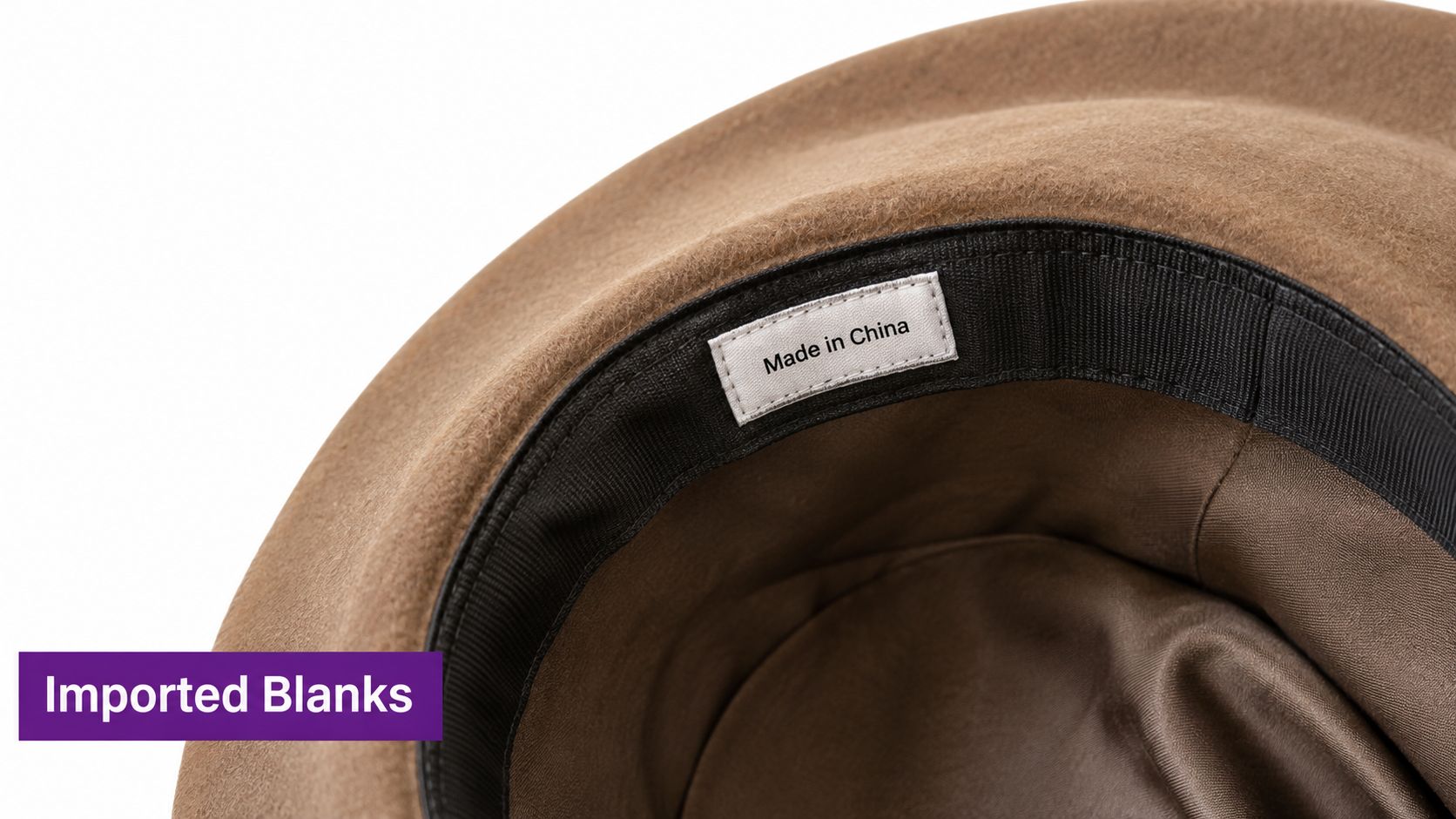
The most common confusion begins with the imported blank. A blank is a completed hat purchased without the final logo or artwork. A business may embroider, print, or attach a patch in the United States, but that decorative work doesn't necessarily transform the blank into a domestically manufactured hat.
Think of the hat as a small frame house. Painting the front door locally doesn't mean the walls, windows, roof, and wiring were built in the same place. The decoration is visible, while the construction is hidden inside the seams.
Look beyond the crown
Foreign content can appear in places shoppers rarely inspect:
- Fabric bodies: Wool, cotton, felt, or a luxury textile may have been woven or processed abroad.
- Linings: A silky lining can be imported even when the outer hat is assembled domestically.
- Sweatbands: Leather, ribbon, or fabric interior bands may come from another country.
- Closures and trim: Snaps, buckles, elastic, labels, cords, and decorative hardware can alter the origin picture.
The FTC standard allows only a negligible amount of foreign content for an unqualified claim. That doesn't mean every small imported detail automatically answers the question by itself. It does mean a brand should know what went into the hat and be able to substantiate the wording it uses.
A useful shopper's vocabulary separates cut and sewn, assembled, decorated, and finished. “Cut and sewn in Seattle” describes a meaningful construction process. “Decorated in the USA” tells you that the hat received artwork here, not necessarily that the hat itself was built here.
Ask for three proof points:
- Factory or studio location. Where were the panels cut and the crown sewn?
- Fabric origin. Where was the principal textile made or processed?
- Documentation. Can the maker explain the components and support the origin claim?
A transparent answer might be more nuanced than a flag graphic, but nuance is valuable. Ethical luxury depends on knowing what you're buying, not admiring how American the styling looks.
How to Verify a Hat Is Truly American Made
You don't need to be a textile detective for an entire afternoon. A few focused questions can tell you whether a hat's origin story is specific or carefully blurred.
Begin with the product page. Look for language that identifies the construction process, not just the location of decoration. Then check the inside of the hat, where origin labels and fiber information may appear. If the description says “made in the USA,” the seller should be able to explain how the claim meets the FTC standard.
A quick verification routine
- Read the exact claim. “Made in USA,” “assembled in USA,” and “decorated in USA” don't communicate the same level of domestic production.
- Ask where construction happened. The answer should address cutting, sewing, shaping, and finishing.
- Request material details. A maker who selected the fabric can usually name it, whether it's wool felt, brushed cotton, Tissavel, or another luxury textile.
- Inspect the interior. Check the sweatband, lining, closure, and sewn-in country-of-origin information.
- Look for a real studio story. Specific tools, named artisans, and a clear production sequence are more useful than vague phrases such as “American quality.”
| Signal to Check | What It Tells You | Green Flag Example |
|---|---|---|
| Country-of-origin tag | Whether the stated origin is disclosed inside the product | A sewn label identifies the country and matches the product description |
| FTC compliance language | Whether the brand understands the “all or virtually all” threshold | The listing explains domestic components and significant processing |
| Atelier transparency | Whether the maker can describe the actual work | A studio names its location and explains how the crown, brim, and lining are handled |
Fit deserves equal attention. Small-batch makers can discuss custom sizing, head shape, and adjustments in a way a large catalog often can't. Our own account of that approach appears in handmade millinery in Seattle, where the value lies in the hands and decisions behind the finished form.
“If a maker can tell you what the fabric is, where the work happens, and how the hat can be adjusted, you're having a more useful conversation than a label alone can provide.”
American Craftsmanship Versus Imported Volume
The choice between a domestic small-batch hat and an imported high-volume style isn't only about national identity. It's about what you want the hat to do after the first fitting, especially if you commute through a damp Seattle winter or move between cold streets and warm offices.
A well-considered cold-weather hat should feel cozy and substantial, not cumbersome. The body should hold its shape, the lining should sit smoothly against the head, and the fit should avoid the pressure points that make a beautiful hat stay on a hook. Weather-resistant materials and careful finishing matter because moisture, friction, and repeated handling test every seam.
American hat-making has deep roots. The 1890 census recorded domestic producers consuming 3,039,700 pounds of wool and 1,058,520 pounds of fur, while producing 6,191,482 wool hats, 2,462,974 soft or felt wool hats, and 2,449,672 fur hats, according to the historical manufacturing record. The same census recorded 229 carding sets and output of 972,475 dozen wool hats valued at $4,612,151, or about $4.74 per dozen, showing a specialized industry with measurable raw-material use and changing production scale.
What changes at small scale
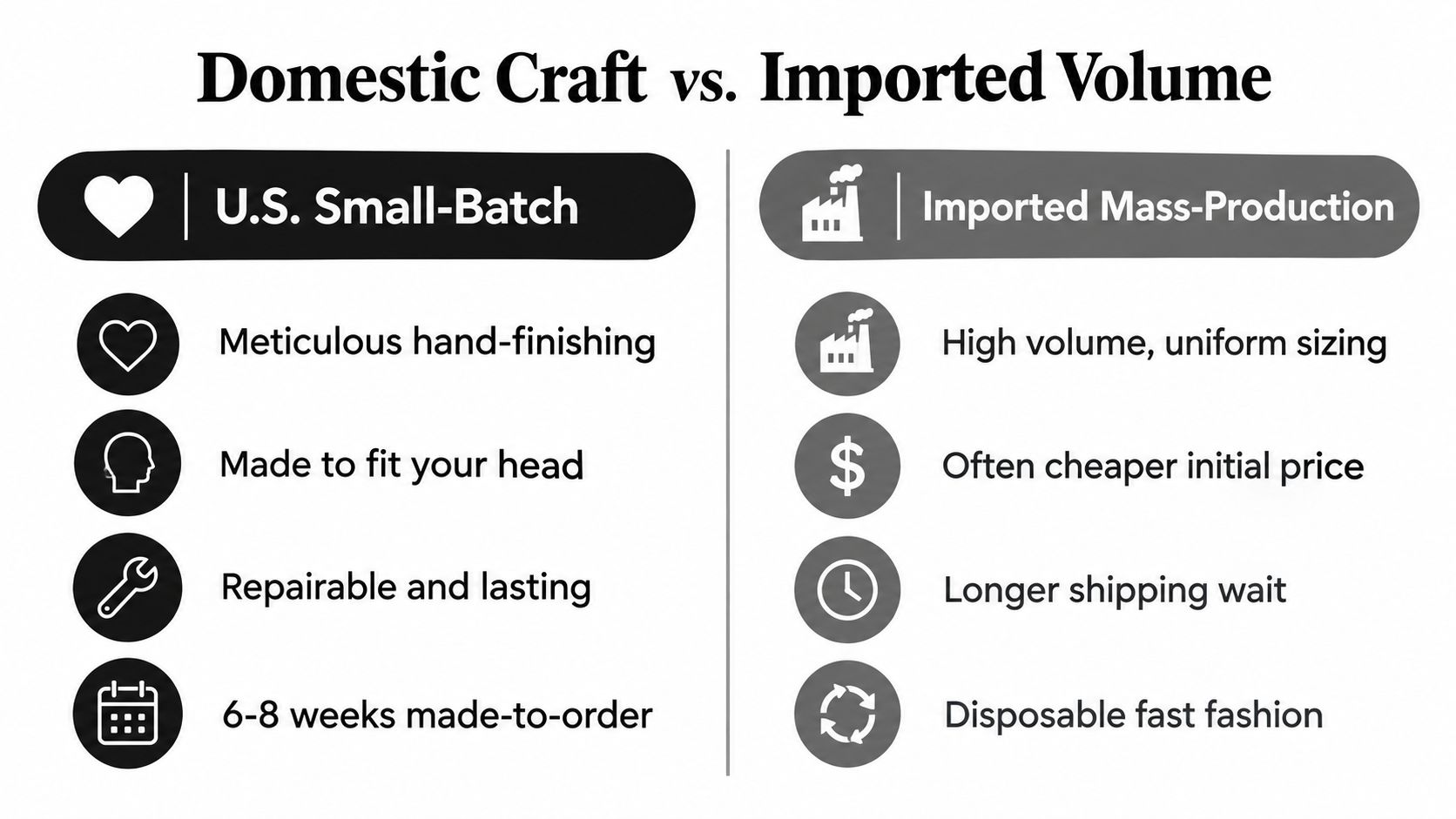
At a small Seattle studio, a maker can notice when a brim sits slightly off, when the lining pulls, or when a hat needs more room at the temples. That attention supports:
- Fit: Custom sizing can address heads that fall outside standard assumptions.
- Repair: A maker who knows the construction may be able to advise on restoration or adjustment.
- Lead time: Made-to-order work takes patience, but the waiting period can reflect individual preparation rather than anonymous inventory.
- Material choice: Small batches make unusual, rich-toned, or tactile textiles more practical to consider.
Our perspective on this balance is explored in small-batch production versus mass-market fashion. Imported volume may offer immediate availability and uniform sizing, while domestic craft may offer a closer relationship with the object and the person making it.
For those comparing today's supply, the contrast is substantial. The United States imported $43 billion of footwear and headwear combined in 2022, making it the world's largest importer in that category, according to the Observatory of Economic Complexity. A choice to buy domestically therefore supports a smaller, more specialized channel rather than the dominant import system.
Inside a Seattle Small-Batch Millinery Studio
A small-batch studio has a different rhythm from a volume production floor. Fabric arrives with a hand feel, a color depth, and a particular drape. Blocks, scissors, measuring tapes, thread, and needles gather around the worktable, and each hat moves through the process with visible decisions rather than an anonymous sequence.
At Pandemonium Millinery, designer Leigh Young brings more than 25 years of design experience to a Seattle practice centered on hand-sewn accessories, apparel, and home pieces. Our work includes high-end faux fur and vegan fur, an ethical alternative for shoppers who want a velvety, plush finish without animal fur.
Follow the work with your hands
The practical questions are straightforward:
- What is the textile? Ask whether the piece uses wool, felt, cotton, faux fur, vegan fur, or a named luxury textile such as Tissavel.
- How is it constructed? Look for language describing cutting, hand-sewing, shaping, lining, and finishing.
- Can the fit change? Ask about custom sizing, head measurements, and adjustments.
- What happens if the hat needs care? A maker should be able to discuss storage, cleaning guidance, and possible repairs.
Our bespoke approach is summarized by a simple phrase, “your fabric, our expertise.” A shopper with a meaningful textile, an unusual head size, or a specific silhouette can ask whether that material can become a custom hat. That possibility is particularly useful for hard-to-fit customers who've learned that standard sizing doesn't always feel weightless or secure.
Learn more about Leigh Young's background through this designer profile from Seattle. Her legacy connects the visual drama of millinery with the everyday comfort required by people who wear their hats through changing weather.
The video below offers another way to observe the tools and hand movements behind the craft.
Ethical luxury and domestic production can reinforce one another, but they aren't identical claims. A cruelty-free hat still needs accurate origin language, and a domestic hat can still require thoughtful material scrutiny. The best questions honor both.
A Buyer's Checklist for Choosing Ethical Luxury Hats
Start with touch. Run your fingers over the hat body and notice whether it feels silky, velvety, plush, weightless, or substantial. Texture won't prove country of origin, but it can help you understand whether the material and construction match the price and the maker's description.
Then examine the inside. Look at the sweatband, lining, seams, labels, and any closure. A polished interior often reveals more about the construction than a dramatic exterior photograph.
Your studio-side inspection
- Measure before ordering. A beautiful hat that pinches or shifts won't become a wardrobe favorite. Ask about custom sizing if your head falls outside standard ranges.
- Name the material. “Luxury textile” is a starting point, not a full answer. Ask whether the piece uses high-end faux fur, vegan fur, Tissavel, felt, wool, or another specific fabric.
- Check the construction wording. “Hand-sewn,” “cut and sewn,” and “made to order” describe work differently from “decorated” or “customized.”
- Consider care and longevity. Ask how to store the hat, protect its shape, and request help if the brim or lining needs attention.
- Look for a human connection. A real maker can usually tell you where the work happens and what drew them to the fabric.
The domestic market remains small beside imported supply. Independent market data estimates that U.S. headwear production was about 93 million units in 2024, meeting only about 4% of U.S. demand, according to IndexBox's U.S. hat and headgear overview. That limited capacity can mean fewer instant choices, but it can also make room for closer communication, bespoke adjustments, and thoughtful small-batch design.
For a wider view of material responsibility and long-wearing choices, visit sustainable luxury fashion. If you're drawn to the shimmering, architectural patterns of our Fractal Collection, you can compare statement silhouettes with the tactile warmth of the Cozy Cable Collection. Custom sizing and “your fabric, our expertise” services are also available for shoppers who need a more personal fit.
Join The Crowd for 15% off and receive studio news, new small-batch releases, and invitations into the making process. When you're ready to choose a hat with a clear Seattle origin and cruelty-free luxury materials, explore the Fractal Collection.
At Pandemonium Millinery, we make hand-sewn, small-batch hats in our Seattle studio, including high-end faux fur designs and bespoke pieces shaped around your measurements or textile. Join The Crowd for 15% off, then visit Pandemonium Millinery to find a made-in-the-USA hat connected to real craftsmanship.


