



You step out of a Seattle office into damp air, a light crosswind, and a temperature that feels colder than the forecast. Your sweater is warm, your buttoned coat looks polished, yet the first gust finds the gap at your throat and the space between the buttons. By the time you reach the bus, you're tugging at the front and wishing your outer layer had been designed for movement rather than a static fitting-room pose.
After 25+ years of design experience, our team at Pandemonium has learned that a winter wrap coat works best when it behaves like a complete weather system. The outer face, lining, insulation, overlap, belt, sleeves, and collar all have to cooperate. A plush silhouette alone won't keep you comfortable if wind can travel straight through the chest.
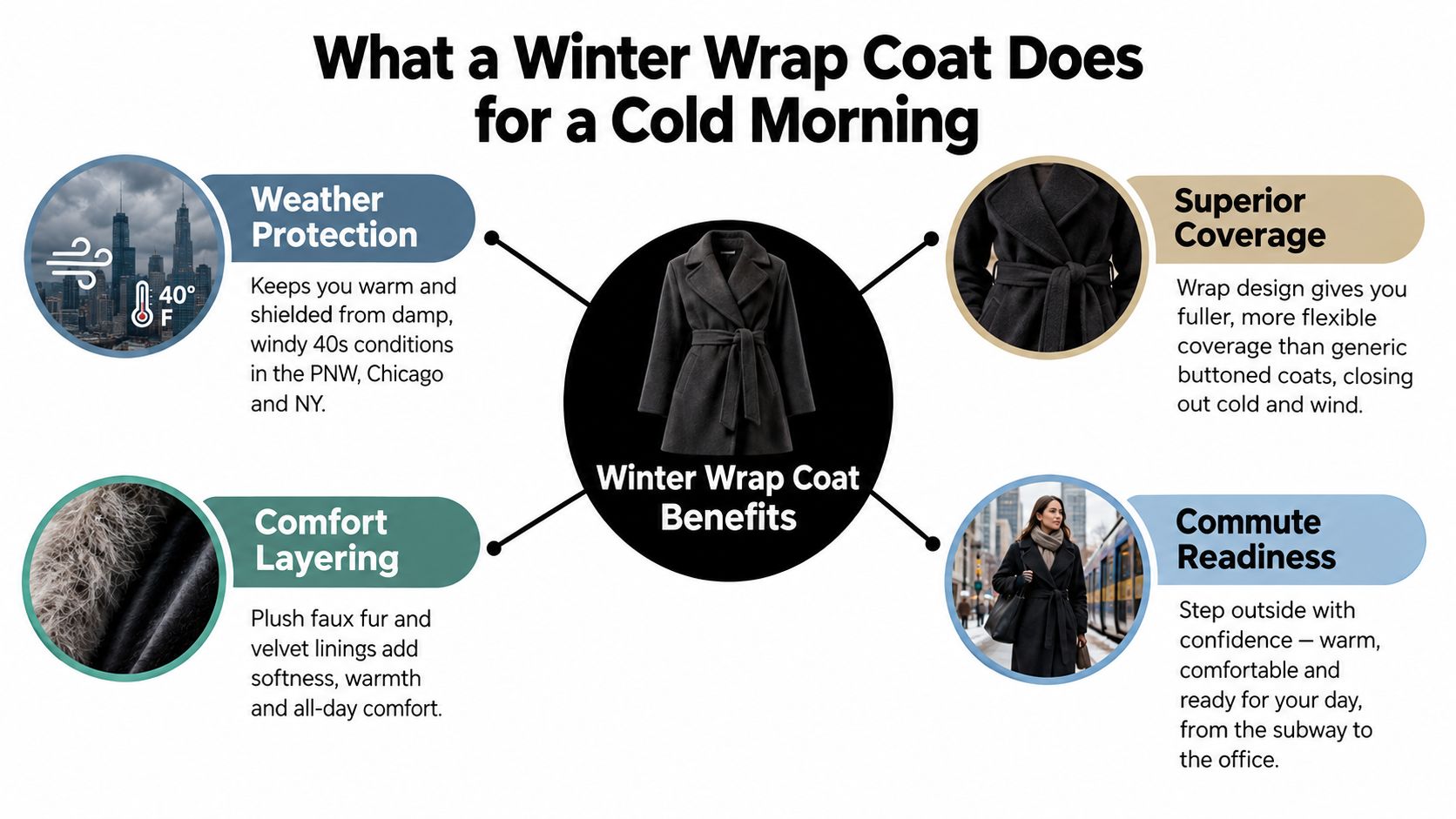
What a Winter Wrap Coat Does for a Cold Morning
A Seattle commuter often needs one coat to handle several small changes in the same trip. The walk to the light rail may be brisk and windy, the platform may feel still and chilly, and the office may be warm enough to loosen the belt. NOAA climate material describes average Seattle winter daytime temperatures in the 40s°F and nighttime temperatures in the 30s°F, which supports choosing versatile everyday outerwear for cool, damp city weather rather than a garment designed only for extreme cold. Seattle climate information from NOAA gives useful context for that decision.
A properly made winter wrap coat answers those changes through adjustable coverage. The front overlaps instead of meeting at a single row of buttons, the belt can secure the torso without forcing a rigid waist, and a shawl or wrap collar can sit high when the wind rises. That flexibility matters over a knit dress, a blazer, or a substantial sweater.
Why generic buttoned coats fall short
A standard buttoned coat can look immaculate while leaving practical weaknesses:
- The throat gap: A collar that won't close comfortably lets moving air reach the neck and upper chest.
- The fixed fit: A narrow front may work over a blouse but strain over a blazer or textured knit.
- The rigid waist: Buttons dictate the silhouette, even when your underlayers or activity change.
- The exposed overlap: Small spaces at the center front can become noticeable once you're walking into wind.
A wrap front isn't automatically superior. If the overlap is shallow or the belt slips, the same design becomes decorative rather than protective. We look for an overlap that stays secure while seated, walking, and reaching for a transit pole.
Practical rule: Judge a coat on the block, not only in front of a mirror. Walk, sit, raise your arms, and check whether the neckline and torso remain covered.
The weather system also includes what you wear underneath. A moisture-managing contact layer, a warm insulating layer, and the coat's protective exterior create a more reliable ensemble than depending on one dramatically thick garment. For a broader cold-weather wardrobe, our guide to best cold-weather gear offers another practical point of comparison.
Understanding the Winter Wrap Coat
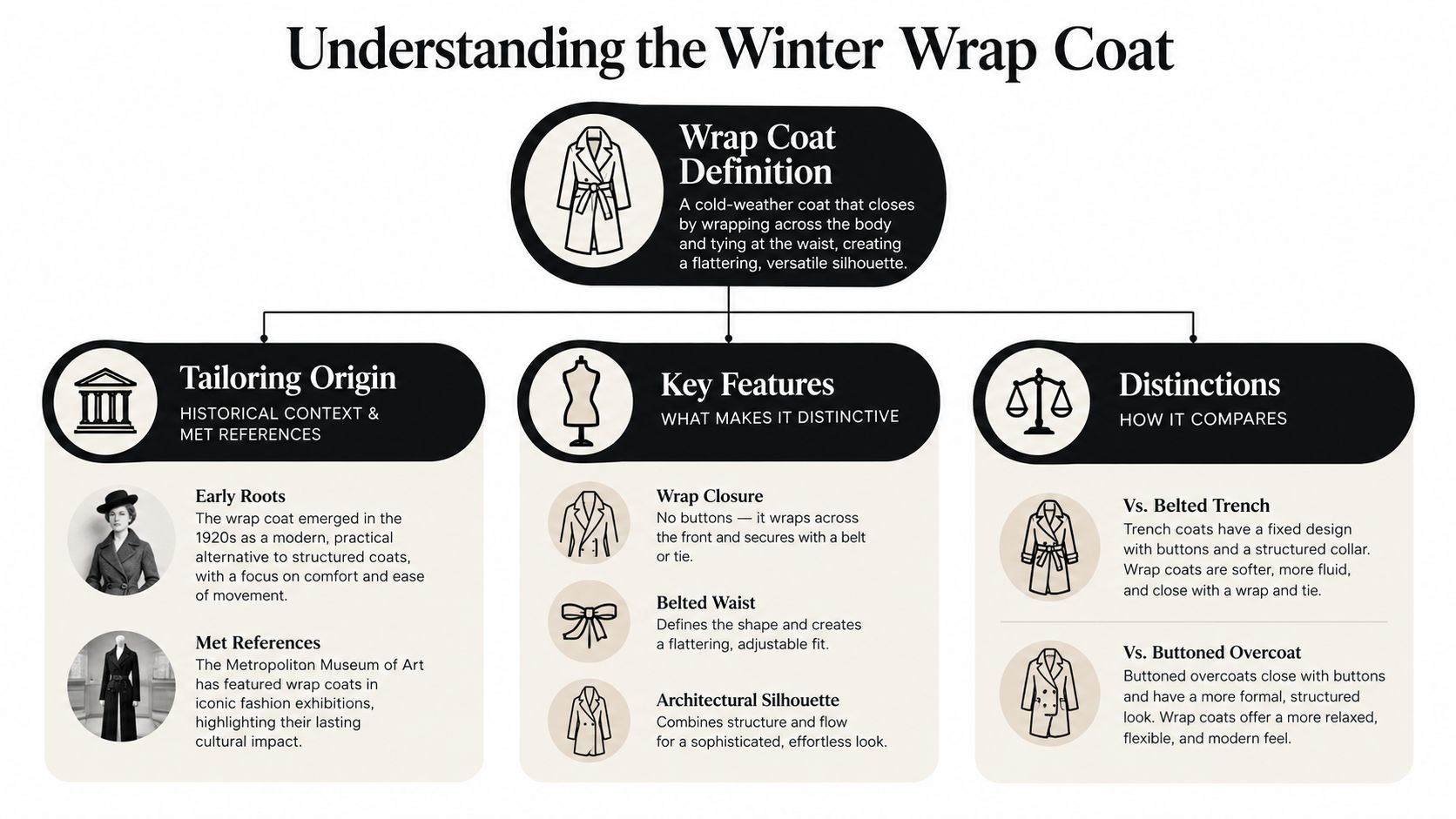
A winter wrap coat is defined by how its parts work together, not by the presence of a belt. The essential structure usually includes an overlapping front, an adjustable tie or belt, and a collar that can frame the neck and shoulders. A belted trench may wrap visually but often relies on a fixed button or storm-front system, while a buttoned overcoat closes along a set line rather than adapting across the torso.
The historical foundation reaches back to the overcoat. The Metropolitan Museum of Art describes an American overcoat connected with the industrial era, when engine smoke and urban pollution created practical reasons to shield finer suits. Its construction also represented the period's ideal of a “grand presence,” showing that protective clothing had already become part of public presentation. A related British coat in the collection demonstrates how construction changed for shooting and hiking, with movement considered alongside coverage. The Met's overcoat collection makes the lineage clear: outerwear has long balanced protection, mobility, and social appearance.
Think of the coat as the outer shell
The U.S. Geological Survey field guide identifies three functional cold-weather layers:
- Contact layer: Moves moisture away from the skin.
- Insulating layer: Retains warmth through fibers and trapped air.
- Outer shell: Protects the inner layers from the environment.
The guide also specifies that temperatures below 32°F require an additional thickly insulated outer garment. The USGS field guide explains why a wrap coat should leave enough room for a sweater or insulating layer without collapsing the wearer's shape.
That layered model changes how we assess style. A coat can be architectural, rich-toned, and beautifully draped, but its value depends on whether the front overlap, collar, lining, and sleeve openings preserve warmth during actual movement. The belt adjusts presentation, yet it should also help maintain the still air around the torso.
Where the design earns its keep
The strongest wrap coats offer:
- Generous coverage: The front panels overlap across the chest and abdomen.
- A stable collar: A shawl or wrap collar can protect the throat without looking stiff.
- Controlled volume: The coat accommodates layers without becoming shapeless.
- A reliable belt path: The belt stays aligned instead of sliding toward the narrowest part of the waist.
Our coat with faux fur shows how softness and coverage can coexist, especially when the collar and wrap line are treated as structural details rather than decoration.
Fabric and Construction Choices for Real Cold
Warmth doesn't come from the word “plush” alone. It comes from loft, still air, surface density, and closure geometry, with each element affecting how the coat feels on a wet sidewalk.
A clothing insulation value is measured in clo, where 1 clo is approximately 0.155 m²·°C/W. The measure reflects resistance created by the textile, air held within it, and air layers between garment components. Research on clothing insulation also reports that walking motion can reduce total ensemble insulation by roughly 20–30% through air pumping. In practical terms, a coat that feels cozy while standing still may lose some of that comfort once you're hurrying for a train.
Start with the outer face
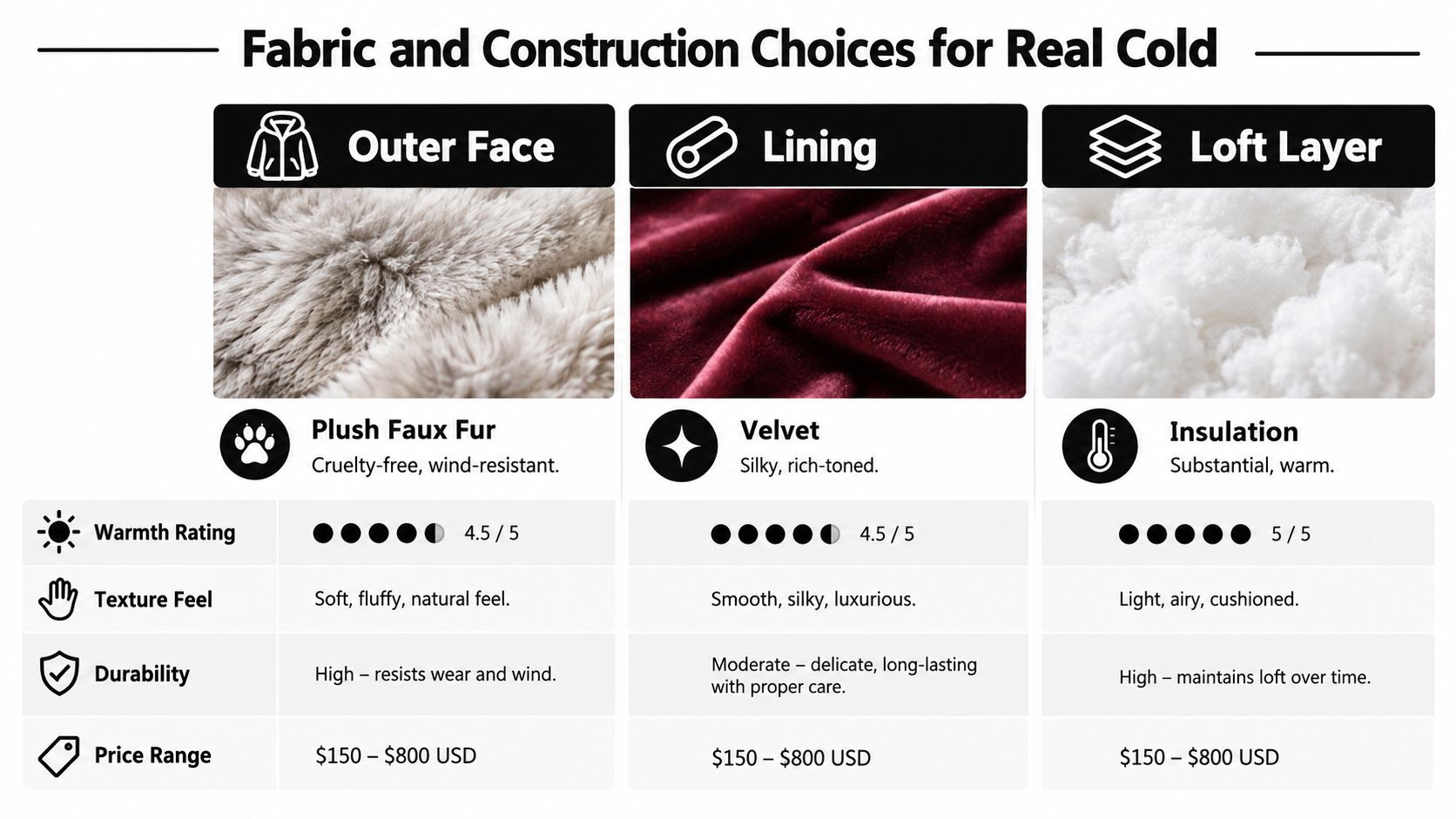
A dense outer surface does two jobs. It creates the visual character of the coat, and it limits the amount of air that reaches the insulating structure beneath.
High-end faux fur can provide a velvety, substantial hand and a plush surface that feels luxurious without using animal fur. Faux fur is a textile category, not one single fiber, and common fibers include polyester, nylon, and acrylic. Those fibers shouldn't automatically be described as biodegradable or impact-free, so we use cruelty-free and ethical alternative accurately, without turning either phrase into a blanket sustainability claim.
Wind deserves particular attention. In controlled testing, increasing wind speed from 0 to 16 km/h reduced measured thermal insulation in tested textile assemblies to less than 15% of its initial value, an approximately 85% loss under those study conditions. The wind and textile assembly research explains why a tightly constructed torso, secure neckline, and broad front overlap matter more than adding visual bulk alone.
Choose the lining for contact and movement
A lining should slide over a sweater rather than catch at the elbows. Velvet offers a silky touch and a rich-toned interior, while a low-compression lining helps preserve the layer of air that contributes to warmth. Tissavel-style luxury textiles can add a smooth, tactile finish, but the lining still needs to be cut generously enough for practical movement.
The middle layer is where many coats become too heavy. A thick pile compressed under a tight lining may lose the loft that made it appealing. We prefer depth that remains resilient, with enough room for the surface to stand away from the body and enough structure to keep the wrap front from collapsing.
Match the textile to the forecast
For a Seattle commute, a weather-resistant outer face and adjustable collar may matter more than extreme loft. For exposed Chicago streets, wind protection and a stable overlap deserve priority. For New York transit, the coat also needs sleeves that allow a blazer underneath and a closure that won't come loose when the garment is pressed against a crowded seat.
A useful fabric conversation should cover:
- Surface: Is it dense enough to limit air penetration?
- Pile: Does it recover after pressure from a bag strap or seat?
- Lining: Will it slide over workwear without pulling?
- Structure: Does the wrap remain aligned when the wearer walks?
- Care: Can the owner refresh it without damaging the pile?
Our guide to types of faux fur fabric is a helpful companion when comparing texture, drape, and the role of a luxury textile in a finished garment.
Picking the Right Size and Closure Style
A winter wrap coat should be measured over the layer you intend to wear, not over a thin shirt chosen for convenience. Bring your heaviest blazer or sweater to the fitting, close the front, sit down, and reach forward. If the belt only holds when pulled tight, the coat is relying on tension instead of sound patterning.
The body needs ease, but excess ease creates its own problems. Too much volume can let the overlap shift, while too little room compresses the lining and restricts the arms. We pay close attention to shoulder width, upper-arm circumference, sleeve pitch, and the point where the belt crosses the torso.
Fit adjustments that make a difference
- Petite proportions: A shorter body length and a belt placed slightly higher can prevent the coat from overwhelming the frame.
- Tall proportions: Additional body and sleeve length preserve coverage without forcing the cuff above the wrist.
- Broad shoulders: A generous back and correctly pitched sleeve prevent drag lines across the chest.
- Extended sizing: The overlap should remain functional at the fullest part of the torso, not merely meet at the waist.
- Layering needs: Check the fit over a blazer, since shoulder pads and sleeve heads require more room than a fine knit.
- Custom sleeves: Sleeve length can be adjusted so the cuff protects the wrist without swallowing the hand.
For a second opinion on taking measurements, these coat measurement tips provide a useful reference before a fitting conversation.
Closure styles at a glance
| Closure | Best for | Watch out for |
|---|---|---|
| Inner tie | A clean exterior and controlled torso fit | It can be difficult to adjust while wearing gloves |
| Outer tie | Flexible styling and a visible waist | The belt may shift if the loops sit too low |
| Hidden snap | Fast security on transit and in wind | Snaps can pull on a delicate surface if poorly reinforced |
| Hook | A quiet, discreet neckline closure | A single hook won't replace a properly overlapping front |
A belt should stay put when you walk, but it shouldn't flatten the coat's loft. Motion matters because clothing insulation can fall as air moves through the ensemble. The research cited earlier associates walking with roughly 20–30% lower total ensemble insulation through air pumping, so a stable closure and preserved trapped air are practical concerns, not abstract tailoring details.
Custom sizing is especially valuable for hard-to-fit bodies. Our bespoke faux fur coat alterations approach reflects a simple principle: your fabric, our expertise. Small changes to sleeve length, body length, belt position, or overlap can turn a beautiful coat into one you reach for without hesitation.
Styling a Winter Wrap Coat for Work and Weekend
A wrap coat earns its place when it can move through the day without requiring a complete outfit change. The same architectural silhouette can look composed over office tailoring, relaxed with denim, or dramatic with evening millinery.

Monday office hours
Start with a knit dress, opaque tights, and a slim ankle boot. Let the coat's collar frame the neckline rather than adding a bulky scarf, and tie the belt slightly above the natural waist if the dress has a long, clean line. A velvet-lined interior feels silky over the knit, while a classic neutral keeps the coat appropriate for a morning meeting.
Skip an oversized scarf that competes with the wrap collar. A structured tote can also crush a plush shoulder, so a softer bag or a hand-carried document case often preserves the coat's line better.
For more office combinations, our business casual winter guide keeps the advice grounded in real layers rather than a single styled photograph.
Saturday market errands
For a market walk, wear the coat open over jeans, a substantial sweater, and boots with a little height. A belt tied loosely gives the silhouette movement, while a close-fitting hat or textural headpiece keeps the overall shape balanced. Rich brown, charcoal, cream, or a vibrant faux-fur surface can make denim feel considered without becoming formal.
Sleeve mobility matters. You should be able to reach for a market bag, turn toward a conversation, and lift an arm without the coat pulling across the back. If the shoulder feels tight over a sweater, no amount of elegant drape will rescue the comfort.
The video below offers another visual cue for thinking about winter accessories as part of a complete silhouette.
Evening texture
For dinner or a gallery opening, keep the palette tonal. A shimmering dark coat over a satin dress, pointed shoe, and statement millinery creates depth through texture rather than contrast. The wrap front becomes an architectural frame, especially when the collar is allowed to sit naturally instead of being overworked.
A small hand-sewn accessory can echo the coat's surface without matching it exactly. Pandemonium's Fractal Collection offers bold prints and sculptural color for readers who want the evening look to feel vibrant rather than merely practical.
Care Tips That Protect Pile, Lining, and Shape
A beautiful wrap coat lasts longer when care is treated as part of its design. Faux fur pile, velvet lining, belt placement, and shoulder structure each need a different kind of attention.
Research on microfiber release finds that low-temperature, shorter wash cycles and air-drying generally reduce shedding, while recovered microfiber mass from top-load machines was approximately seven times that from front-load machines. The textile-care research also cautions against assuming that natural fibers always shed less. Under some test conditions, wool and cotton can release amounts in a similar range, so the responsible choice is a careful, material-specific routine.
A practical care card
- Spot-clean first. Blot a small mark with a suitable cloth rather than immersing the entire coat. Rubbing can disturb plush fibers and create a visibly different patch.
- Refresh the surface gently. Use a soft brush in the direction of the pile. Steam should never be applied casually to an unfamiliar lining or backing, since heat and moisture can alter texture.
- Check the label before washing. A heavy wrap coat may be better suited to professional cleaning than a home machine, especially when it combines plush fabric, structured shoulders, and a separate lining.
- Air-dry with support. Lay the coat flat or use a broad, supportive hanger according to the garment's construction. Don't hang a saturated heavy coat from a narrow hanger, because the shoulders and wrap line can stretch.
- Store with room to breathe. A wide hanger, breathable garment cover, and cool dry closet protect the pile through humid months. Avoid compressing the coat under other winter pieces.
For a gentler comparison of cleaning methods, how to wash a faux fur throw offers useful material-care context, although a coat still needs its own label and construction considered.
Care principle: Preserve the shape before chasing a spotless surface. A lightly refreshed pile is easier to live with than a distorted shoulder or stretched belt line.
Why a Handmade Wrap Coat Makes a Standout Gift
A winter wrap coat is a thoughtful gift because it solves several personal questions at once. It can suit someone who dislikes rigid tailoring, someone who struggles with sleeve length, or someone who wants the tactile pleasure of high-end faux fur without animal fur.
At Pandemonium, our local Seattle studio works in small-batch production, with hand-sewn faux fur accessories and apparel shaped by Leigh Young's 25+ years of design experience. That setting supports adjustments that a standard size chart can't provide, including custom sleeve length, body length, belt position, and fabric conversations. Our approach is your fabric, our expertise, whether the recipient prefers a classic surface or a more expressive luxury textile.
The ethical conversation also deserves precision. The Fur Free Alliance summary reports that producing 1 kilogram of mink fur generates approximately 110 kilograms of carbon-dioxide emissions, a figure cited in discussions of high-end faux fur as an ethical alternative for consumers who reject animal fur. The referenced faux-fur overview also notes that faux fur commonly uses polyester, nylon, or acrylic, and that synthetic textiles can contribute to microplastic pollution. Cruelty-free luxury is a meaningful sourcing position, but it isn't a complete environmental claim.
Give the recipient room to be themselves
A handmade coat feels more personal when the buyer considers:
- Daily climate: Does the recipient face damp Seattle streets, exposed Chicago wind, or cold New York transit?
- Layering habits: Will the coat need to fit over a blazer or a substantial knit?
- Proportion: Would a shorter body, longer sleeve, or adjusted belt placement make the garment more comfortable?
- Style language: Is the right direction classic, architectural, shimmering, or vibrant?
- Care reality: Can the recipient spot-clean, air-dry, and store the coat properly?
For readers collecting thoughtful ideas beyond conventional registries, this EasyRegistry wedding gift guide offers broader inspiration for choosing something distinctive and lasting.
A winter wrap coat made locally and adjusted thoughtfully isn't disposable seasonal decoration. It's an intimate piece of everyday equipment, one that can accompany commutes, dinners, markets, and changing wardrobes for years.
Join The Crowd for 15% off and receive Pandemonium's warm, tactile updates from our Seattle studio. When you're ready to choose a small-batch winter wrap coat or explore custom sizing, visit Pandemonium Millinery to browse our cruelty-free luxury collections, including the Fractal Collection, and begin a conversation about your fabric, our expertise.


