



You step off the bus into a wet Seattle wind, one hand holding your coffee and the other pulling a collar closed against the chill. Your coat needs to do more than photograph beautifully. It must keep you cozy through the commute, allow you to climb stairs and reach for a transit pole, then arrive at the office looking polished rather than overbuilt. That's where a well-made long faux fur coat earns its place.
At our Seattle studio, we've spent 25+ years under designer Leigh Young refining the relationship between a luxury textile and the body that wears it. The right piece feels plush and substantial, yet unexpectedly weightless in motion. It has an architectural silhouette, a silky lining, and enough practical intelligence to become an everyday winter sanctuary.
The Evolution of the Long Faux Fur Coat
From dramatic silhouette to ethical luxury
Long faux fur coats belong to a broader shift from animal fur toward synthetic alternatives in fashion. Early artificial-fur products appeared in the early twentieth century, and by the 1950s synthetic-fur garments had become sufficiently popular and affordable for mass-market clothing, as documented in this history of fur and faux fur garments.
That development made the visual language of a full-length fur coat, including volume, pile, warmth, and a dramatic silhouette, available without using animal pelts. Genuine fur was especially prominent in 1960s luxury fashion, when mink, rabbit, leopard, jaguar, panther, fox, and other animal furs were widely associated with status dressing. Faux fur gradually became more than a lower-cost imitation. It became a material through which designers could respond to changing consumer priorities, technological improvement, and animal-welfare concerns.
Why the long silhouette still matters
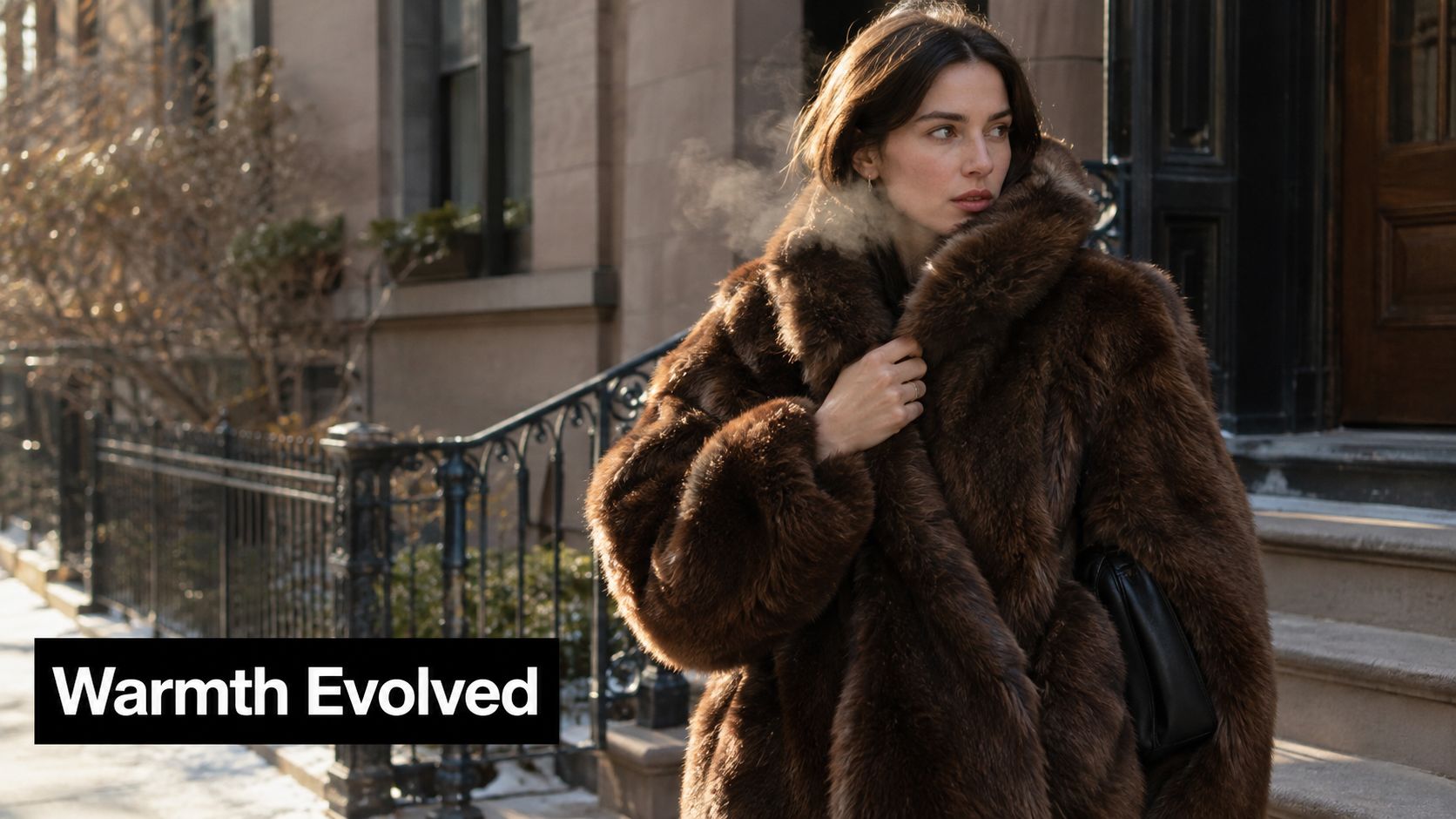
A full-length coat retains a sense of occasion, but its appeal isn't only theatrical. Covering the hips and upper legs can make a bitter commute feel more sheltered, while a carefully shaped swing or column silhouette keeps the garment from looking like anonymous winter equipment.
Prominent fashion companies have also moved away from real fur. Gucci announced a fur-free policy in 2017, while Kering stated in 2021 that all its brands would stop using animal fur beginning with Fall/Winter 2022 collections. Those decisions helped move faux fur into the vocabulary of contemporary ethical luxury.
Our approach: Preserve the glamour of the classic fur coat, then refine the fit, lining, and construction until it works for real life.
At Pandemonium, our local studio uses small-batch, hand-sewn production to create pieces with a more personal character. A long faux fur coat can be an ethical alternative without losing its rich-toned surface, velvety hand, or commanding presence. With bespoke sizing and our “your fabric, our expertise” service, we can also shape the garment around the wearer rather than forcing the wearer into a fixed pattern.
Understanding Warmth and Insulation Dynamics
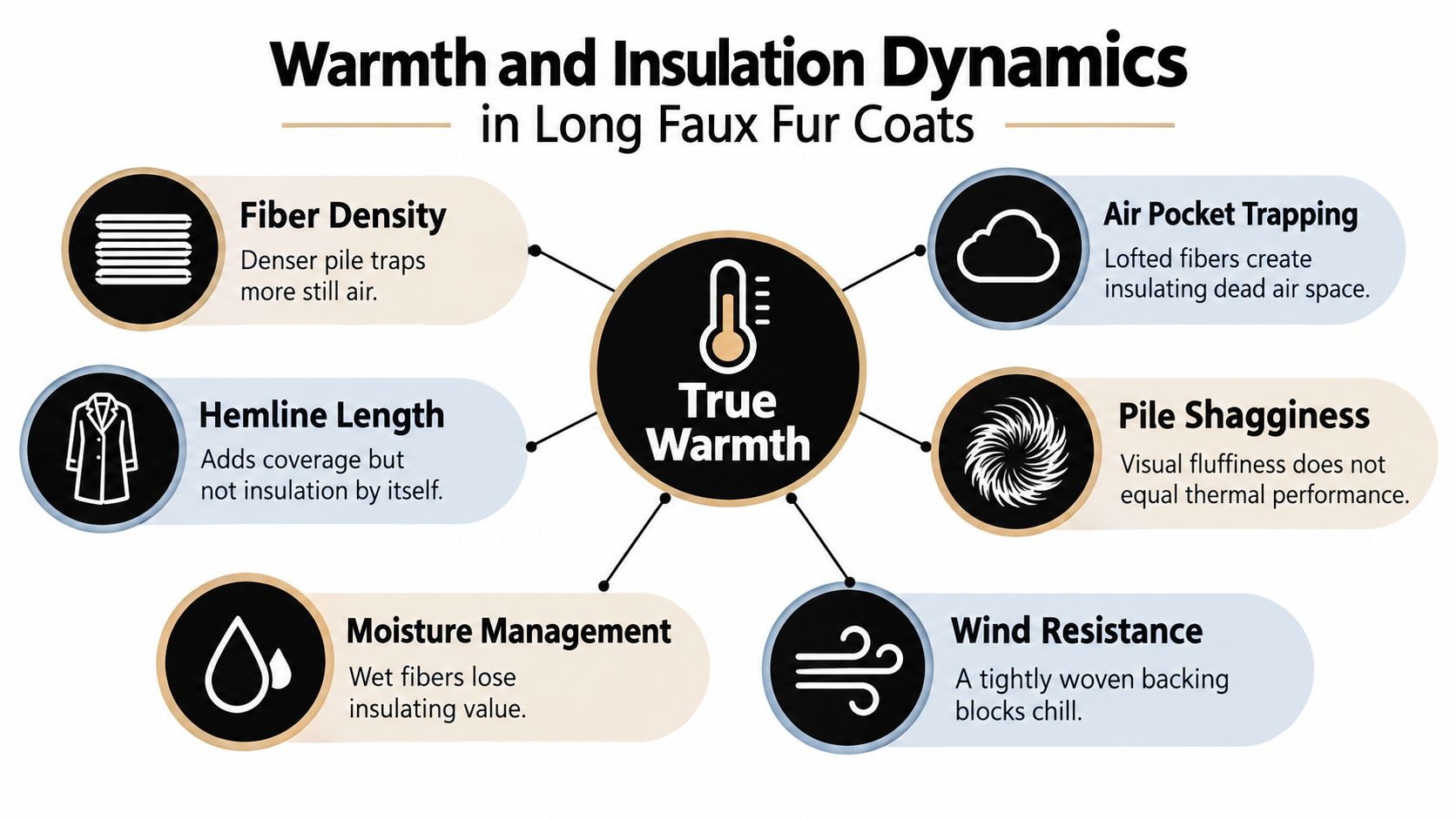
A longer hemline helps with coverage, but it doesn't automatically make a coat warmer. A shaggy surface can look wonderfully plush while offering less insulation than a denser, resilient pile backed by a continuous lining.
NASA textile testing found that, within the tested structures, doubling material density reduced apparent thermal conductivity to approximately half its original value. The study also concluded that lower conductivity resulted from the combination of density and fine fibers, as shown in the NASA textile testing report. Because those tests used controlled textile structures rather than a specific commercial coat, the result is best treated as a design principle, not a guaranteed temperature rating.
What to inspect before you buy
For a cold-climate commuter, evaluate the complete system rather than judging the pile by eye.
- Fiber density: A compact, fine pile can hold still air more effectively than a loose, visually dramatic surface.
- Lining continuity: A smooth, insulating lining should cover the body and sleeves without exposed gaps at seams.
- Wind resistance: The backing should help block drafts instead of allowing moving air to pass easily through the textile.
- Fit over layers: A slightly relaxed pattern preserves room for a sweater and helps avoid compressing the insulating structure.
- Moisture management: Wet fibers can lose insulating value, so the coat needs sensible protection and careful drying.
High-friction areas deserve separate attention. The seat, elbows, underarms, cuffs, and shoulder-bag contact zone can compress the pile during daily use. A beautifully long coat that collapses at those points may still have an intact backing, but it won't retain the same velvety appearance or loft.
Our guidance on acrylic faux fur construction can help you compare the surface, backing, and intended use of different luxury textiles. The practical question isn't “How fluffy does it look?” It's “How will this pile, lining, pattern, and backing behave together during my commute?”
Achieving the Perfect Bespoke Fit and Mobility
A long coat should move when you move. If the shoulder pulls while you reach for a train pole, the sleeves ride up over your gloves, or the hem catches on stairs, the garment has missed its most important job.
Start with a light sweater or the workwear you will wear beneath it. Measure across the shoulders, around the chest or bust, through the upper arm, and from the shoulder point to the wrist bone. Then consider the coat's finished length, closure placement, and ease through the seat.
Measurements that protect comfort
A practical fitting appointment should answer more than whether your usual size closes.
- Shoulders: The seam should sit cleanly at the shoulder bone. Too wide, and the coat loses its drape. Too narrow, and every reaching motion pulls across the back.
- Upper-arm ease: Leave room for a sweater or fitted jacket. A slim sleeve can look elegant but become restrictive when layered.
- Sleeve length: Check the cuff while your arms are relaxed and while reaching forward. Your hands should stay protected without the sleeve swallowing them.
- Hem clearance: Mid-calf can provide generous coverage, but the hem must remain manageable on wet pavement, stairs, and vehicle entry.
- Seat and hip room: Test the coat seated at a desk or in a car. A narrow back panel can strain the closures and flatten the pile.
- Back movement: A vent or slit can preserve a full stride without disturbing the coat's architectural line.
A luxurious fit should feel weightless in motion and substantial in protection.
Bespoke work earns its keep here. At our Seattle studio, we can discuss custom sizing, sleeve adjustments, length changes, and proportion for petite, tall, or hard-to-fit bodies. Our bespoke faux fur coat alterations service reflects a simple principle, your fabric, our expertise.
A coat can be plush without becoming cumbersome. The best pattern gives your arms room to swing, lets the lining glide over clothing, and maintains enough volume for trapped air without creating unnecessary bulk.
Selecting Premium Linings and Luxury Textiles
The exterior gets the attention, but the lining determines how the coat behaves against your clothes. A slippery lining can help the garment pass smoothly over a knit dress or blazer, while a more tactile interior may feel warmer but catch at sleeves and cuffs.
For daily office wear, we favor interiors that combine a soft hand with controlled movement. Velvet-lined details can bring a rich, cocooning sensation to collars, cuffs, or hats, while a smooth full lining helps the coat slide on without disturbing a carefully pressed outfit. The ideal finish feels silky rather than static and plush without becoming sticky.
Comparing textile qualities
Premium faux fur isn't defined by pile length alone. Look closely at the backing, the consistency of the surface, the direction of the nap, and how the textile recovers after being gently compressed. A resilient pile should spring back rather than remain visibly flattened.
Tissavel fabrics are valued for their shimmering surface and architectural presence. They can create a more nuanced visual effect than a uniform plush, especially when the coat's cut allows the nap to catch light across a wide collar or sweeping hem.
| Feature | What to look for | Why it matters |
|---|---|---|
| Pile | Fine, dense, resilient fibers | Supports loft and appearance retention |
| Backing | Stable, even construction | Helps the coat keep its shape |
| Lining | Smooth, continuous finish | Improves layering and mobility |
| Surface | Rich tone and controlled sheen | Gives depth without looking flat |
| Hand-feel | Velvety, silky, substantial | Signals comfort in direct wear |
In the European Union, a long faux fur coat placed on the market must disclose its fibre composition. Regulation (EU) No. 1007/2011 covers textile products containing at least 80% by weight of textile fibres and requires approved fibre terminology with constituent fibres listed by percentage in descending order, according to the European Commission textile rules.
Read that label rather than relying only on phrases such as “luxury textile” or “vegan fur.” Composition won't tell you everything about performance, but it gives you a concrete starting point for comparing pile, lining, and backing.
Styling Your Coat for the PNW Commute and Office
Seattle dressing asks for a delicate balance. You need a weather-resistant outer layer for wet streets, but you also want to enter a meeting with a clean silhouette rather than a mound of technical clothing.

Start with a clean foundation. A fine-gauge sweater, fitted trouser, or column dress gives the coat room to speak. If the outer layer has a wide swing silhouette, keep the pieces underneath visually calm. If the coat is narrow and architectural, a softly draped scarf can introduce movement without adding bulk.
A polished commute formula
- Neutral foundation: Charcoal, cream, black, and deep brown let a rich-toned coat remain the focal point.
- One vibrant note: A jewel-toned scarf, glove, or handbag brings color without competing with the pile.
- Controlled volume: Pair a generous collar with a close-fitting base, or choose a simpler neckline when the coat has a dramatic swing.
- Practical footwear: A substantial boot supports the long hem and handles wet pavement more gracefully than delicate shoes.
- Intentional accessories: Hand-sewn millinery, a plush scarf, or a statement hat can connect the coat to the rest of the wardrobe.
A long silhouette also creates an opportunity for repetition. Match a collar tone to a hat band, echo a coat's contrasting cuff in a handbag, or choose a scarf with a similar sheen. These small decisions make ethical luxury feel composed rather than costume-like.
If you're drawn to a reversible piece with a little more flexibility, Pandemonium's Garland Coat offers a long faux fur profile with a wide swing shape, reversible button closure, patch pockets, and an adjustable contrasting collar and cuffs. For a more expressive winter wardrobe, browse the Fractal Collection, where bold prints and sculptural accessories can add a vibrant counterpoint to a classic outer layer.
The following visual offers another way to think about proportion, movement, and styling a long coat for daily wear.
Care and Storage for Lasting Plushness
A long faux fur coat deserves gentler treatment than an ordinary washable layer. The surface may be durable, but repeated agitation, heat, and moisture can disturb the pile, flatten the drape, and increase fibre release.
A published 2016 study reported that synthetic jackets released an average of 1,174 milligrams of microfibres during washing, as reported in this discussion of real and faux fur sustainability. That figure doesn't mean every coat sheds the same amount. Fibre type, construction, machine design, textile quality, and wash conditions all change the result, but the finding makes care part of the garment's environmental responsibility.
A quieter care routine
- Air first. Hang the coat in a cool, ventilated place after wearing it. Gentle airing often removes everyday odours without disturbing the pile.
- Spot-clean carefully. Use a clean cloth and the method approved on the care label. Avoid scrubbing, which can tangle surface fibers.
- Use professional care when needed. A specialist can assess the pile, lining, closures, and backing before treating the whole garment.
- Wash only if permitted. If the label allows laundering, use the lowest suitable temperature and the gentlest cycle. Don't assume a plush textile belongs in a standard wash.
- Avoid unnecessary tumble drying. Heat and tumbling can encourage matting, distortion, and fibre release.
- Restore the nap gently. Once dry, follow the maker's guidance for light brushing. Never force a brush through a dense or tangled pile.
Our fur coat cleaning guide provides a useful starting point, but the garment's own care label takes priority.
Storage matters
Use a broad, supportive hanger rather than a narrow wire shape. Give the shoulders room, keep the coat away from direct heat and strong sunlight, and avoid compressing it beneath other garments. During the off-season, breathable storage protects the hand-feel better than a tightly sealed plastic covering.
Treat the coat as a long-term wardrobe piece. Regular airing, careful spot treatment, and sensible storage preserve both its tactile pleasure and its structural drape.
Investing in Handmade Seattle Craftsmanship
A long faux fur coat becomes more useful when its maker considers the whole wearing life of the garment. The pile should feel plush, the lining should move over clothing, the hem should suit your commute, and the pattern should accommodate the body rather than fight it.
Small-batch production makes those decisions visible. At our local Seattle studio, hand-sewn construction lets us pay attention to collar shape, closure placement, sleeve proportion, pocket position, and the way a fabric's nap moves across the body. That's the practical difference between a coat selected only by appearance and one developed through fitting, textile knowledge, and repeated wear.
Cruelty-free luxury also benefits from transparency. Compare the declared fibre composition, ask how the pile and backing are constructed, and consider whether custom sizing could make you wear the piece more often. A coat that works for transit, office hours, dinner, and wet winter streets has a stronger place in your wardrobe than one reserved for a single dramatic entrance.
Our 25+ years of design experience under Leigh Young informs a broader approach to Seattle craftsmanship, from hand-sewn faux fur apparel to sculptural accessories and thoughtful millinery. You can read more about that practice in our story of handmade millinery in Seattle.
Join The Crowd for studio news, new small-batch releases, and 15% off your welcome purchase. When you're ready for a coat shaped around your proportions and your winter routine, explore the Garland Coat collection and begin a conversation about custom sizing or our “your fabric, our expertise” service.
At our Seattle studio, Pandemonium creates hand-sewn faux fur apparel, millinery, and accessories for people who want warmth, tactile beauty, and an ethical alternative to animal fur. Visit Pandemonium Millinery to explore small-batch outerwear and discuss a bespoke long faux fur coat made for the way you move through winter.


