



Your large dog is probably half on a bed that is too small right now, one paw on the floor and his chin balanced on an edge that has already collapsed. Bolster beds for large dogs should not work that way. At Pandemonium, we treat that bed as a daily use home textile, measured, built, and finished with the same care we bring to millinery in our Seattle studio.
Why a Large Dog's Bed Deserves Real Thought
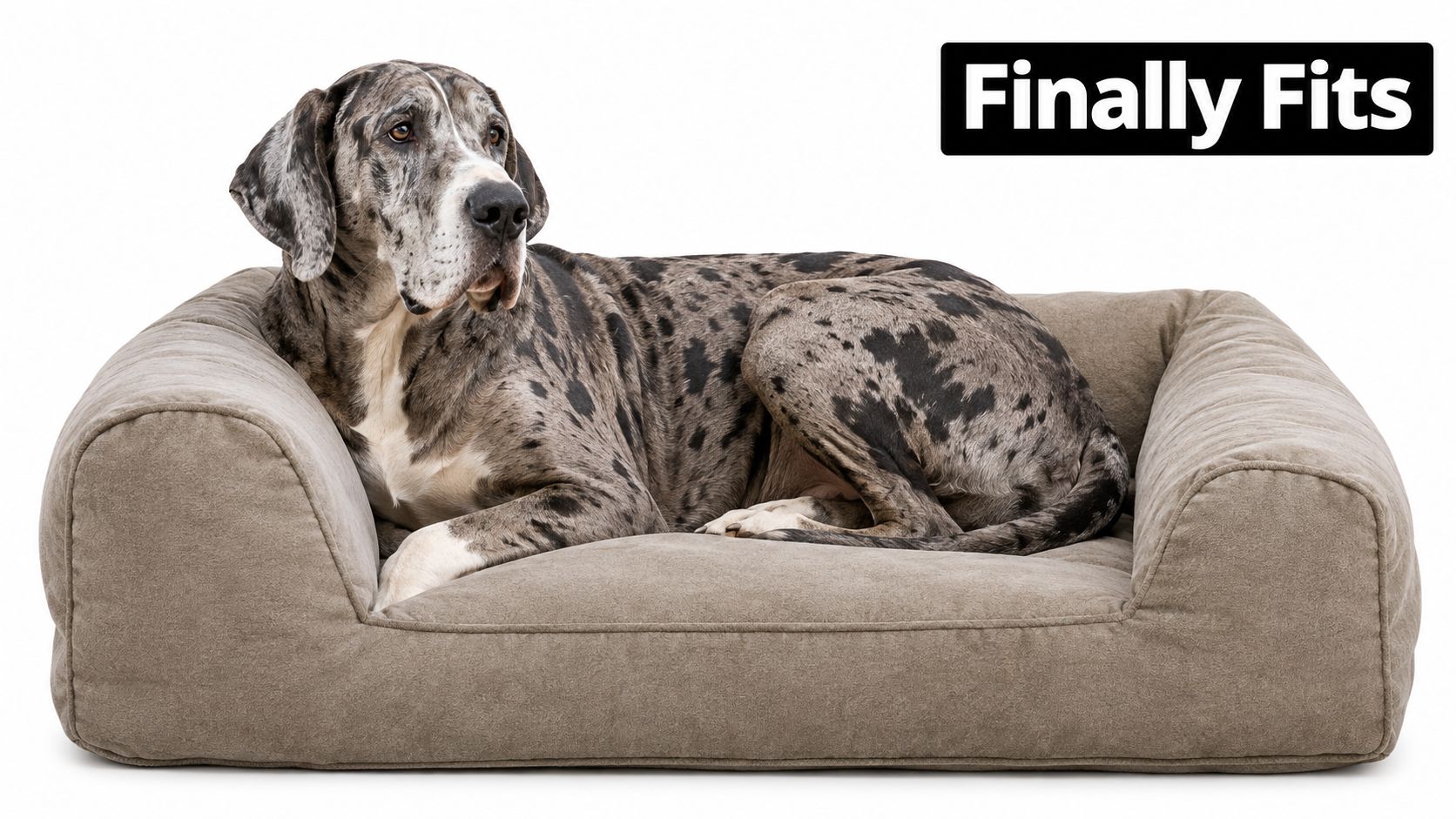
A Great Dane circles twice, sighs, and finally lowers his full weight in one trusting drop. His shoulder finds the bolster. His neck settles. Nothing spills onto the floor.
That moment tells you more than a size chart can. A bed that fits changes how a large dog rests, turns, and rises again. A bed that does not fit becomes an expensive mat he politely ignores.
Rest Is Not a Small Part of His Day
Adult dogs commonly sleep about 12 to 14 hours per day, and some reach 16 hours in a 24 hour period, according to PetMD guidance on how much sleep dogs need. Senior dogs often need more, and large and giant breeds generally appear to sleep more than smaller breeds. You are not choosing an occasional accessory. You are choosing the textile your dog will press his elbows, hips, and spine into for a third to half of his life.
A separate peer reviewed study found companion dogs sleep an average of approximately 10 hours per day, with most sleep between 9 p.m. and 6 a.m., plus afternoon inactivity, as reported in research on companion dog sleep patterns in Scientific Reports. In two hour recordings, dogs moved between wakefulness, drowsiness, non REM sleep, and REM sleep in repeated cycles. That restless pattern is exactly why surface area, stable construction, and a raised edge matter. Your dog will enter, leave, curl, stretch, and reposition all day.
A bolster bed should hold its shape through hundreds of those small arrivals, not just look plush on the day it arrives.
How We See It in Our Studio
Our team at Pandemonium has spent 25+ years under Leigh Young's design direction making velvety hats, scarves, throws, and home pieces in small batches. We know how a pile recovers after compression. We know where a seam fails when weight pulls against it every night.
That is the lens we bring to pet essentials. High-end faux fur is our cruelty-free luxury surface, an ethical alternative that can feel silky and substantial without animal product. A large dog deserves that tactile seriousness, and your room deserves a bed that looks intentional beside your furniture.
Demand alone does not make a product good, but it explains why choice feels overwhelming. The American Pet Products Association reported 68 million U.S. households owned a dog in 2024 and total pet industry expenditures reached $152 billion, figures detailed in APPA's 2025 State of the Industry report announcement. Skip the noise. Start with your dog's body, then judge construction, cleaning, and how the piece lives in your home.
Measure Your Dog Before You Measure the Bed
Don't shop by weight first. A long-backed Great Dane and a broad-chested Rottweiler can share a weight range and need completely different interior dimensions. Measure the dog you live with, in the posture he sleeps in.
The Four Measurements That Matter
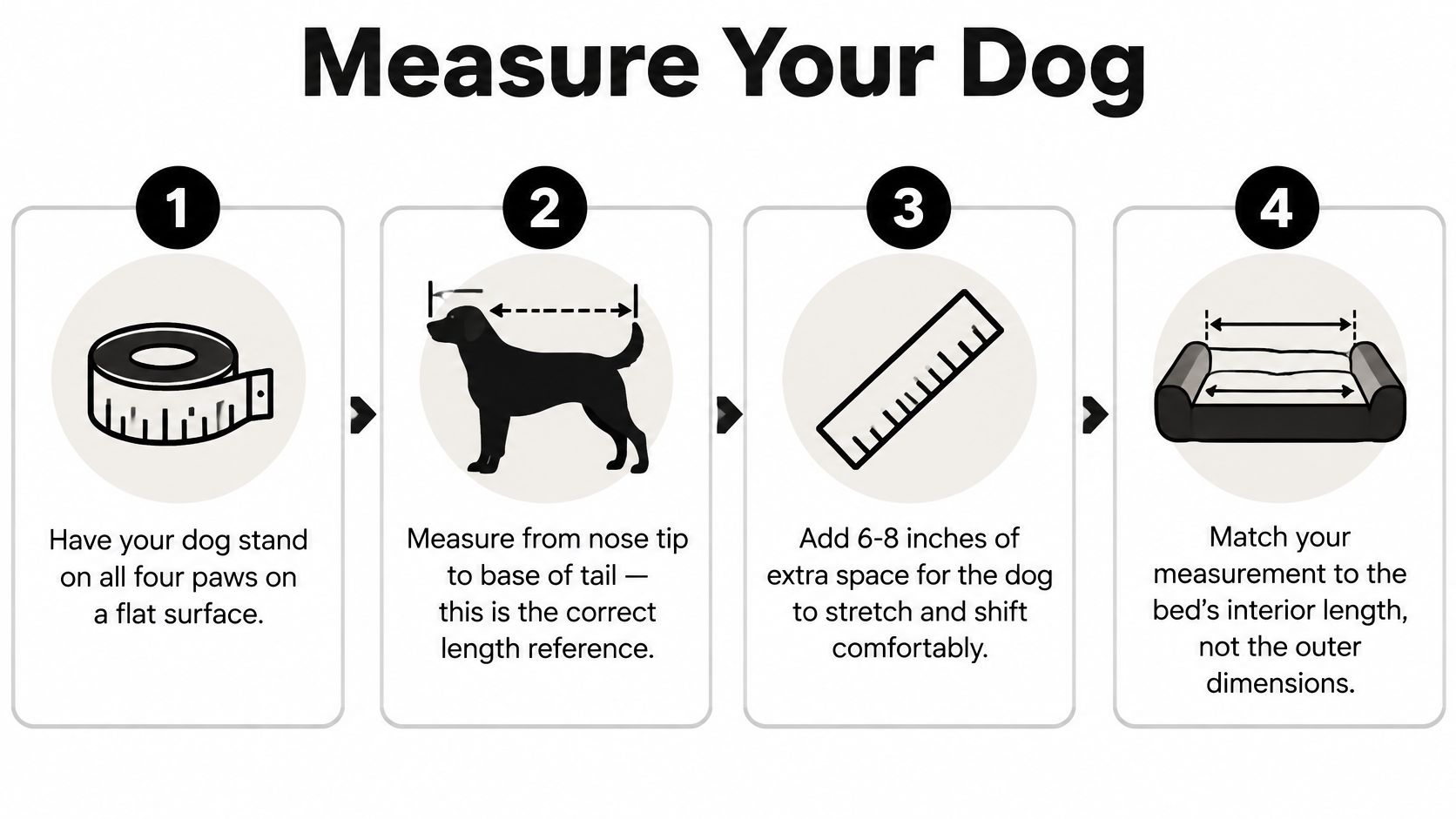
Use a soft tape while your dog stands naturally on all four paws. If you have measured for apparel before, our guide on how to measure a dog for a coat uses the same calm, standing approach.
- Length first: Measure from the tip of the nose to the base of the tail, not the tail tip, following the protocol described in Business Insider guidance on large dog bed sizing. The tail moves and misleads you.
- Width second: Measure across the widest point, usually the shoulders or hips. Broad dogs fail beds on width long before they fail them on length.
- Posture third: Watch one full nap. Does he curl tight, sprawl on his side, or rest his head high on an edge?
- Entry fourth: Note how he steps in and rises. A senior dog needs a lower opening, even if he loves a bolster for leaning.
One sizing guide recommends adding 15 to 30 centimetres to nose to tail base length for minimum internal length, advice set out in Flamingo's dog bed size guide. In inches, our practical rule matches the verified guidance. Add roughly 6 to 8 inches for a curler and 10 to 12 inches for a sprawler.
Practical rule: Buy the interior, not the footprint. Thick bolsters can steal inches you were counting on for stretching.
Interior Space Is the Real Size
Always ask for the usable interior sleeping area. Exterior dimensions flatter the product listing and shortchange your dog. For dogs above 120 lb, a benchmark interior around 52 by 40 inches is a useful starting point, while general large breed bed lengths commonly sit around 42 to 54 inches.
Those are benchmarks, not promises. Lay painter's tape on the floor at the interior size you are considering. Invite your dog to lie inside it fully extended. If his shoulders or hips press where the bolsters would rise, go larger.
When Standard Charts Stop Working
Great Danes, Irish Wolfhounds, mastiffs, and senior stretchers routinely fall between sizes. That is where our bespoke model earns its keep. We offer custom sizing and our your fabric, our expertise service from our Seattle studio, so interior length, bolster height, and textile can be adjusted together. Do not force an unusual frame into a fixed chart. Have the textile made around the dog.
Reading Fill and Fabric Like a Textile Buyer
Softness is the easiest quality to sell and the least useful quality to judge alone. Press your knee into a display bed the way an 85 pound Labrador drops his hip. If you feel the floor, you have your answer, no matter how plush the top feels under your fingers.
Support Is a Load Distribution System
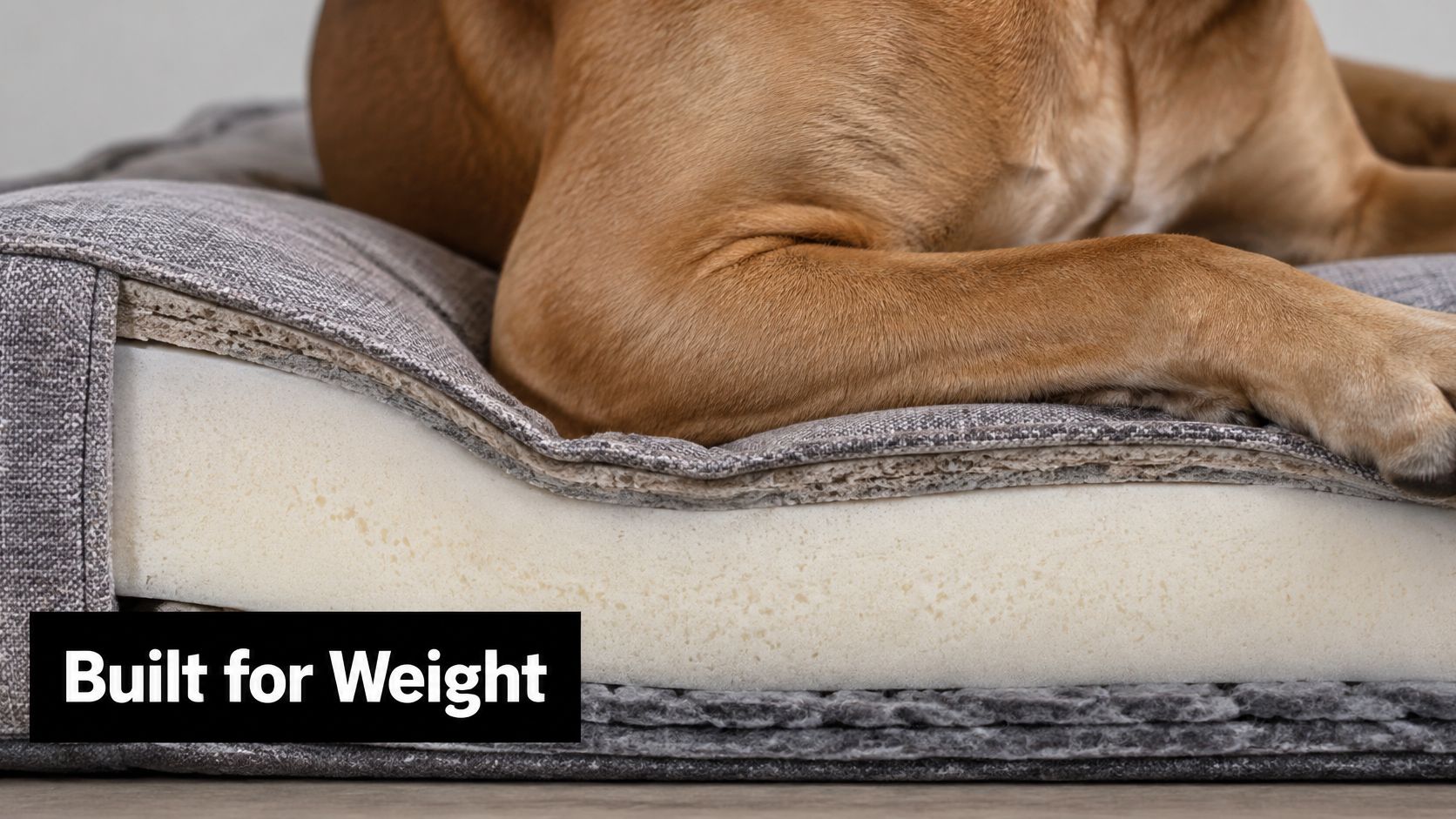
Large dogs concentrate force at the shoulders, elbows, hips, and hocks. A core that compresses completely recreates the hard floor problem under a nicer cover. Look for a multi layer system instead.
- Resilient base: This layer stops bottoming out and gives the bed its architecture.
- Pressure relieving middle: This layer spreads weight so one hip does not carry the whole load.
- Tactile top: A cozy, velvety surface belongs here, after structure is solved.
A University of Pennsylvania pilot study evaluated a 7 inch, three layer therapeutic mattress in 40 large dogs with diagnosed osteoarthritis over 38 nights, and owner reported outcomes indicated significant improvements in pain, stiffness, joint function, gait, and quality of life, as documented in the University of Pennsylvania therapeutic mattress pilot study. Treat that correctly. It was a single center, open label proof of concept study, not proof that every orthopedic bed delivers the same result.
General guidance for large dogs often points to about 5 to 6 inches of orthopedic foam to distribute weight and reduce sinking toward the floor, a recommendation discussed alongside broader bed selection advice in WebMD's guide to dog beds. Thickness without resilience still fails. Ask what each layer does and whether the maker states a weight rating.
The same layered thinking applies elsewhere in the home. If you are comparing support for your own seating while you evaluate your dog's cushion, you can find your perfect down filled cushion through Stahl Home Center and notice how fill choice changes posture and recovery.
Fabric You Can Judge With Your Hands
High-end faux fur and vegan fur are not one generic plush. A quality luxury textile, including Tissavel style weaves, has tighter pile, a substantial backing, and cleaner recovery after you brush it against the grain. Run your palm across it twice. It should feel silky, then spring back without showing a thin base.
Check four details before you buy.
- Pile density: Part the fibers. You should not see backing easily.
- Backing weight: A flimsy backing stretches at the seams under a large dog's turning weight.
- Seam finishing: Seams should lie flat, especially where the bolster meets the sleeping platform.
- Zipper quality: The zipper must open wide enough for real cleaning and close without catching pile.
Our studio notes on choosing faux fur that resists pet hair go deeper on pile behavior. In short, don't buy shag for its photograph. Buy pile that releases hair, holds loft, and still feels cozy after repeated washing.
Handmade, Mass-Produced, or Flat Orthopedic
There is no single right category. There is a right category for your dog's mobility, your cleaning tolerance, and how visible this very large object will be in your home. Be honest about all three.
Recent survey data reported 14% of dogs with moderate medical needs and another 15% with somewhat or highly complex needs, figures presented in the Dogs Trust National Dog Survey 2025 report. That is a substantial share of households for whom entry height and support are not minor preferences.
Bolster Bed Construction Options Compared
| Criteria | Handmade Bolster | Mass-Produced Bolster | Flat Orthopedic |
|---|---|---|---|
| Construction | Hand sewn, small batch, inspected piece by piece | Consistent, but seams and fill vary by production run | Simplest structure, focus stays on the core |
| Customization | Interior size, bolster height, and textile can be tailored | Fixed sizes and colors | Usually fixed sizes, sometimes more thickness options |
| Bolster benefit | Defined edge for leaning and head resting | Present, but may collapse under repeated leaning | No edge, maximum open sprawl |
| Entry | Can be made with a lower front opening | Often one standard height all around | Easiest step on access for stiff dogs |
| Washability | Strongest when covers and bolsters separate by design | Removable covers are common, inserts vary | Easiest to strip and launder |
| Fit in the room | Can echo your throws and upholstery palette | Predictable, rarely bespoke | Clean and architectural, less nest like |
Our Clear Recommendation
Choose a handmade bolster when your dog leans, curls against an edge, or rests his chin up high, and when you want the bed to belong in the room. Our own background in handcrafted accessories made in small batches is why we trust this route. Hands catch a twisted seam. Hands feel a thin patch of pile.
Choose a flat orthopedic when entry is the priority. A dog recovering from surgery, living with hip dysplasia, or struggling to rise should not have to negotiate a high wall to reach support. A bolster that comforts a healthy three year old can frustrate a twelve year old with arthritis.
If your dog hesitates at the edge, pants while repositioning, or cannot rise without sliding, lower the entry and call your veterinarian. Bedding supports care, it does not replace it.
Mass produced bolster beds sit in the middle. They can be a reasonable first bed for a young, average sized large dog. They rarely solve the unusual fit, fabric matching, or replaceable parts problem. If you are buying for a giant frame or a dog you expect to age in this bed, bespoke construction is the stronger long term decision.
Cleaning a Bed the Size of a Small Person
Nobody warns you about wrestling a damp bolster the size of a toddler into a hallway. We will. Washability is not a checkbox on a listing. For a large dog bed, it is a weekly physical task that has to work in your actual laundry space.
A Care Protocol for Oversized Bolster Beds
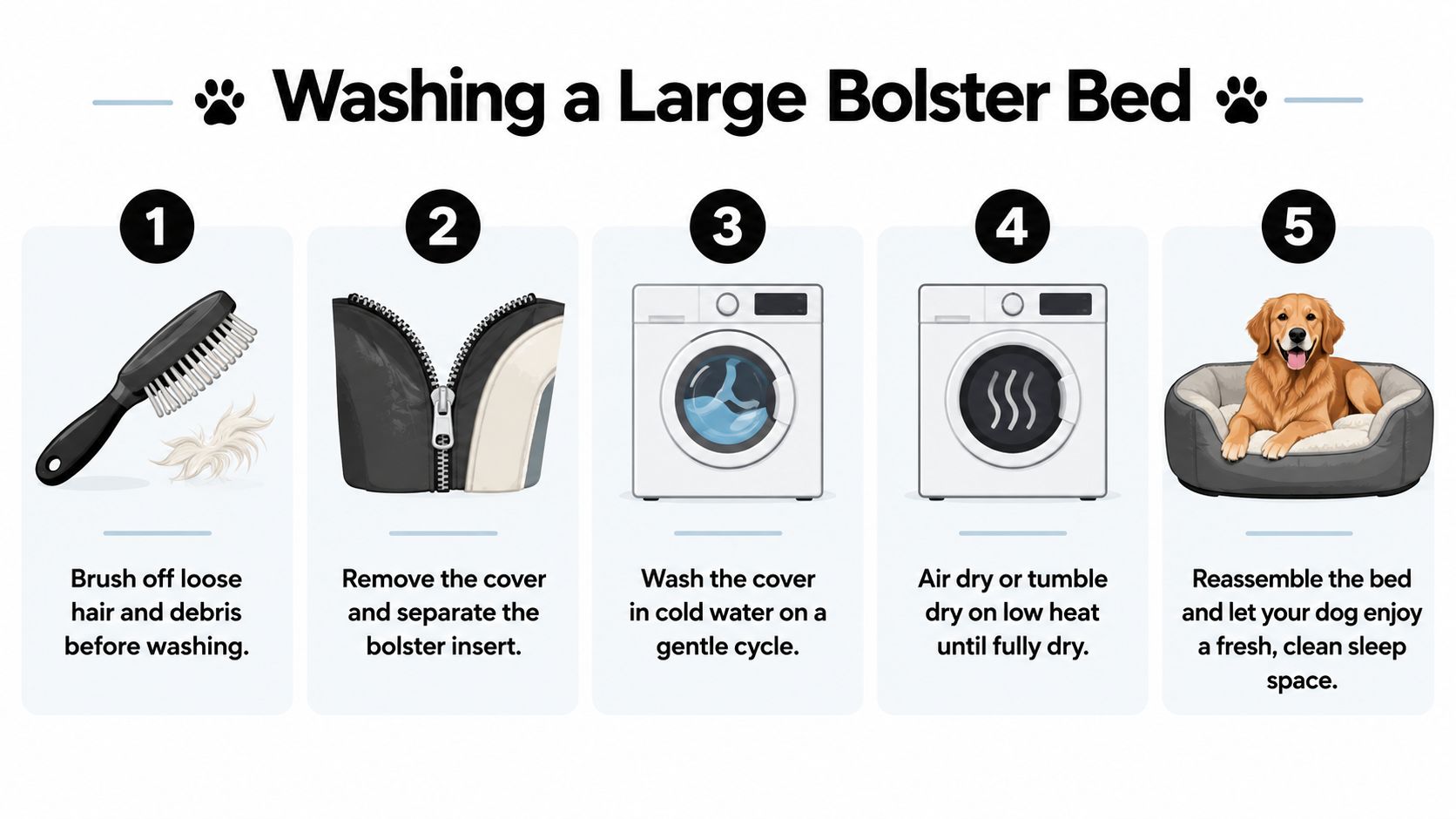
The CDC recommends cleaning pet beds, blankets, and habitats weekly, and veterinary guidance summarized in PetMD's guide to washing a dog bed notes frequency should increase for heavy shedders, outdoor dogs, and allergy households. Build a routine you can repeat without dread.
- Brush before washing: Lift loose hair and debris from seams and bolster creases first. Washing hair into wet pile makes cleanup harder.
- Separate every part: Remove the cover from the sleeping platform and from the bolster walls if the design allows it. Wash components according to their own labels.
- Confirm temperature: Use the maximum safe wash temperature stated by the maker, not your guess. Heat can damage backing and distort fit.
- Submerge with caution: Fully submerge an insert only when the label allows it. Many thick cores should be spot cleaned and aired instead.
- Dry to the center: Press deep into the thickest bolster section. If it feels cool or damp inside, it is not ready to reassemble.
- Use commercial machines when needed: A bed that fills your home washer cannot move freely or rinse clean. A laundromat is not failure, it is correct scale.
Plush Is Not Automatically Hygienic
Here is our contrarian view from years of handling textiles. A long, lush surface can trap hair, dander, moisture, and outdoor debris deep in the pile. Cozy and clean can pull in opposite directions if the pile is chosen only for looks.
That is why we pair beds with washable layers a dog can claim daily. Our notes on luxury faux fur dog blankets explain how a removable top layer catches much of the shedding before it reaches the bed structure. Wash the blanket often. Deep clean the bolster on schedule. Your routine stays manageable.
Studio standard: If you cannot separate it, wash it, and dry it fully, you do not yet have a long term bed. You have a short term cushion.
Favor a maker who documents care clearly and offers replaceable covers. A repairable system with a fresh cover in year three beats discarding a whole bed because one bolster seam split or one insert never dried properly. Ethical luxury should last through real muddy Tuesdays, not just photograph beautifully on delivery day.
Matching the Bed to the Room
A large dog bed is often the biggest textile on your floor. Pretending it will disappear is a mistake. Design it into the room the way you would place an ottoman, a substantial throw, or a low bench.
Color and Texture That Belong Together
Start with what already anchors the space. A rich toned faux fur bolster can echo a throw across the sofa, deepen a leather chair, or soften hard flooring under a reading nook. You are matching mood and texture, not hunting for an identical dye lot.
- Warm living rooms: Choose warm neutrals and honeyed browns that sit comfortably with wood, wool, and afternoon light.
- Modern spaces: Choose deep charcoal or clean ivory with a tighter, more architectural pile. Let silhouette do the work.
- Layered hygge rooms: Mix a plush bolster with cable knits and velvet nearby. The bed becomes part of the soft setting, not an apology in the corner.
Our perspective on creating cozy bedroom decor with layered textiles applies directly here. Rooms feel finished when textures talk to each other. A shimmering, velvety bolster beside a flat, tired cushion looks accidental. The same bolster beside a weightless throw in a related tone looks chosen.
Silhouette Matters as Much as Shade
In millinery, we shape a hat to flatter a face. In a room, bolster height and proportion flatter furniture scale. A low sofa wants a lower, cleaner bolster line. A tall upholstered bed can carry a more substantial raised back.
Bespoke sizing changes the result. We can adjust the footprint to a bay window, a fireplace hearth, or the exact stretch of wall your dog already claims at night. Cruelty-free luxury means you get the look and touch of a high-end faux fur surface as an ethical alternative, cut and hand sewn for that place in your home.
Don't hide the bed behind a door if your dog wants to sleep near you. Place a beautiful one where he already chooses to be. He will use it more, and you will enjoy looking at it every day.
Your Shortlist and Next Steps
You now have a decision sequence, not a pile of product claims. Work through it in order and stop second guessing each step once it is answered.
The Five Point Shortlist
- Interior confirmed: Your dog's nose to tail base length and shoulder or hip width fit inside the bolsters with posture based clearance.
- Core documented: The maker explains the support layers and total depth, and the bed does not bottom out under firm hand or knee pressure.
- Entry tested: Bolster height suits your dog's age, joints, and ability to rise without sliding or hesitation.
- Cleaning mapped: The cover separates, care temperatures are documented, and you know exactly how you will dry the thickest section.
- Room matched: Color, pile, and silhouette work with the furniture your dog sleeps beside, so the bed stays where he wants to be.
Wayfair sizing guidance likewise advises measuring while the dog stands, adding 6 to 12 inches to length and width, and choosing somewhat larger for older dogs with joint issues, as outlined in Wayfair's dog bed size guide. Use that as a final cross check, then trust your tape outline on the floor.
Bolster Beds for Large Dogs Made Around Your Dog
If your dog falls outside standard sizing, or your room calls for a specific textile, talk with our Seattle team about custom sizing and your fabric, our expertise. We hand sew in small batches, drawing on Leigh Young's 25+ years of design experience, so a bolster bed can be made as a bespoke home textile rather than picked from a fixed chart.
Join The Crowd, our email list, for 15% off your first order and studio notes on new textiles and seasonal pieces. When you are ready to buy, explore our pet beds and blankets alongside our home textiles and choose the palette that belongs in your room. Start with your dog's measurements in hand, not a guess at checkout.
We believe a large dog should settle into a bed that feels plush, substantial, and unmistakably his. Make it well once, care for it properly, and it will hold his weight and your room together for years.
At Pandemonium Millinery, our Seattle studio hand sews small batch faux fur hats, apparel, home textiles, and pet essentials, including bolster beds shaped around your dog's measurements and your room. Visit Pandemonium Millinery to explore our cruelty-free luxury collections, ask about custom sizing, and bring home a bed made with Leigh Young's 25+ years of craftsmanship behind every seam.


