



You've found a fedora with the right silhouette, but the fit falls apart the moment you put it on. The temples pinch, the crown flattens your hair, or the whole hat shifts when you turn toward the wind. Bespoke fedora hats should solve those problems, not replace a standard size label with a custom one.
At our Seattle bench, we start with the person beneath the hat: your head shape, your usual hairstyle, and the weather between your front door and your destination. Our recommendation is straightforward. Choose the fit and fabric for your actual life, then refine the silhouette.
Why Off-the-Rack Fedoras Almost Never Fit Right
You try the smaller hat first. It stays put, but you can feel pressure across your forehead. The next size feels comfortable until you look down and it slides toward your eyes.
That doesn't necessarily mean your head falls awkwardly between sizes. It can mean the hat's opening is the wrong shape. A specialist hat-fitting guide describes how bespoke makers may use a conformateur to record head shape, rather than relying on circumference alone.
This familiar shopping scene captures the frustration.

What Bespoke Fedora Hats Should Solve
Treat these as different problems, not interchangeable reasons to order a larger hat:
- Pressure at the temples: Ask whether the opening needs a different shape before adding circumference.
- A crushed hairstyle: Discuss interior crown clearance and where you want the hat to sit.
- Movement outdoors: Describe when the hat shifts, especially whether it happens while walking, looking down, or facing wind.
- An awkward silhouette: Separate visual proportions from physical fit. A comfortable hat can still have the wrong crown height for your taste.
Our fitting rule: Don't accept pressure as the price of security, and don't accept slipping as the price of comfort.
Customization Should Have a Purpose
Historical summaries put U.S. hat consumption at more than 35 million hats annually at its late-1940s peak, followed by a decline of over 80% by 1970. Those figures cover hats broadly, not fedoras alone, as the history of the fedora and American hat market makes clear.
Our view is that bespoke work earns its place by addressing what standardized sizing leaves unresolved. That means useful adjustments, not ornament for ornament's sake.
In our small-batch Seattle studio, custom sizing and “your fabric, our expertise” services begin with those practical questions. We want a cruelty-free luxury textile to feel considered on your head, not merely beautiful on the shelf.
Measuring Your Head for a True Custom Fit
Measure your head, not a hat you already own. An existing hat may have stretched, shrunk, or always fitted poorly.
Use the illustration to orient yourself before taking the readings.
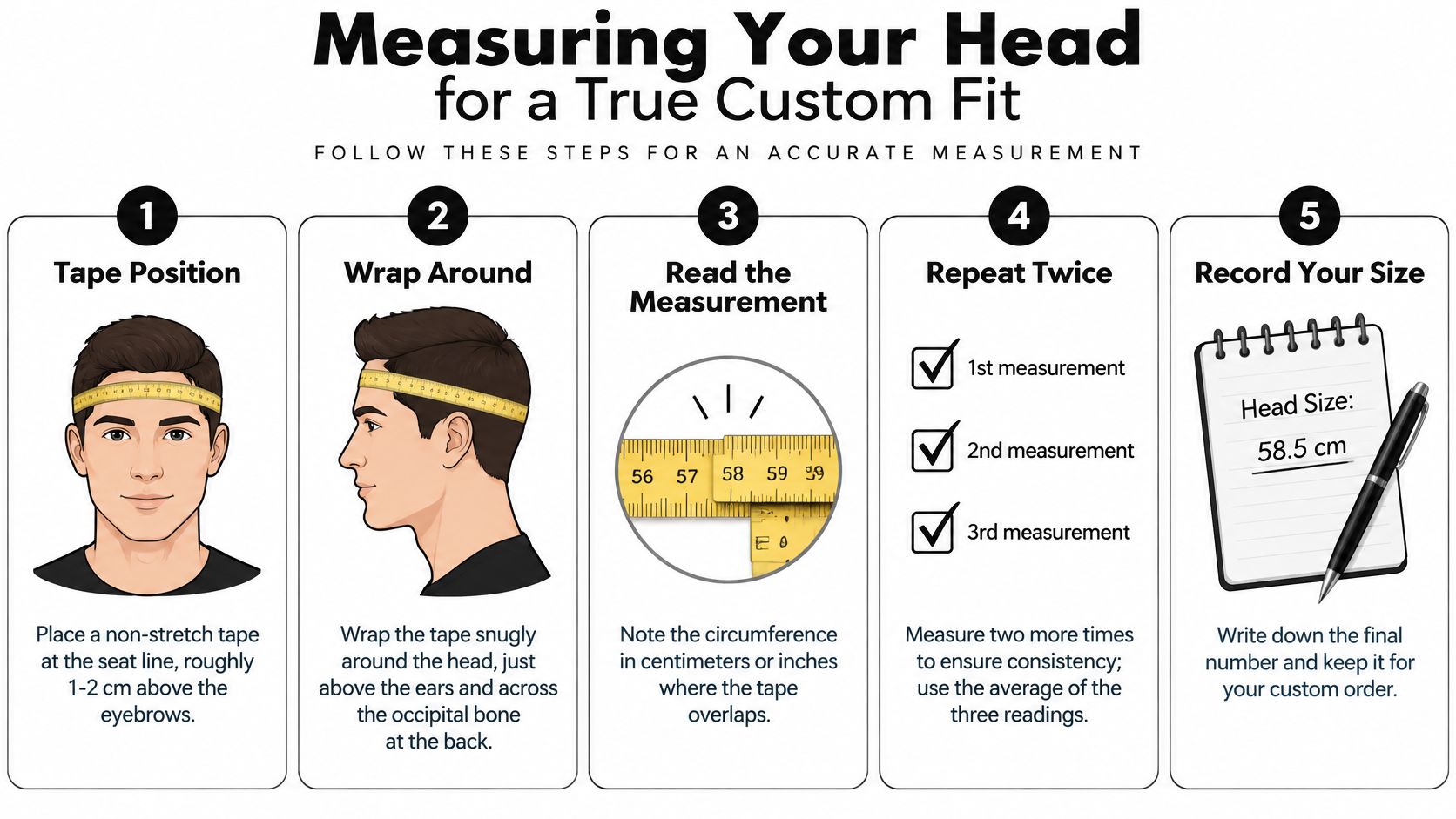
Find the Seat Line First
Use a non-stretch tape at the intended wearing position, approximately 1–2 cm above your eyebrows, above your ears, and around the fullest rear point of your head. Take three readings, keeping the tape snug without compressing your skin, following this millinery measuring reference.
- Position the tape: Keep it at the same height all the way around. A mirror or helper makes this easier.
- Release and repeat: Remove the tape between readings so you're checking the measurement rather than preserving a mistake.
- Keep the raw results: Record every reading and identify the median or repeatable result. Don't hide disagreement between readings inside an average.
- Note the wearing angle: Tell us whether you prefer the brim level, tipped back, or slightly angled.
If the readings disagree noticeably, measure again. Repeatability matters more than forcing a tidy size label.
For familiar reference points, 55 cm is approximately US 6 ⅞, 58 cm is US 7 ¼, and 61 cm is US 7 ⅝, using the same sizing reference above. These conversions help translate labels; they don't describe head shape.
Measure Above the Opening, Too
Crown depth is a separate measurement. Run the tape from the top of one ear, over the highest point of your head, to the top of the other ear, as described in this custom millinery measurement guide.
Wear your hair as you expect to wear it beneath the finished hat. Record whether that means a smooth style, natural volume, braids, or an updo, and flag any sensitive areas.
For a moving demonstration, use this measurement video alongside your written notes.
Follow our hat-size measuring guide before sending your measurements. The common mistakes are simple: pulling too tightly, changing the tape's height, or trusting a single reading.
For another activity-focused perspective, Tattoo Golf's guide to what to look for in a golf hat offers a useful companion topic: considering fit alongside how you'll use the hat.
Choosing the Right Felt and Lining for Your Climate
Choose the material category before choosing the color. Traditional felt, plush faux fur, and velvet aren't interchangeable because each can appear in millinery.
We recommend cruelty-free textiles, but we won't call every alternative a felt or promise that every plush fabric will hold an architectural fedora crease. If you love Tissavel, discuss the particular textile's suitability for a trim, panel, or proposed silhouette rather than assuming it behaves like blocked felt.
Felt and Lining Options at a Glance
These are purchasing checks, not universal performance ratings. Ask for the actual fabric specification and care instructions.
| Material | Weight and Drape | Weather Behavior | Care Notes | Ethics |
|---|---|---|---|---|
| Merino wool felt | Assess the finished felt body, not fiber name alone | Request the finish specification | Follow felt-specific instructions | Animal-derived |
| Rabbit felt | Examine stiffness and recovery in a sample | Don't assume waterproof performance | Confirm reshaping requirements | Animal-derived, not our cruelty-free recommendation |
| High-end faux fur or vegan fur | Choose the pile and backing for the intended use | Confirm suitability for damp wear | Follow the exact textile's instructions | An ethical alternative to animal fur |
| Silk or cotton lining | Compare a silky surface with a less slippery hand | Ask about moisture management | Confirm whether cleaning is localized or professional | Check fiber composition |
| Velvet lining | Consider its plush feel and interior bulk | Don't infer weather resistance from texture | Check pile-care requirements | Verify composition |
| Cashmere-blend lining | Request the complete blend | Evaluate the finished construction | Confirm specialist-care needs | Contains animal fiber |
Technical references report Merino wool fibers at roughly 19.5–21.5 microns, with reported linear shrinkage of about 35–40% for wool versus 28–32% for rabbit felt. These felt and fedora material references are process-specific, not guarantees for every finished hat.
Our practical conclusion is to test the actual material before committing to a shape. A maker should validate steam response, allowances, and shape retention rather than treating a nominal block size as the finished fit.
Don't Let the Lining Become an Afterthought
Ask to feel the lining against your forehead, not just between your fingers. A velvety interior may be exactly what you want for a cozy commute, but its bulk must be included in the fit.
A plush lining should be part of the original specification, not an extra layer squeezed into an already-fitted crown.
Use our cold-weather hat guide to frame the warmth conversation. Then ask which fabric, lining, and care routine suit your particular route.
Customizing Crown Shape, Brim, and Trims
The fedora has always allowed interpretation. The hat associated with the original 1882 Fédora featured soft felt, a relatively tall tapered crown, a deep center crease, and sometimes a front pinch, according to this history of the original Fédora hat.
That's a useful starting vocabulary, not a rulebook for your face. We'd rather hear that you want a restrained office hat than insist you memorize crease terminology.
Use this comparison to identify the choices you want to discuss.
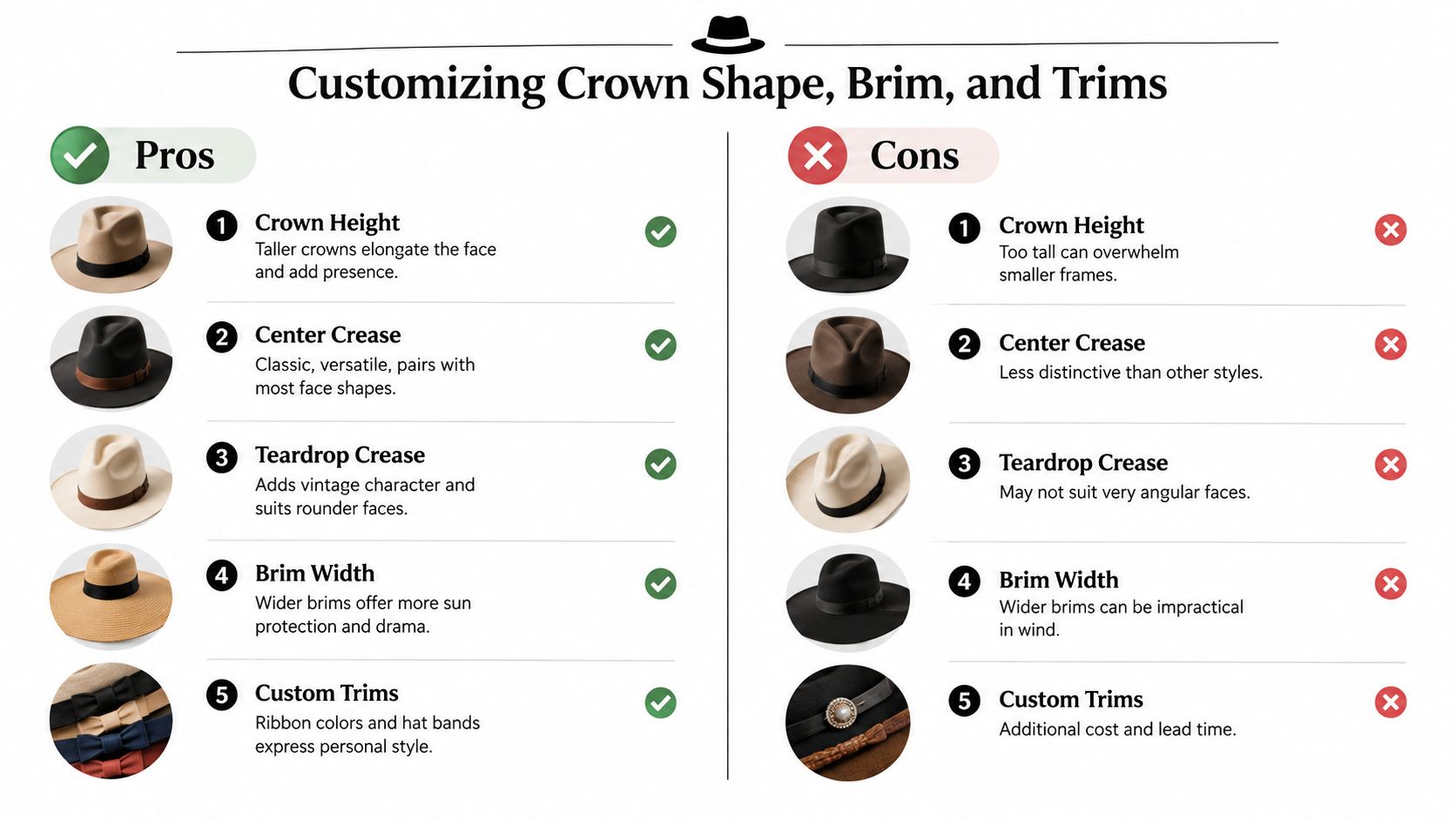
Choose the Outline Before the Decoration
Start with a front and side view. We recommend deciding how much visual presence you want before choosing ribbons, bindings, or bands.
- Crown height and taper: Specify whether you want an upright, architectural outline or something quieter. Ask how the proposed shaping affects usable interior space.
- Crease: Compare center, teardrop, and diamond options in the actual material. Don't select a crease solely because a face-shape chart approves it.
- Brim treatment: Consider snap, curl, or flat treatments as different visual directions. Ask which the selected construction can support.
- Sweatband: Confirm its material, finish, and adjustment options before the order is finalized.
A photograph of a hat you like is useful, but explain what you like about it. It may be the rich-toned ribbon rather than the crown, or the crisp brim rather than the overall scale.
Give the Trim a Clear Job
For a polished office look, we favor a restrained band that doesn't compete with your coat collar. For a more expressive piece, a cruelty-free faux fur accent can introduce texture without requiring an animal-fur trim.
Explore our custom hat-band guidance and send a color reference with your inquiry. Ask whether the trim is removable, how it should be cleaned, and whether your preferred fabric needs backing.
Keep your fabric, our expertise practical: tell us about sentimental cloth, directional prints, or a particular motif before cutting is discussed. Material suitability comes before a promise to reproduce a reference image exactly.
Matching Your Fedora to How You Actually Wear It
Don't buy a fedora on the premise that most body heat escapes through your head. A review of head heat-loss evidence reports that the head represents approximately 7% of body surface and roughly 10% of total heat output when a person isn't shivering.
Head covering can improve comfort, but that doesn't make a fashion fedora a complete cold-weather system. We judge the whole outfit, including what remains exposed.
Use this climate guide as a conversation starter, not a substitute for the finished hat's specifications.
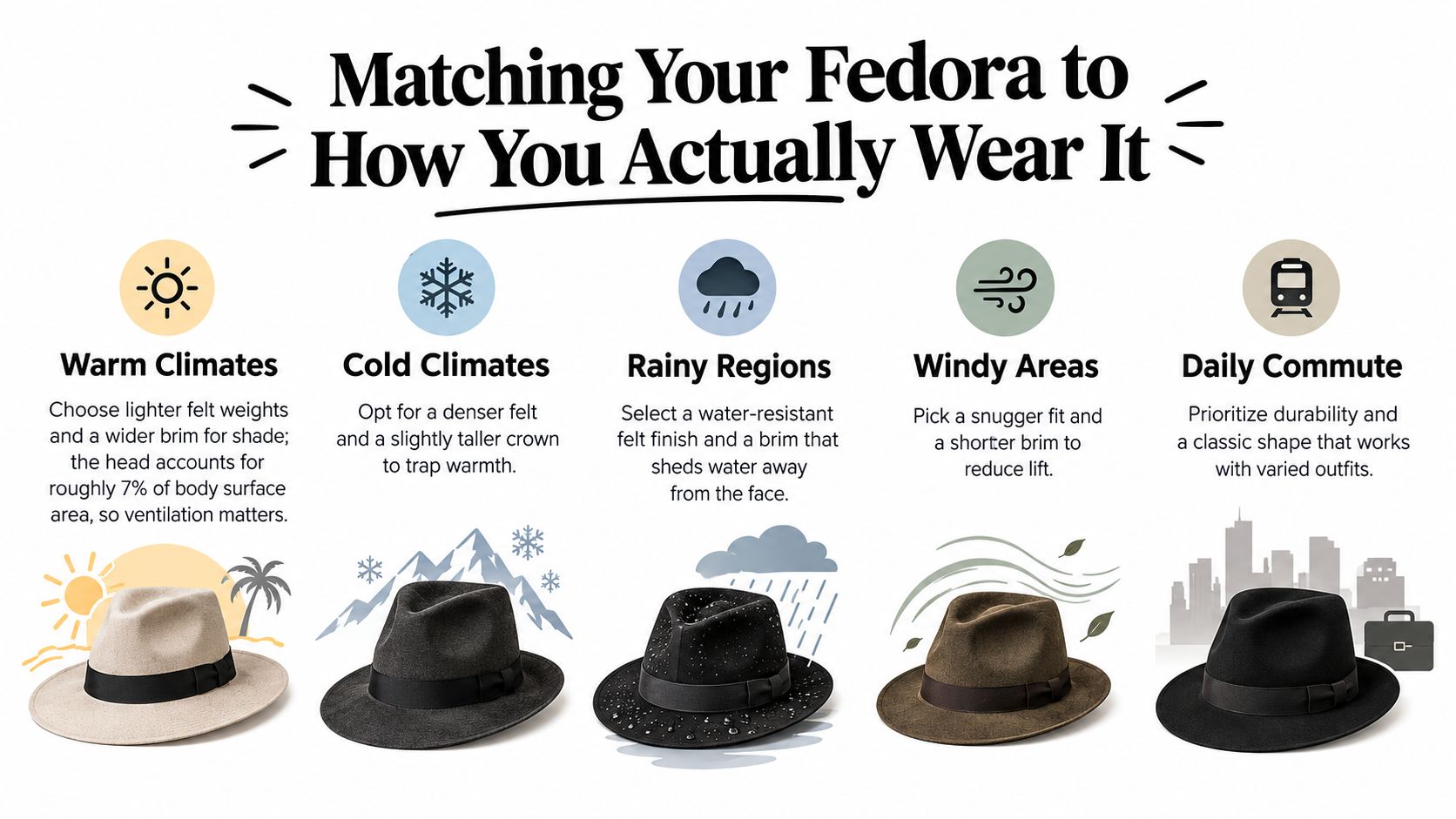
Match the Specification to the Route
| Your Routine | Our Recommendation | What to Confirm |
|---|---|---|
| Seattle transit commute | Prioritize manageable brim coverage and a documented weather-resistant finish | Damp-care instructions and security in exposed conditions |
| Chicago or New York winter commute | Plan the fedora alongside an ear-covering layer and suitable outerwear | Whether the complete outfit protects exposed areas |
| Milder-climate dress wear | Favor an interior that doesn't feel unnecessarily enclosed | Lining comfort during indoor transitions |
For damp Pacific Northwest wear, ask how the brim directs runoff and how you should handle the hat after rain. Weather-resistant is not waterproof, and a beautiful surface finish isn't a reason to ignore the care label.
For severe continental cold, we recommend accepting the limits of the silhouette. If your ears are exposed and uncomfortable, add appropriate coverage or choose another hat for that journey.
Test the Commute, Not Just the Mirror
A wider brim may offer useful coverage, but we'd discuss wind exposure before recommending it for an open platform or waterfront walk. A taller crown isn't automatically warmer, either; don't use height as a substitute for evaluating the complete construction.
Dress for the least comfortable part of your route, not just the sheltered walk from your door.
For proportion and styling, consult our guide to pairing hats with faces. Use it to refine your preferences, not to override what feels comfortable or what your commute demands.
What to Send Us for a Remote Bespoke Order
A useful remote brief lets us assess your request without guessing. Send clear information before deciding that a particular silhouette, textile, or deadline is settled.
Founder Leigh Young has led our Seattle studio since 1992, giving us more than 25 years of design experience, as documented in our studio history. We bring that experience to the conversation, but accurate customer information still matters.
Prepare a Visual and Written Brief
- Photographs: Include front, side, and top-of-head views, plus your usual hairstyle. Keep the camera level where possible and avoid filters.
- Measurement record: Send the raw readings, crown depth, intended seat line, and notes about previous pressure points.
- Wear preferences: Tell us whether you dislike forehead contact, need room for hair volume, or prefer a particularly secure feel.
- Daily context: Describe your commute, dress code, storage space, and how often you expect to carry the hat rather than wear it.
- Fabric direction: Include color references and explain whether you're requesting studio fabric or proposing your own material.
For a detailed fabric or trim proposal, a structured visual document can help. Genpire's tool to make a tech pack online is an optional way to organize images and specifications, not a requirement for contacting us.
Confirm the Order Before Checkout
Ask about swatches, construction feasibility, current lead time, and what adjustments are possible after delivery. For an event or gift, provide the actual date and wait for confirmation rather than assuming a turnaround.
Read about our handmade Seattle millinery before sending your brief. Include the Olivia Fedora as a reference if that's the direction you're considering, while leaving room to discuss which fabric and modifications are suitable.
The most useful final step is a written summary everyone can check. Confirm the selected textile, fit specification, trim, care expectations, and agreed scope before work begins.
Caring for Your Fedora So It Lasts a Decade
You come home after a wet journey, put the hat near the radiator, and forget about it. We'd stop you at the radiator: gentle handling beats forced drying, and the exact textile's care instructions take priority.
A decade is a worthwhile care ambition, not a lifespan we can guarantee. How you store, clean, and repair the finished hat matters more than treating it as indestructible.
Give the Shape Somewhere Safe to Rest
Store the hat on suitable support or in a structured hat box, without forcing the brim against other objects. Don't leave a carefully shaped crown compressed beneath a winter coat.
- For felt: Use an appropriate soft brush gently in a consistent direction, subject to the maker's instructions.
- For faux fur trim: Follow the pile-specific care directions rather than applying felt-cleaning advice.
- After light rain: Let the hat dry naturally on suitable support, away from direct heat.
- After soaking or crushing: Contact the maker before attempting aggressive reshaping.
A warped brim, a crown crease that won't recover, or a sweatband that no longer feels secure deserves assessment. Don't compensate with improvised padding or strong steam before checking whether the problem involves the body, band, or construction.
Repair Without Overpromising
We recommend asking about refurbishment before replacing a piece you still enjoy. Steam can be a forming tool in skilled hands, but it isn't a universal home remedy for every luxury textile, lining, or trim.
The ethical material conversation also needs precision. A summary of CE Delft's mink-fur and faux-fur life-cycle assessment reports approximately ten times the climate-change impact per kilogram for mink fur compared with faux fur in the scenarios studied.
That comparison supports considering high-end faux fur as an ethical alternative to animal fur. It doesn't establish the footprint of a particular fedora, and it doesn't remove the need for thoughtful maintenance.
We'd rather help you choose a material you'll care for than encourage a purchase based on texture alone. Keep the care instructions with your order details, and ask before experimenting.
We offer custom sizing and “your fabric, our expertise” services through our small-batch Seattle studio, helping you discuss a fedora around your head shape, hairstyle, and daily conditions. Visit Pandemonium Millinery to explore our Olivia Fedora options and The Fractal Collection, or start a custom-order conversation with your measurements and fabric references. Join The Crowd for 15% off, and let's make your next hat a considered choice.


