


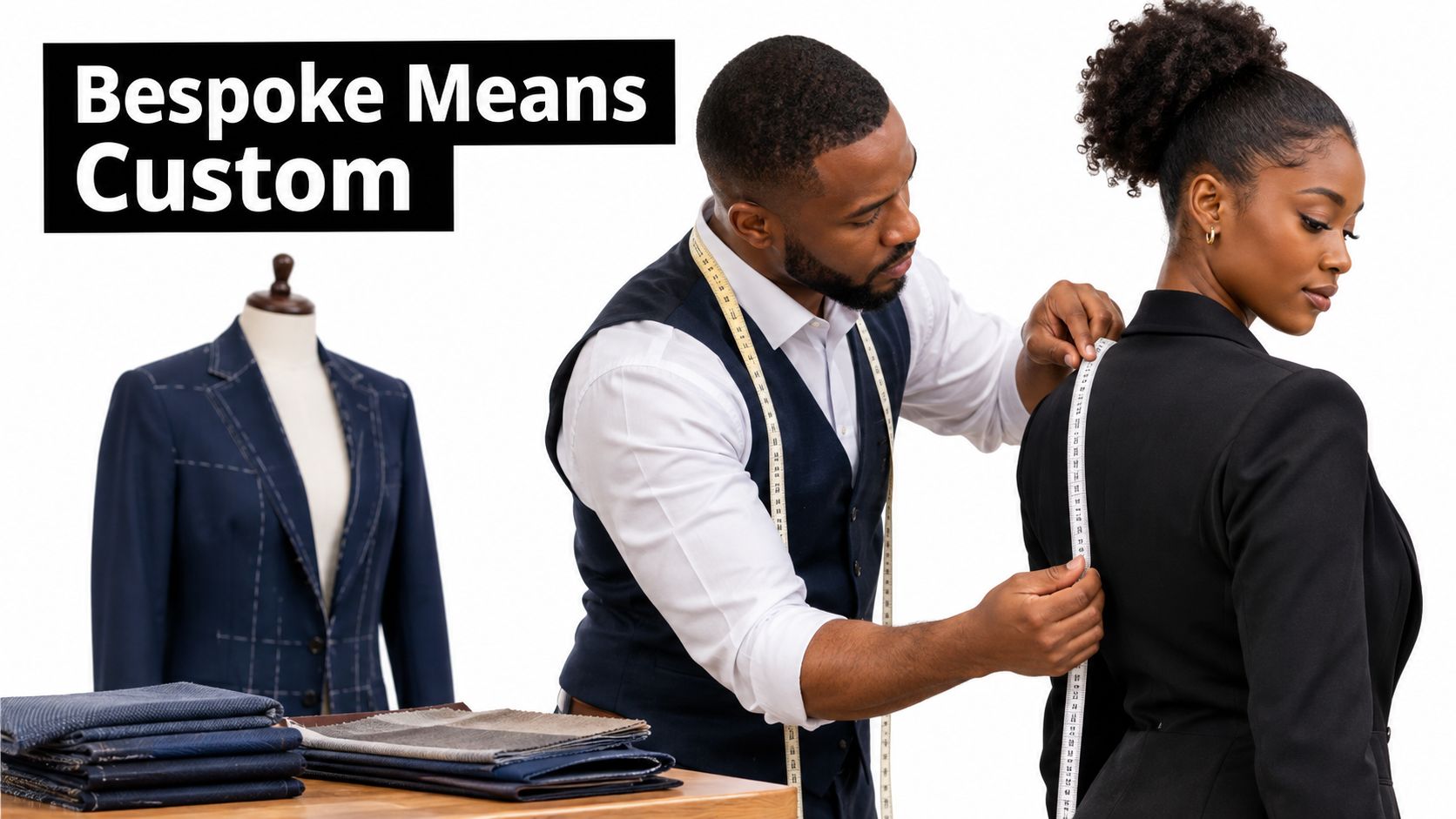
Bespoke means a piece built from scratch around one customer's measurements and design choices, while custom means any personal adjustment to an existing design, such as sizing, sleeve length, lining, or closure placement. For a shopper whose hat keeps slipping or whose favorite coat needs a different sleeve length, bespoke custom work turns “almost right” into a piece shaped around real needs.
We can start with a familiar frustration: a hat looks beautiful on the shelf, but the crown sits too high, the band pinches, or the shape won't stay put. At Pandemonium Millinery, our Seattle studio brings more than 25 years of design experience under Leigh Young to hand-sewn, small-batch faux fur accessories, apparel, and home décor. The point isn't to promise that every detail can change. It's to make the process clear, from what we can adjust to what may need a fresh pattern.
What Bespoke Custom Means in Practice
Think of a tailor's worktable. For a bespoke piece, we begin with a blank pattern and build around the customer's measurements, design preferences, and chosen material. For a custom piece, we start with an existing silhouette and reshape selected details. A hat might keep its classic form while gaining a different size, crown height, lining, or closure.
That distinction matters because “personalized” can mean many things. One customer may need a smaller head circumference, while another wants a particular fabric or a softer brim. A bespoke design combines these decisions into a new piece; a custom adjustment makes a specific change to a design we already know how to make.
The pattern is the starting point
A useful workshop analogy is the difference between cutting from a new paper pattern and adjusting one that's already drafted. Bespoke starts with the new pattern. Custom starts with a known shape, then changes the fit or finish where it makes sense.
That's why “your fabric, our expertise” describes the collaboration well. We listen to what you want to wear, feel, and see. You might choose a plush, velvety texture; our artisans consider how that material will sit, drape, and work with the proportions of the finished piece.
True bespoke work takes skilled, hands-on labor. Industry analysis describes bespoke garments as created from scratch to a customer's design preferences and physical measurements, a labor-intensive approach historically associated with higher price tiers (custom-made clothing market analysis). So the best first question isn't “Can you make it custom?” It's “Which parts are adjustable, and which need a new pattern?”
At Pandemonium, our hand-sewn faux fur pieces are made in small batches in Seattle. To see the range of styles that may suit different preferences, start at our studio homepage.
Bespoke, Custom, and Made-to-Measure Compared
These terms describe different starting points, and the starting point affects how much fitting work happens before a piece is finished. A ready-to-wear hat is made in standard sizes. Made-to-measure begins with a prepared design that can be adjusted after an order. Bespoke begins with the customer's measurements and a pattern created for that individual design.
| Approach | How the Garment Starts | Fitting Effort | Scalability |
|---|---|---|---|
| Bespoke | A new pattern built around measurements and design choices | Hands-on measurement and fitting, with adjustments as needed | Least scalable because each piece involves individual work |
| Made-to-measure | A partly prepared garment or pattern adjusted to the order | Measurements and selected fit changes | More scalable than bespoke when the base design stays consistent |
| Ready-to-wear | A finished design produced in standard sizes | Customer selects the closest available size | Most scalable because the same sizing and design serve many shoppers |
Which approach fits your needs?
Ready-to-wear can be straightforward if standard sizes already work for you and you're comfortable choosing from a size chart. Made-to-measure may suit you if you like a familiar design but need a limited adjustment, such as sleeve length or fit preference.
Bespoke is worth discussing when the fit problem can't be solved by selecting a different standard size. That might mean an unusually small or large head circumference, a specific crown proportion, or a design that calls for a fresh pattern. More measurements and fittings create more opportunities to check the result, but they also ask more time and coordination from both customer and maker.
The practical difference is that bespoke isn't just an online size recommendation. A separate fashion-industry report distinguishes true bespoke from scalable made-to-measure by the hands-on work involved in multiple measurements and fittings. At our studio, we treat each adjustment as a conversation about what's changing and what that means for construction.
For readers curious about how small-batch work differs from larger production runs, our article on small-batch production offers more context. Whichever route you choose, ask how the maker defines the service, what measurements they need, and whether fittings or revisions are part of the process.
Our Bespoke Process from Consultation to Fitting
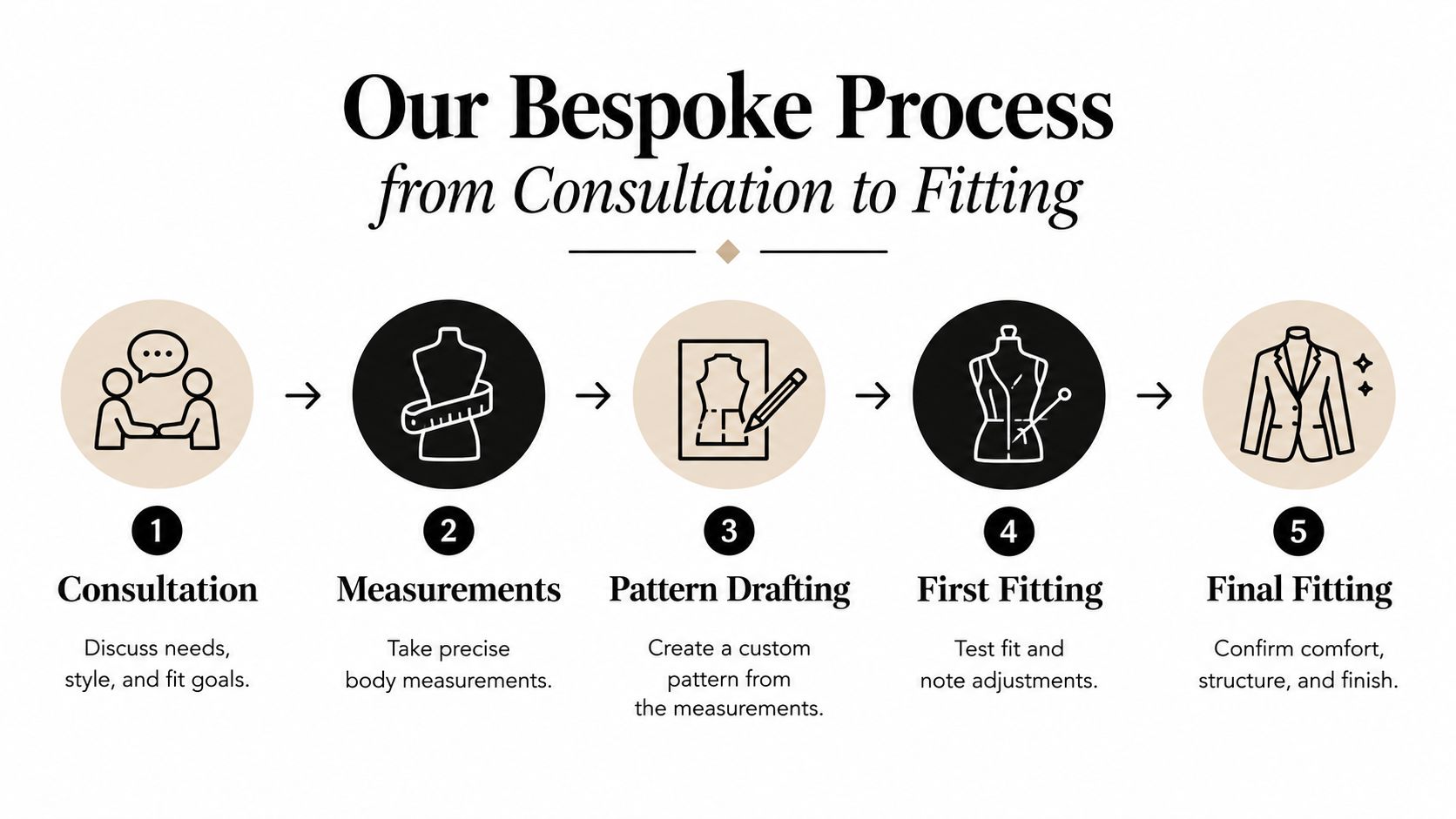
A good bespoke order begins with a conversation, not a tape measure. We first ask what the piece needs to do: keep you cozy on a Seattle commute, add a plush layer to a home, or fit a pet comfortably. Purpose helps us make decisions about shape, materials, coverage, and ease before we discuss details.
From measurements to a first fitting
Next, we identify the measurements that matter for the design. A hat needs more than a nominal size if its shape depends on crown height or how it sits around the head. A coat may call for sleeve and body length, while a pet coat depends on the animal's proportions and the way it moves. We document measurements so we can refer back to the same information as we make pattern decisions.
Measurement quality makes a difference. A recent comparison of manual tape measurements, 3D body scanning, and camera-based apps considered 14 garment-relevant body landmarks under ISO 8559-1. It found that 3D scanning produced more reliable measurements for on-demand garments, while smartphone apps often missed important dimensions or lacked precision. The researchers' six-stage digital pipeline, from setup and body acquisition through validation and data export, also points to a useful studio habit: use a consistent method, check the recorded dimensions, and keep a clear measurement record (measurement methods for on-demand garments).
Once the pattern is drafted, the first fitting helps us assess proportion and comfort before final construction. If the piece needs a change, we can discuss what's feasible and whether the pattern or a particular detail needs adjusting. A first fitting isn't a failed order. It's a decision point in a careful process.
Practical rule: Tell us what feels wrong in everyday terms. “The crown tips forward when I walk” gives us a useful starting point for a fit conversation.
If you're measuring a hat at home, our hat-size measuring guide can help you prepare. For another example of custom work guided by measurements and design details, see this resource on ordering choir robes with custom logos. When you're ready to talk through your own project, begin with Pandemonium Millinery.
The process can be easier to picture in motion. Here's a video to introduce the work of measuring and fitting:
Fabric Choices, Lead Times, and Pricing Explained
A fabric isn't just a color swatch. It changes how a piece feels against the skin, how it falls, and how much structure it holds. For a cold-weather hat, we might discuss plush, weather-resistant high-end faux fur with a silky lining. For a throw, a rich-toned luxury textile or Tissavel fabric may create the drape and tactile presence you want on a sofa.
Match the material to the job
A substantial fabric can bring a reassuring, weighty feel to a statement piece. A lighter lining may feel nearly weightless in comparison and help the finished item sit comfortably. The right choice depends on use, not just on which sample feels softest in your hand. A commuter may prioritize cozy coverage and weather resistance; someone choosing a decorative throw may care more about texture, color, and how the textile settles over furniture.
If you're comparing fabrics, note their feel and intended use alongside their appearance. Our guide to types of faux fur fabric can help you learn the vocabulary before a consultation. For a useful example of how material, color, and sizing details can be organized together, consult this regalia sizing guide.
What shapes timing and cost?
Lead times depend on fabric availability, the scope of the design, and how many fittings the piece needs. One-of-a-kind millinery may call for more pattern and proportion decisions than a small adjustment to an existing silhouette. We recommend confirming the current schedule during your consultation rather than relying on a general estimate.
Pricing reflects the materials and the skilled hand labor involved, as well as how much of the work is custom. A different lining is not the same undertaking as starting a new pattern. If you have a budget or deadline in mind, share it early. That gives us a practical frame for discussing suitable materials and the work each option requires.
How Bespoke Fit and Uniqueness Benefit Shoppers
Standard sizing doesn't work for everyone. A shopper with a smaller or larger head may find that a hat's band feels tight even when the crown looks right. Someone who needs a particular sleeve length may discover that choosing a larger coat solves one problem while changing the proportions elsewhere.
That frustration has a wider context. An industry study cited in a fashion-business conference paper found that only about 30% to 40% of a target market could be served with well-fitting clothing, and 50% of women reported difficulty finding clothes that fit (custom-made clothing market study). Those figures help explain why discussing measurements and proportions can feel more useful than trying another standard size and hoping for a better result.
Fit is personal, and the choices can be personal too
A measurement conversation gives us something concrete to work with. Instead of saying “this hat never fits,” we can talk about head circumference, where the band sits, and whether the crown feels too high or too shallow. For apparel, sleeve length or body length can be discussed as separate decisions, rather than assuming one size change will solve every fit concern.
The second benefit is individuality. A piece built around your choices can combine details that matter to you, from a classic silhouette to a plush, velvety lining selected for comfort and feel. The result isn't only a different color. It's a particular balance of proportion, texture, and finish that reflects the wearer.
A useful question to bring: Which part of your current hat or coat feels wrong first, the size, the proportion, the material, or the way it moves?
Customization has limits, and a change that reaches beyond the existing pattern may require more design work. That's why we prefer a documented fit conversation over a vague promise. We can talk through which details are adjustable, what measurements will help, and whether the first fitting may reveal a need for correction.
For a seasonal companion read, explore our winter wardrobe planning guide. It can help you think about what you need from cold-weather pieces before choosing a material or silhouette.
Ethical Production and Longer-Lasting Ownership
Cruelty-free luxury asks us to consider more than appearance. At Pandemonium, high-end faux fur offers an ethical alternative for customers who want a silky, plush textile without animal fur. Our Seattle studio makes hand-sewn pieces in small batches, a model that connects each order more closely to a specific design and customer.
Research offers a reason to take that involvement seriously. A 2023 experimental study in the Journal of Operations Management compared customization at different stages, including use, assembly, fabrication, and design. Perceived customization increased when consumers took part earlier in production, with design-level participation producing the strongest perceptions. Participants also expected design-customized products to remain in use for more months before disposal and showed greater willingness to pay (customization and consumer attitudes toward clothing).
Ownership can extend beyond the order
That finding doesn't mean every bespoke item automatically lasts longer or has a lower environmental impact. Material sourcing, construction, care, repair, and eventual disposal still matter. But it suggests that a customer's direct role in shaping a piece may help create a stronger sense of ownership, which can encourage more thoughtful use.
A custom hat chosen for its fit and lining may become the one you reach for each winter. A faux fur throw selected for its color and feel may settle into a familiar place at home. Those are not guaranteed outcomes. They're examples of how design involvement can make a piece feel personal enough to keep in regular use.
“A thoughtful piece earns its place through how it feels, how it fits, and how well we care for it.”
We see ethical making as a relationship between material, maker, and owner. Small-batch production and customization can support that relationship, but they don't remove our responsibility to choose materials carefully or explain what an item needs after purchase. For more on the values behind our approach, read our story on ethical production, then continue with our history of fur and faux fur garments.
Customization Options, Limits, and How to Start
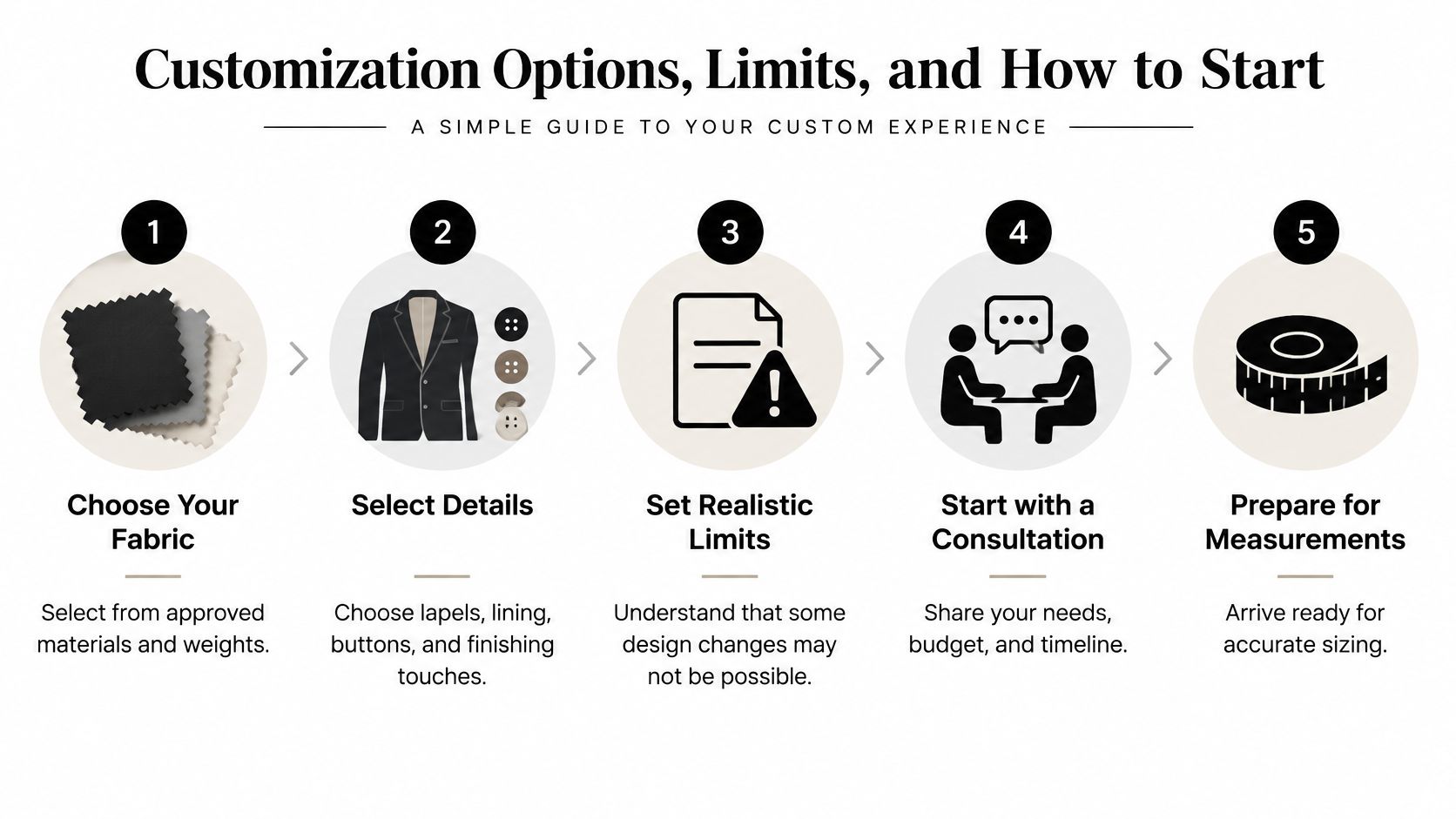
A useful consultation begins with a clear idea of what you want to change. We can discuss custom sizing for a hat, sleeve or body length for a coat, crown height or brim shape, and choices such as lining or closure placement. Pet coats and home pieces can also be discussed in terms of their intended use and fit.
The boundary depends on the design. A small sizing adjustment may work within an existing pattern; a major change in silhouette or proportion may call for a new pattern. A larger brim adjustment, for example, can affect the balance of a hat rather than changing only its appearance. We'll need to review the design and material before promising what a particular change can achieve.
Think about how and where you'll wear it
Fit also affects warmth. A looser or more insulating construction can hold a thicker layer of air around the body, while movement, wind, garment compression, and fabric permeability can change that layer and increase heat exchange. A validated dynamic-clothing model tested six clothing ensembles at different walking and wind speeds, with most prediction errors below 16%; separate fit experiments also found that compression and fabric extension influence heat transfer and surface temperature (dynamic clothing thermal-comfort model).
That's why we ask about use, not only body dimensions. A Seattle commuter may want different ease, closure placement, lining, and coverage from someone who spends most of the day indoors. We can consider adjustable fit and layered construction, then evaluate a prototype in movement rather than judging warmth by touch alone.
Before you meet with a maker, gather a few notes:
- Purpose: Tell us whether the piece is for commuting, an occasion, home use, or a pet.
- Fit: Note what feels too tight, loose, long, short, high, or low.
- Material: Bring a fabric preference, or describe the texture and weight you enjoy.
- Limits: Decide which details matter most if not every change is possible.
- Timing: Share when you hope to have the finished piece.
A customer planning branded headwear for an event may have different goals from someone commissioning one-of-a-kind millinery. This guide to ordering branded headwear for trade shows offers a useful contrast between coordinated group orders and an individually fitted piece. If you're considering a decorative hat detail, our article about custom hat bands can help you think through finishing options.
When you're ready, bring your fit questions and material ideas to the conversation. If you'd like to browse bold prints before choosing a direction, explore the Fractal Collection.
We make hand-sewn faux fur accessories, apparel, and home pieces in small batches at our Seattle studio, with custom sizing and “your fabric, our expertise” options shaped around your needs. Join The Crowd for 15% off, then visit Pandemonium Millinery to explore the Fractal Collection and start a conversation about your piece.


