



You know the moment. You've paid for coffee, your coat's buttoned, and you step onto a Seattle sidewalk into damp air that finds every gap at your throat and shoulders. A good winter wrap scarf solves that problem without forcing you to wrestle a narrow scarf into a knot or carry a separate shawl for indoors. Our team has hand-sewn cold-weather layers in our Seattle studio for more than 25 years, and the wraps people keep for seasons all do the same four jobs well. They insulate, they drape cleanly, they transition, and they last.
What a Winter Wrap Scarf Actually Does for You
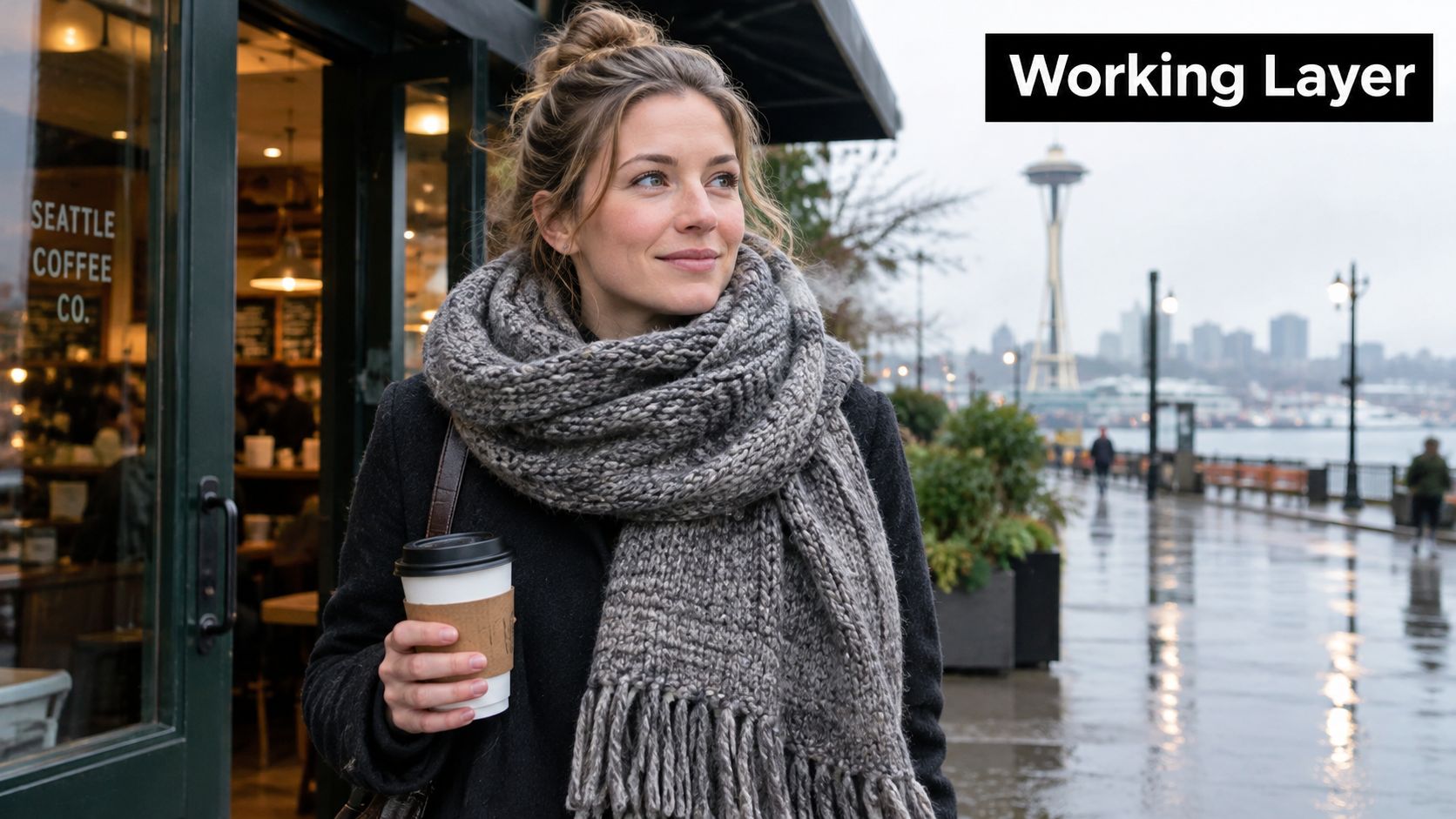
That sidewalk chill is exactly where the distinction matters. A fashion scarf is usually narrow and decorative first. A shawl gives you shoulder coverage but often slips when you're carrying a bag, opening a door, or reaching for a bus strap. A true wrap sits between them, wide enough to cover shoulders and upper back, long enough to loop at the neck, and soft enough to fold across your lap.
We've watched customers use one piece three ways before lunch. It's a neck layer for the walk, a shoulder throw in a cold office, then a plush, velvety lap layer on the ride home. That versatility isn't new, and the Metropolitan Museum of Art collection record for a 1947 scarf shows the modern scarf was already a recognizable fashion object by the mid-20th century. What changed is expectation. You now want warmth and polish from the same piece.
The Four Jobs We Design For
- Insulate without gaps: Coverage at the sides and back of the neck matters more than a dramatic front drape.
- Sit cleanly over outerwear: The wrap shouldn't fight your coat collar or bunch at the chest.
- Transition indoors: You should be able to loosen, fold, or drape it instead of overheating.
- Hold up for years: Seams, pile, and lining need to survive real commuting, not just look good on a hanger.
Scarves and shawls aren't minor add-ons, either. Market reporting that put shawls and scarves at 17% of the winter-wear market also noted that approximately 48% of female consumers purchased shawls as seasonal accessories, which matches what we see in the boutique. People buy for softness, yes, but they come back when the piece works.
That is why designer Leigh Young built our bespoke approach around proportion, not decoration alone. Through custom sizing and our your fabric, our expertise service, we adjust length, width, and lining so a wrap falls where your body needs it. High-end faux fur, especially Tissavel style luxury textiles, gives us a cruelty-free, plush surface we can tailor that way without asking you to compromise on warmth.
Choosing the Right Fabric for Your Climate
Damp cold and dry cold punish fabrics differently, and that's where most buying mistakes happen. Seattle cold soaks and settles. Chicago or Denver cold bites with wind and then lets heated indoor air dry everything out. Your wrap has to manage both the street and the room you enter next.
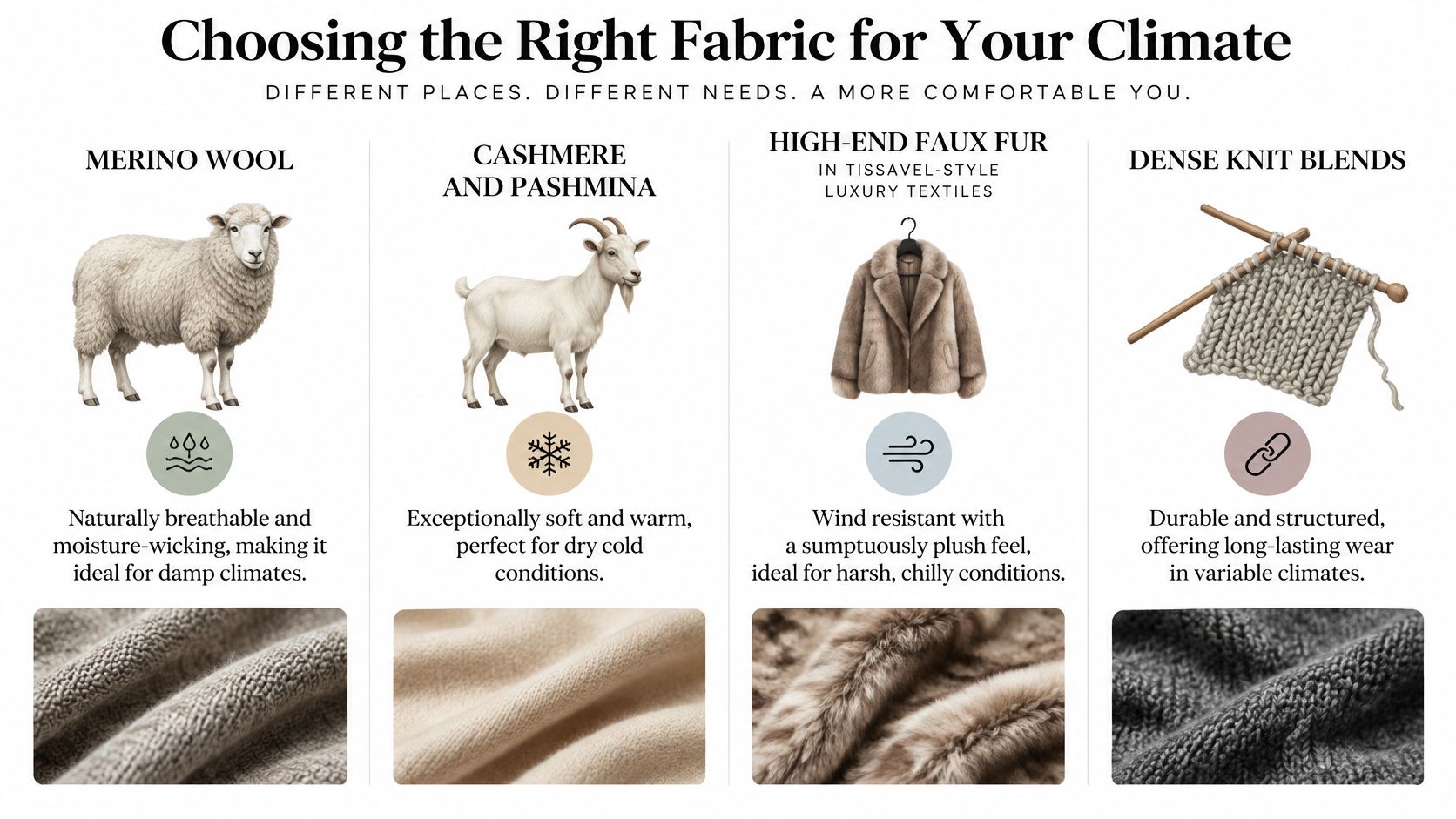
Merino wool is our recommendation when dampness is the daily problem. It breathes, moves moisture away from skin, and feels substantial without looking bulky. Cashmere and pashmina feel silky and weightless, and they're lovely in dry, bitter cold or for evenings, but they compress easily and need gentler handling. In a wet commute, a fine pashmina can feel elegant for ten minutes and limp for the rest of the day.
High-end faux fur changes the equation because pile traps air above the base fabric. A dense Tissavel pile resists wind, looks rich-toned over a black coat, and gives you that cozy, weather-resistant surface people associate with luxury. If you want the full breakdown before you choose, our guide to the different types of faux fur fabric and how each pile behaves walks through density and backing in detail. Dense knit blends, including our Cozy Cable knits, sit in the practical middle. They hold structure, travel well, and forgive daily wear.
Winter Wrap Scarf Fabrics at a Glance
| Fabric | Best Climate | Drape | Care Notes |
|---|---|---|---|
| Merino wool | Damp, changeable cold | Smooth, controlled | Air between wears, wash gently |
| Cashmere and pashmina | Dry cold, indoor events | Fluid, delicate | Protect from abrasion, fold to store |
| High-end faux fur | Windy cold, polished outerwear | Plush, architectural | Spot-clean, air, wash rarely and cold |
| Dense knit blends | Everyday commuting, travel | Structured, substantial | Reshape flat, avoid stretching when wet |
Don't trust thickness alone. A very thick knit with an open structure lets wind straight through, while a denser, loft-retaining pile can feel warmer at half the visual bulk. When you're comparing options in hand, compress the fabric, let go, and watch the recovery. Slow or flat recovery on the table usually means flat performance under a coat collar.
Start with climate, then choose the hand you want to live with. If you run cold on windy walks, look first at our Minky Faux Fur styles for a plush, velvety surface. If you need a wrap that folds into a tote and works at your desk, the Cozy Cable knits are the more forgiving daily choice.
Studio rule: Choose for the wettest, windiest ten minutes of your day, not for the mirror at home.
Four Ways to Wear a Wrap on Cold Mornings
You don't need twelve knots. You need four reliable shapes you can repeat without a mirror, each solving a different cold, coat, or setting. The right one depends on where you're losing heat and how much freedom your arms need.
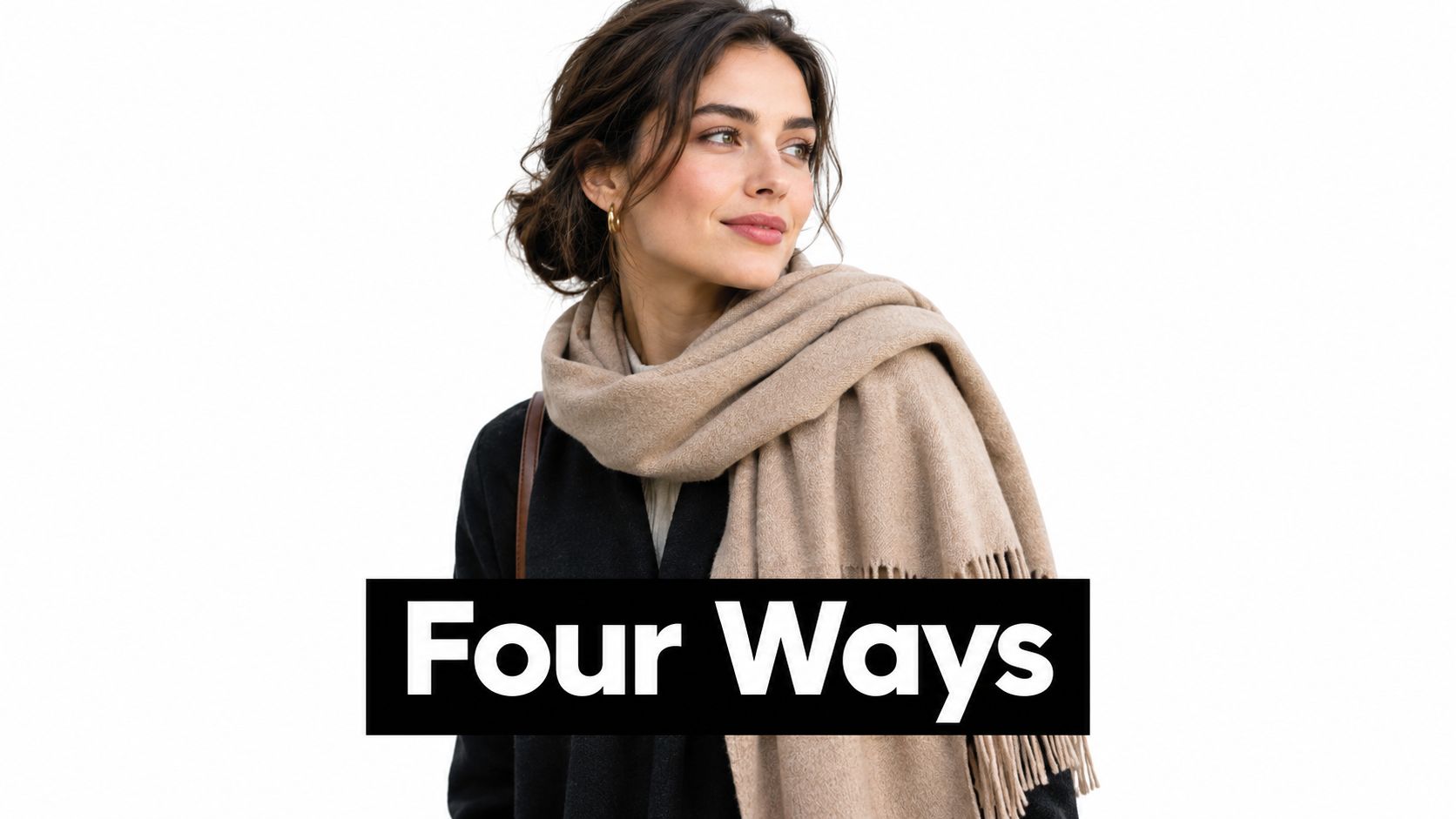
The Parisian shoulder drape is the polished option. Center the wrap at the back of your neck, bring both ends forward, and let one side cross slightly higher than the other so the line looks intentional rather than matched. It flatters a structured coat and keeps your hands free. The common mistake is pulling it tight like a tie. Leave a little lift at the throat so the pile or knit keeps its loft.
For the coldest walk, use the doubled neck loop. Fold the wrap lengthwise only as much as you need, circle your neck twice, and tuck the short ends under the second pass at the side, not the front. Side tucking stops the ends from bouncing loose and protects the spots beside your jaw where wind sneaks in. If the back of your neck still feels exposed, your wrap is either too short for a double loop or you're starting too far forward.
Two Shapes for Shoulders and Severe Cold
The shawl over coat works best when your coat is already warm through the body but your shoulders and upper back feel the wind. Spread the wrap wide, settle it over both shoulders, and bring the front corners to a loose cross at your waist or secure them under a bag strap once you're moving. Petite readers often drown in this shape because standard wraps hang too long. That isn't a styling failure. It's a proportion issue, and a shorter bespoke length lets the drape end at the hip instead of the knee.
When wind hits your ears as well, try the hooded cocoon. Start with a single neck loop, then lift the back section over your head and adjust the front so you can breathe and turn comfortably. It reads dramatic, but it's practical for a ferry deck, dog walk, or exposed platform. Plus-size customers tell us this one's comfort depends on width across the shoulders, not just total length, which is why we adjust both measurements in custom work.
Watch the loop, side tuck, and hood adjustment in motion before you practice with a plush piece, since small hand placement changes the finished silhouette.
Pair the shape to the collar, too. A high funnel collar wants a lower shoulder drape. A flat lapel can take the doubled loop. A collarless coat usually needs the most neck coverage. When the wrap and collar compete for the same space, you'll keep adjusting all day.
Why Fit and Construction Matter as Much as Fabric
A wrap that feels wonderfully plush on a mannequin can disappoint on a twenty-minute walk. Standing still, loft traps warm air. Walking pumps that air out, shifts the overlap at your neck, and presses pile flat under straps and collars. That's why we test fit in motion in the studio, turning, reaching, and sitting, instead of judging a sample only on a table.
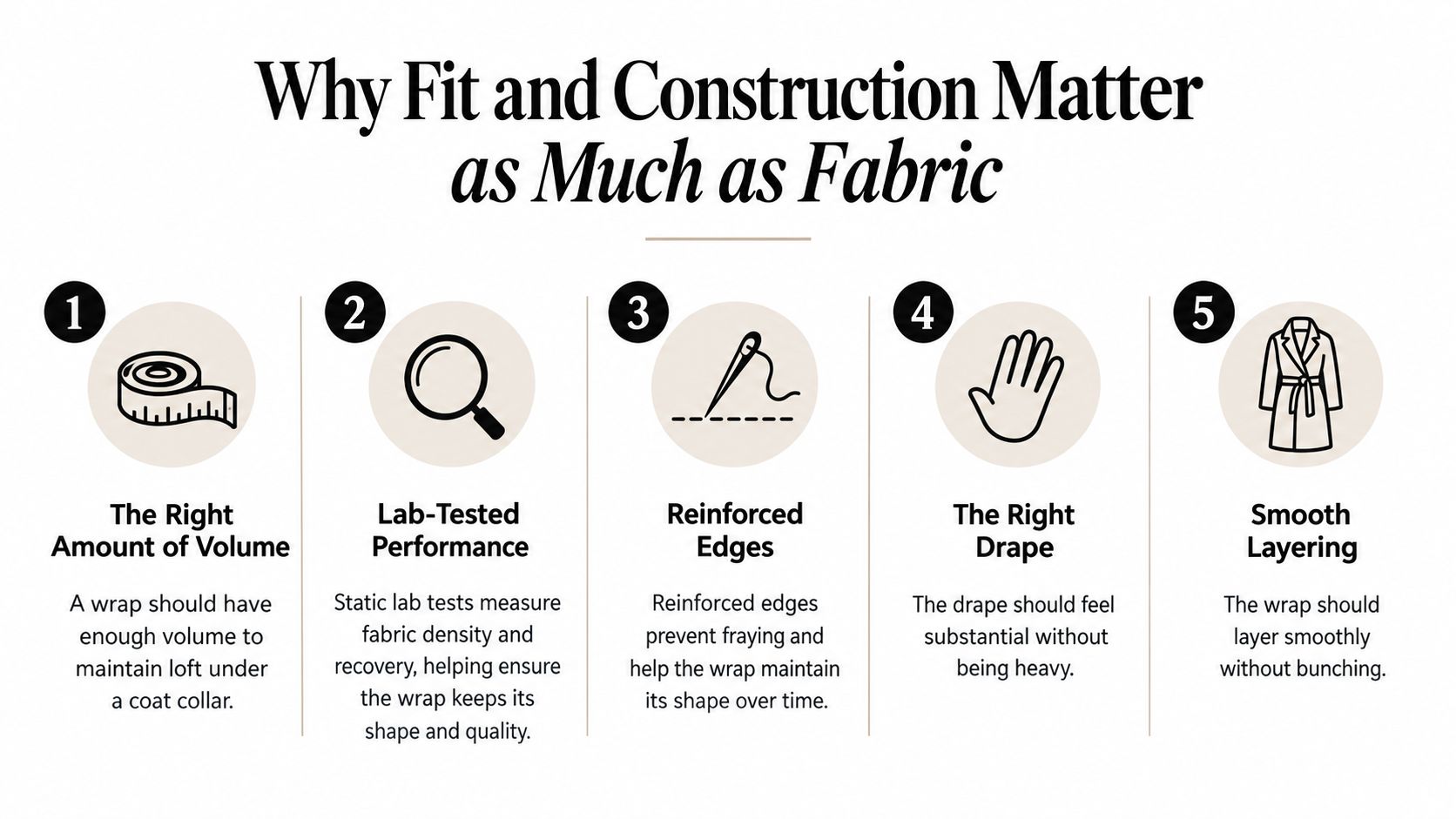
The construction details behind that experience are measurable. A 2025 scarf study modeling thermal resistance from yarn density, ends and picks per inch, and grams per square meter supports a point we repeat to customers: you can't infer reliable warmth from a fiber name alone. Two pieces can share a label and perform differently because one is dense and loft-retaining while the other is open, slippery, or cut too narrow to overlap.
Put in plain terms:
- Fabric mass: More material per area can help, but only if the structure holds air.
- Pile or weave density: Denser construction generally resists wind and shedding better than a loose one.
- Overlap at the neck: Secure coverage matters when movement opens gaps.
- Compression recovery: Pile that stays flat under your collar stops insulating where you need it most.
Fit failures are just as specific. Shoulder slippage often means the wrap is too wide and smooth for your frame, not that you need to pull it tighter. Bulk at the chest can fight a seat belt. A long end catches a backpack strap. An oversized shape feels luxurious for a photo and exhausting by the second errand.
The best wrap isn't always the largest one. Controlled volume and a secure fastening often feel warmer because they stay where you put them.
learning how to recognize quality faux fur construction helps you check backing, density, and recovery before you buy. At Pandemonium Millinery, we treat custom sizing as the functional fix for those problems. We can move a closure, narrow the shoulder spread, change lining, or shorten the fall so the wrap clears your coat, your bag, and your belt. The Fractal Collection shows another side of fit, too. A bold, shimmering print changes where the eye reads volume, so placement and proportion need to be considered together.
Layering, Travel, and the Office Transition
The strongest case for a wrap is a day with three temperatures. You're cold outside, warm on the train, then chilly again at a desk near a window. A narrow scarf handles the first part. A wrap handles all three because you can change its coverage without changing clothes.
Over a structured wool coat, keep the wrap's widest part across your upper back and let the front fall in two clean panels. That preserves the coat's architectural line instead of burying it. Over office tailoring, fold the wrap narrower and use the shoulder drape. A high-end faux fur in a classic tone can read polished rather than sleepy, especially when the rest of the outfit is simple.
Moisture is the part people underestimate during those transitions. Breath and perspiration collect at the mouth and neck, then cool you when you stop moving. Textile research on wicking and cold-weather comfort notes that even 3 to 5% moisture content in a garment can create substantial discomfort, which is why an impermeable lining pressed against your face is usually a poor design choice. If the inside feels clammy after a short walk, loosen the front fold and let vapor escape before you sit down.
Practical Moves Through the Day
- On a flight: Use it wide across shoulders, then fold it over your lap when cabin air warms.
- With a backpack: Put the wrap on after the straps if it slips, or choose a narrower custom width.
- In a heated office: Drop it below the shoulders like a stole instead of bundling it at your throat.
- Over a down jacket: Skip the double loop. You already have torso insulation, so use a light shoulder layer.
Our guide to layering pieces for cold weather without losing your silhouette goes deeper on pairing wraps with sweaters, shells, and tailoring. We also design plush handbags and coordinated cold-weather accessories in the same small-batch spirit, so textures can echo without matching exactly. A wrap should join your wardrobe, not demand a separate styling system every morning.
Travel exposes weak construction quickly. Repeated folding, seat friction, and stuffing into a carry-on flatten some piles and stretch some knits. Before a trip, shake the wrap out, check the edges, and roll rather than crush it. You'll arrive with a piece that still drapes instead of one that needs rescuing.
Caring for a Faux Fur Wrap Without the Guilt
Here's our candid position: machine washable doesn't automatically mean low impact. For a synthetic pile in the technical sense, every wash is friction, water, and fiber release. The kindest care routine is usually the least frequent one that keeps the wrap fresh and wearable.
Air your wrap after wear, away from direct heat. Spot-clean makeup at the edge, coffee, or winter salt with a barely damp cloth and let it dry fully before storing. Most wraps do not need washing after every outing, and many smell stale because they were folded while still holding moisture from breath or rain.
When a full wash can't be avoided, keep it cold and short. A 2025 study of polyester fleece shedding and wash settings reported an average of 1.4 mg of microplastic fibers per gram of fabric in the first wash, and a move from 40°C for 85 minutes to 15°C for 30 minutes reduced microfiber generation by 30%. Use a laundry filter option if you have one, avoid tumble heat, and brush or shake the pile only once it's dry.
Construction affects shedding as well. Comparative research on polyester constructions and fiber release found that polyester fleece shed far more fibers than ordinary polyester fabrics, while looser and worn textiles shed more. Don't judge every vegan fur by the loosest example you've touched. Density, backing, and wear history matter.
Our care sequence: Air first. Spot-clean second. Wash cold, short, and rarely. Repair before replacing.
Ethical claims deserve the same precision. A 2021 CE Delft life-cycle assessment comparing mink and faux fur found natural fur had greater impacts in every category assessed, at least three times higher than the least favorable faux-fur variant in the scenarios and more than ten times higher for some categories. At the same time, UK Parliament evidence summarizing a 2018 landfill biodegradability study reported that natural fur biodegraded while the synthetic imitation showed no signs of biodegradation during testing. Cruelty-free and biodegradable aren't interchangeable claims.
That honesty is why longevity matters. Store your wrap cool, dry, and uncompressed. Mend a loose edge early. Ask about adjustments instead of retiring a piece because a closure sits wrong. Our notes on whether you can safely steam faux fur accessories explain where gentle steam helps and where heat can damage the fibers.
Pairing Your Wrap with the Rest of Your Cold-Weather Wardrobe
A wrap earns its place when it works with what you already own. With a black wool coat, a vibrant Fractal print becomes the focal point and your bag can stay quiet. With a patterned coat, choose a solid, rich-toned faux fur or a Cozy Cable knit so textures carry the interest. Matching everything exactly usually looks less considered than repeating one color in a hat, glove, or handbag.
Think from the skin outward. A smooth sweater lets a plush wrap slide into place. A heavily textured knit can grab the lining and make adjustment awkward. If your lower legs are the next cold or sore spot after a long walk, SunnyBay's resource on recovery leg warmers explained is a useful companion read on targeted warmth beyond the neck and shoulders. For pattern confidence, our article on wearing statement scarves with everyday coats shows how scale changes the effect.
Join The Crowd, our email list, for 15% off and first looks at small-batch colors before they sell through. Then compare the fabrics you've just read about across the Fractal Collection, Cozy Cable knits, and Minky Faux Fur scarves and throws. The right piece should feel velvety in hand, architectural over a coat, and easy enough that you reach for it without thinking.
At Pandemonium Millinery, our Seattle studio hand-sews bespoke faux fur wraps, scarves, hats, and accessories in small batches, with custom sizing when standard proportions don't work. Explore the collections, tell us about your coat, climate, and fit frustrations, and we'll help you choose or tailor a cruelty-free wrap you'll wear all winter.


