



On a damp Seattle morning, rain ticks against a waxed coat while a terrier trots past our Panama hat shop in a hand-stitched wool vest. The scene looks polished, but the luxury is quieter: the vest fits, moves, dries, and belongs in the dog's life.
For us, luxury pet clothing is a small, intentional wardrobe built with the same care as a favorite human garment. At Pandemonium, our local Seattle studio brings 25+ years of Leigh Young's design experience to small-batch, cruelty-free work, including high-end faux fur, reversible coats, and custom-fit pet pieces. The question isn't whether a garment signals status. It's whether the materials, fit, construction, and ethics deserve a place in your home.
What Luxury Pet Clothing Really Means Today
Luxury pet clothing isn't defined by a logo, a runway reference, or an impressive price tag. It's defined by decisions you can feel in the hand and observe in use: a shell that handles drizzle, a lining that doesn't chafe, closures that stay secure, and a shape that lets a dog sit, turn, and walk naturally.
That approach follows slow-fashion principles. A pet's wardrobe becomes a deliberate extension of a cruelty-free home aesthetic, not a costume drawer filled with impulse purchases. Price should reflect luxury textile choices, skilled labor, pattern development, and small-batch production, rather than branding alone.
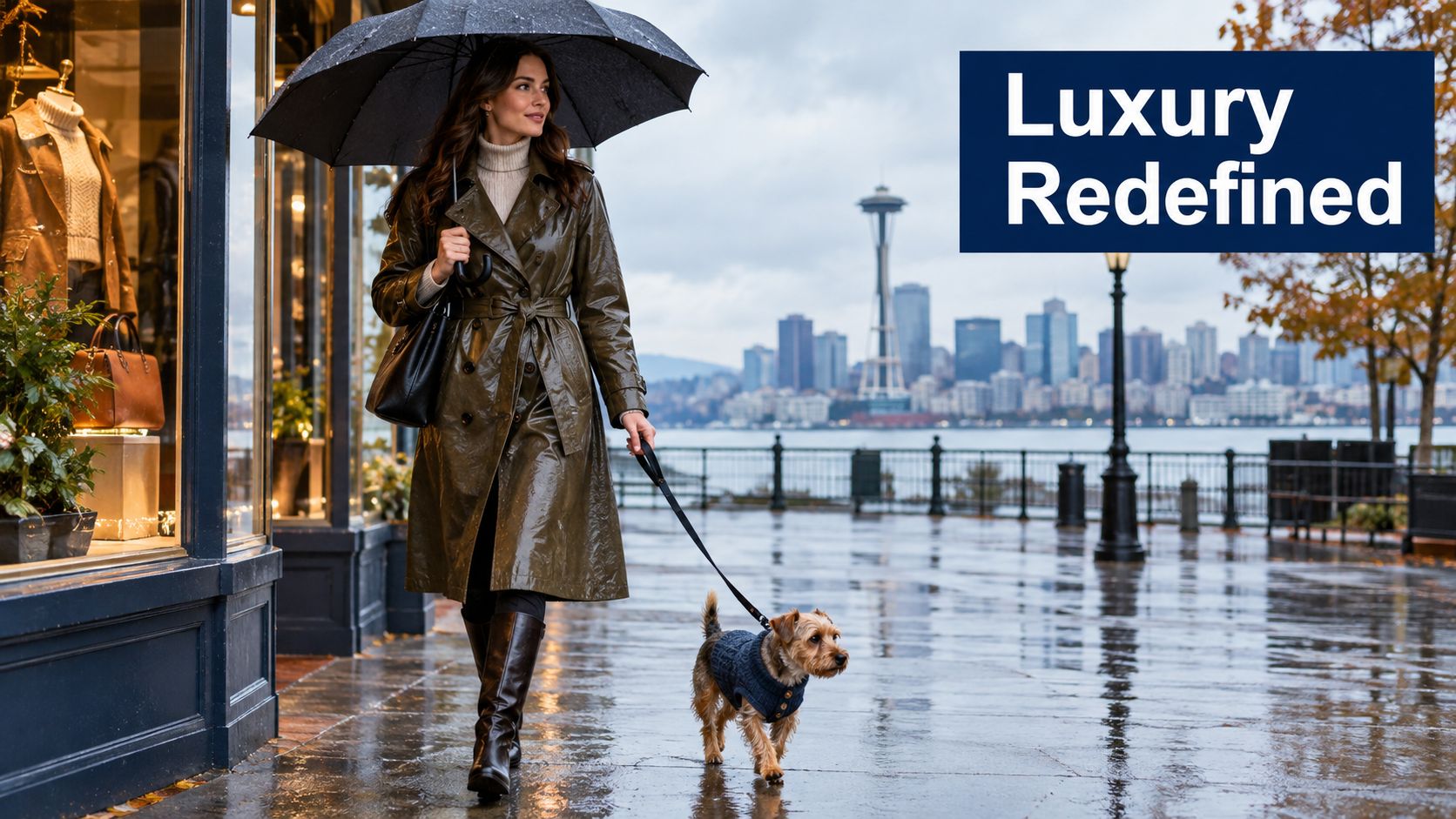
A wardrobe with a reason
The global pet clothing market was valued at USD 6.05 billion in 2025 and is projected to reach USD 10.34 billion by 2034, with a projected 6.31% CAGR, according to Fortune Business Insights' pet clothing market analysis. North America accounted for 33.52% of the market in 2025, which helps explain why functional, polished garments resonate in colder, high-income urban environments.
Luxury sits inside that broader market with its own logic. One industry estimate values the global luxury pet apparels market at USD 2.1 billion in 2025, projecting USD 4.6 billion by 2034 and a 9.1% CAGR. Clothing represented 42.3% of luxury pet apparel revenue in 2025, or about USD 888.3 million, while listed price points range from USD 150 to more than USD 1,200, as reported by Cognitive Market Research.
Those figures show that luxury pet clothing is an established premium category, but they don't prove that every expensive coat performs better. A thoughtful buyer still needs to ask whether the garment offers useful durability, fit, weather protection, or comfort.
For a wider view of exclusive luxury fashion craft value, the same principle applies across human and pet wardrobes: craft matters when it becomes visible through material integrity and considered construction. Our own cruelty-free luxury approach begins there, with an ethical alternative to animal fur and an insistence that beauty and responsibility can share the same seam.
The Building Blocks of a Truly Premium Garment
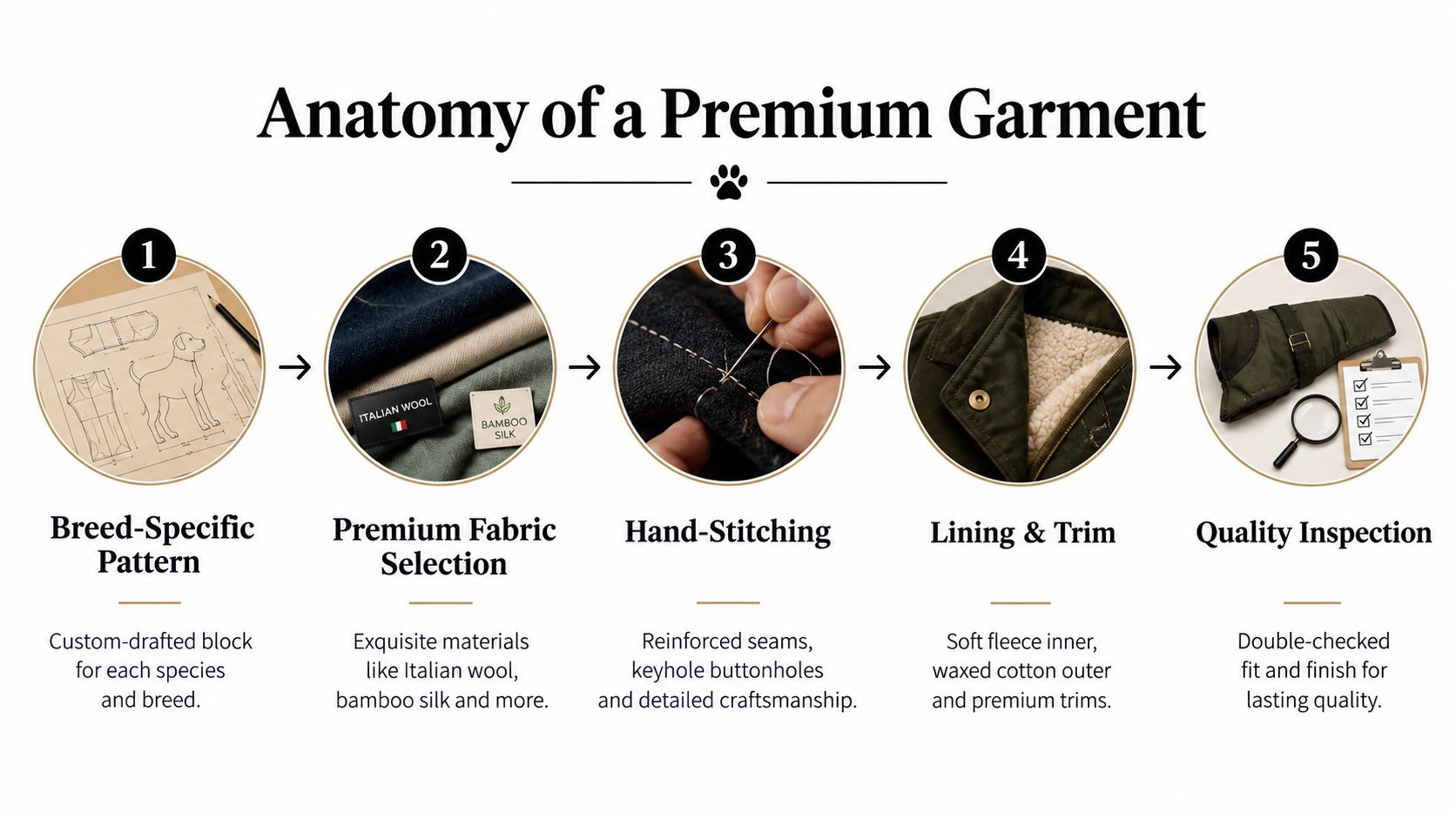
A premium pet garment begins before the fabric reaches the cutting table. We start with a pattern that respects species, breed, posture, and movement instead of forcing every body through a generic template.
Pattern before decoration
A custom-drafted block can account for a deep chest, short legs, a long torso, or a roach back. Thoughtful seam allowances give the maker room to adjust. That flexibility matters because a coat that looks beautiful on a hanger can pull across the shoulders or gape at the belly once the animal moves.
Construction reveals the maker's discipline. French seams enclose raw edges, while bound seam allowances reduce irritation against sensitive skin. Consistent topstitching gives a piece architectural clarity, and a floated lining keeps bulky seam allowances away from the shoulders.
Closures deserve equal scrutiny. Cap rivets, metal D-rings, hand-set snaps, and cotton webbing generally hold their shape more reliably than welded plastic components. Stress points should receive reinforcement, hems should feel clean rather than scratchy, and patterned fabric should meet neatly at the center back.
Read the listing like a maker
Product descriptions often lead with adjectives. Buyers should look for evidence.
- Pattern information: Does the maker explain breed-specific shaping or only list generic sizes?
- Interior finish: Can you see binding, lining details, or photographs of the inside?
- Stress management: Are closures and leash openings reinforced where tension occurs?
- Adjustment options: Does the garment accommodate a real body, or does it depend on a narrow size range?
- Repair potential: Can a snap, strap, or seam be replaced without discarding the entire piece?
Practical rule: If a listing explains the fabric's feel but says nothing about fit, reinforcement, or interior finishing, keep asking questions.
Our reversible pet coats illustrate why reversibility has to be engineered, not merely advertised. Both sides need clean finishing, stable closures, and a leash opening that remains practical whichever surface faces outward. For a tactile extension of the same home aesthetic, custom faux fur pet blankets can coordinate with a coat without turning the animal into a display piece.
Materials, Linings, and Hardware That Earn the Price
A luxury pet garment earns its price through a chain of material decisions. The shell, lining, insulation, trim, and hardware must work together, and cruelty-free sourcing should remain part of the evaluation rather than a decorative footnote.
Densely woven waxed cotton can resist light rain while developing a softened hand over time. Boiled wool offers a substantial, cozy surface for cool conditions, while organic canvas brings structure and durability. Recycled nylon can make sense for a weather-resistant outer layer when low weight and easy cleaning matter. Generic polyester may be serviceable, but it tells you very little by itself about breathability, finish, or longevity.
Against the skin, cotton flannel, brushed organic cotton, and lightweight wool can feel silky and gentle. Synthetic fleece may provide plush insulation, but its moisture behavior and laundering requirements deserve attention. Wool batting, recycled wadding, and polyester fill each make different compromises between warmth-to-weight, loft, drying, and wash stability.
Hardware should be judged by location and load. Solid brass and stainless steel offer reassuring substance, while aluminum cap rivets reduce weight. Plated components can wear through, and plastic can become brittle or distort. Leather reinforcements may be useful, but a cruelty-free maker should clarify whether an alternative material is used.
For textile safety, OEKO-TEX Standard 100 guidance describes a voluntary certification that verifies every component is free from harmful substances. The same comparison cites a formaldehyde limit of 75 ppm under OEKO-TEX for textiles. Certification isn't a substitute for fit or good design, but it gives buyers a concrete sourcing question.
| Component | Premium Choice | Standard Choice | What to Look For |
|---|---|---|---|
| Shell | Waxed cotton, boiled wool, organic canvas, recycled nylon | Undisclosed polyester | Breathability, hand feel, weather resistance, care instructions |
| Lining | Brushed cotton, flannel, lightweight wool | Basic fleece or unlined interior | Softness, moisture management, seam comfort |
| Insulation | Wool batting or considered recycled wadding | Unspecified polyester fill | Loft, compression behavior, wash stability |
| Hardware | Stainless steel, solid brass, aluminum | Plated metal or plastic | Corrosion resistance, secure attachment, weight |
| Trim | Cotton or wool binding, woven labels, cruelty-free reinforcement | Exposed edges and generic trim | Clean finish, skin safety, repairability |
Our guide to identifying high-quality faux fur explains why pile density, backing, and hand feel matter. High-end faux fur should feel velvety or plush without relying on animal fibers, and Tissavel remains one example of a luxury textile associated with a rich, convincing finish.
How to Measure Your Pet for a Flawless Fit
A soft tape, a calm animal, and a flat floor will produce better information than guessing from breed labels. Fit is a performance variable, not just a style preference. A 2026 peer-reviewed comfort study on dog apparel found clothing pressure generally increased in the order padding, mesh, cotton, showing that fabric structure and patterning change how garments load the body in the published study.
Take four measurements
Have your pet stand squarely, with all four feet supported. Keep two fingers beneath the tape so it rests against the body without compressing the coat or skin.
- Neck: Measure around the base of the neck, where a collar naturally sits.
- Chest girth: Wrap the tape around the widest point behind the front legs.
- Back length: Measure from the collar area to the base of the tail, following the topline without stretching.
- Coat extra: Record the belly circumference or the distance from chest to waist when the design requires closer shaping.
Log each figure to the nearest half inch, then compare it with the maker's chart. Don't choose a size solely from weight or breed. The back length is especially easy to misread because shoulder placement changes where the garment must begin.
Know when standard sizing falls short
A deep-chested sighthound may need more room through the ribs without excess fabric at the neck. A barrel-chested bulldog can require a broader chest block and a shorter back. Cats with long torsos often expose the weakness of patterns developed only for compact canine proportions.
Choose custom sizing when:
- Measurements conflict: Your pet's neck corresponds to one size, but the chest or back belongs to another.
- Movement changes the fit: The garment shifts when your pet sits, climbs, or turns.
- The body is unusual: Deep chests, broad shoulders, short legs, long torsos, or a pronounced topline need pattern adjustment.
- Skin is sensitive: A lining, neckline, or closure requires special placement.
- The purchase is substantial: Custom planning is more sensible than repeated returns for a high-ticket piece.
A made-to-measure service can also help clarify whether extra room is needed for a harness, thick coat, or active movement. At Pandemonium, our principle is “your fabric, our expertise”, with custom sizing and adjustment options available through our Seattle studio. Our dog coat measurement guide offers a useful preparation point before a consultation.
Performance, Weather Range, and Everyday Comfort
A beautiful coat has to behave well outside the boutique. For damp, chilly Pacific Northwest mornings, a densely woven wool or felted wool blend can provide a cozy hand and useful wind resistance. Under a waterproof shell, breathable cotton or hemp lining helps keep the interior from feeling clammy during shoulder-season walks.
Indoor cats and pets that overheat easily need a different approach. Lightweight silk or cotton voile can provide a gentle layer without the loft of winter insulation. Lofty fibers trap warm air, but harness pressure can compress them and reduce their insulating effect. Flat weaves breathe more easily beneath pressure, though they may offer less protection in still, cold weather.
Match the layer to the use
| Condition | Shell | Lining | Best Use |
|---|---|---|---|
| Damp, chilly morning | Densely woven wool or felted wool blend | Brushed cotton | Short urban walks and cool drizzle |
| Changeable shoulder season | Weather-resistant shell | Cotton or hemp | Errands and moderate outdoor activity |
| Dry winter wind | Wind-resistant textile | Wool or recycled wadding | Layered warmth during calm walks |
| Warm indoor environment | Lightweight cotton or silk | Cotton voile | Pets that need minimal coverage |
| Low-light outing | Weather-resistant shell with reflective trim | Soft breathable lining | Visibility-conscious walking |
Independent guidance for active pets emphasizes breathable shells, mesh linings, and moisture-wicking blends because impermeable or rubberized fabrics can trap heat during activity in this technical overview of active-pet clothing. Winter fills in the Thinsulate or PrimaLoft style retain warmth when damp, while windproof outer layers reduce convective heat loss without unnecessary bulk.
Freedom of movement depends on patterning. Gussets, shaped armholes, and curved hemlines should follow the natural sit and stride. Closures must remain secure, but safety design matters too. Reflective trim helps in low light, force-releasing features can reduce entanglement risk, and heavy embellishments near the eyes or ears have no place on an everyday garment.
For broader outdoor planning, Denver Dog's guide to essential dog hiking clothes is a useful companion resource. Our own discussion of whether dogs need coats keeps the decision grounded in the individual pet rather than fashion pressure.
Layering rule: Start with the lightest breathable layer that solves the weather problem, then add insulation only when your pet remains comfortable and mobile.
Styling, Gifting, and Making a Piece Uniquely Yours
A handmade garment feels most successful when it belongs to the household rather than competing with it. Tonal oat and slate can echo a quiet interior, while one waxed-thread accent adds character without making the pet look costumed.
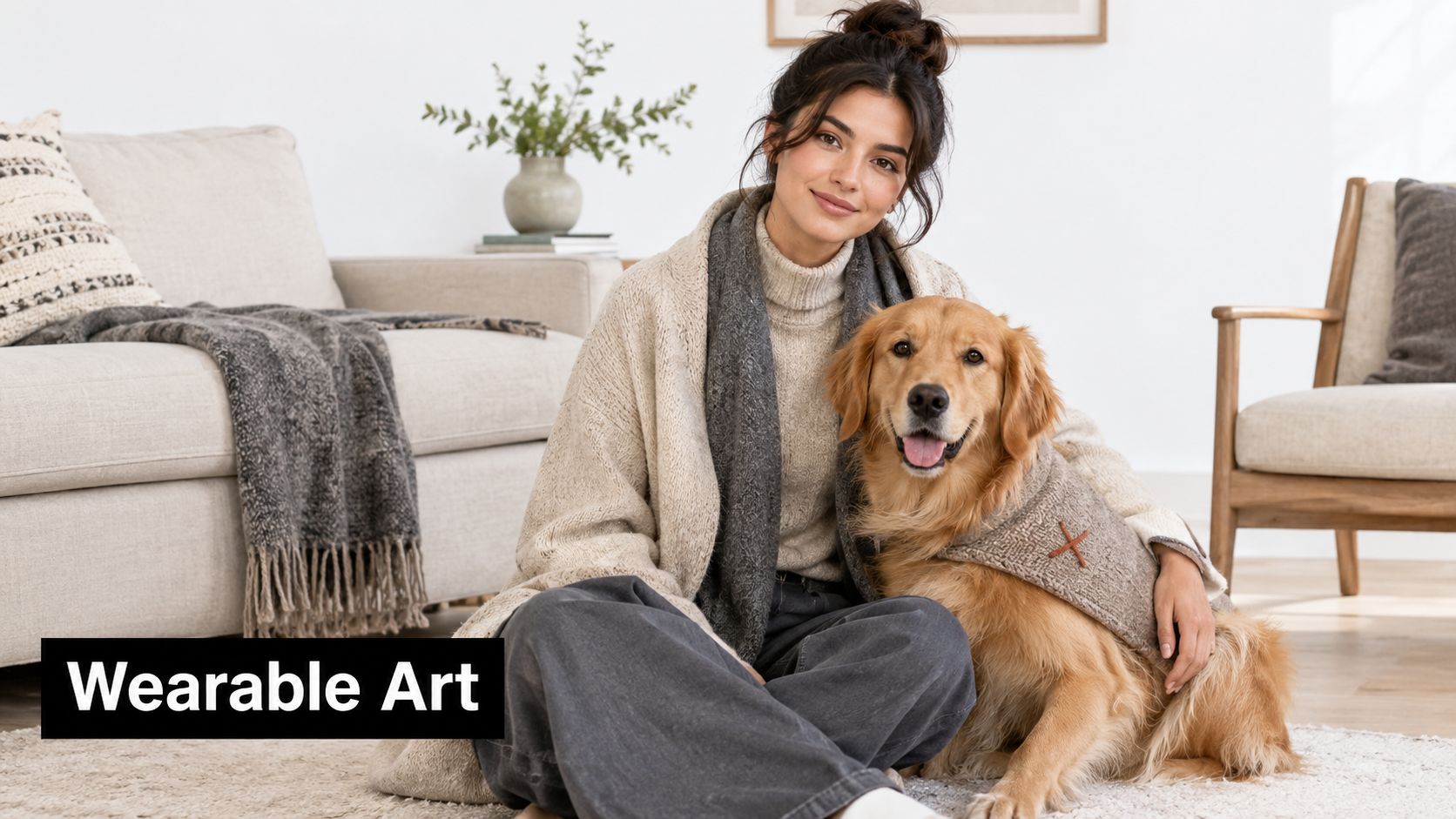
Style through restraint
A soft crown shape can reference millinery without becoming theatrical. A rich-toned lining can introduce color when the coat is open, and a reversible design can move from classic to vibrant with a simple turn.
Customization makes those choices practical. We can adapt a neckline for sensitive skin, add a discreet harness port, or coordinate a pet's coat with a human wardrobe palette. Your fabric, our expertise is especially useful when a client already owns a meaningful textile and wants to give it a second life through bespoke work.
Gifting requires more care than selecting a color from a screen. A fitted piece chosen after a private consultation avoids the guesswork of standard sizing. Monogrammed linings, seasonal color stories, and custom initials make the interior personal while keeping the exterior architectural and wearable.
A Seattle client once came to us with a clear vision for a greyhound's wedding-ready coat in a particular sage linen. The challenge wasn't ornament. It was giving the long, narrow body enough coverage while preserving the breed's elegant line and leaving room for natural movement.
Let the pet lead the design
The most useful questions are simple:
- What does the pet already tolerate? Start with familiar textures and avoid forcing a dramatic change.
- Where will the piece be worn? An indoor layer needs a different weight from a rain-facing walking coat.
- What does the home already contain? A pet garment can echo upholstery, knitwear, millinery, or a favorite wall color.
- Which detail matters emotionally? A lining, trim, or fabric may carry more meaning than a visible monogram.
For a complementary human wardrobe, explore Pandemonium's Cozy Cable collection. Its tactile knit language can guide a coordinated pet look without demanding identical garments.
The same thinking applies to a statement palette. The Fractal Collection offers bold prints and visual movement, while a pet piece can borrow one color from that story rather than reproduce every element.
The video below offers another visual reference for thinking about coordinated texture and proportion.
A good bespoke piece leaves room for the animal's personality. It should look considered in a photograph, but feel weightless, silky, plush, or substantial in the places that matter during an ordinary day.
Choosing With Intention and Caring for the Craft
The strongest purchase decision combines four questions: Where did the material come from? How was the garment built? Does the sizing evidence make sense? Can you care for it properly? If a product answers those questions clearly, the price becomes easier to evaluate without treating cost as proof of quality.
Use a practical buying checklist
- Material provenance: Look for named fibers, known textile qualities, and cruelty-free alternatives such as high-end faux fur or vegan fur.
- Construction evidence: Inspect seam finishing, reinforcement, lining placement, closures, and the leash opening.
- Sizing support: Expect a measurement chart, adjustment guidance, or a real custom-sizing conversation.
- Care demands: Read whether the piece requires spot cleaning, gentle washing, air drying, or professional attention.
- Daily safety: Check that trim, fasteners, and embellishments won't interfere with breathing, vision, movement, or harness use.
Luxury pet apparel is worth the price when it solves a real problem beautifully. It may provide a better fit for a difficult body, a more comfortable interior, a weather-resistant layer, or a durable piece that remains useful across seasons. It isn't worth the price when the premium rests only on a label or decorative excess.
Care determines whether the craftsmanship has time to reveal itself. Rotate between two pieces instead of wearing one continuously. Brush faux fur before storage, spot-clean wool and cashmere, condition leather tabs when the design includes them, and refasten loose closures before they become a failure point.
Our faux fur coat cleaning guide offers a sensible starting point for preserving plush fibers. Store garments clean and dry, give linings room to air, and avoid compressing velvety pile beneath heavy objects.
Small-batch pieces can become more personal with age. A softened waxed cotton shell, a familiar lining, or a carefully maintained high-end faux fur surface carries the record of use without becoming disposable. That's the quiet distinction between an intentional wardrobe and a status purchase.
At our Seattle studio, we make cruelty-free accessories and pet essentials in small batches, including reversible coats, custom sizing, colorways, custom initials, and monogrammed linings. Our 25+ years of Leigh Young's design experience guide the work, but the measure of success remains practical: the pet is comfortable, the garment is cared for, and the home feels more like itself.
Join The Crowd for studio notes and receive 15% off your first order, then visit Pandemonium Millinery to explore cruelty-free, small-batch pet coats and bespoke services shaped around your fabric, your pet, and our Seattle expertise.


