



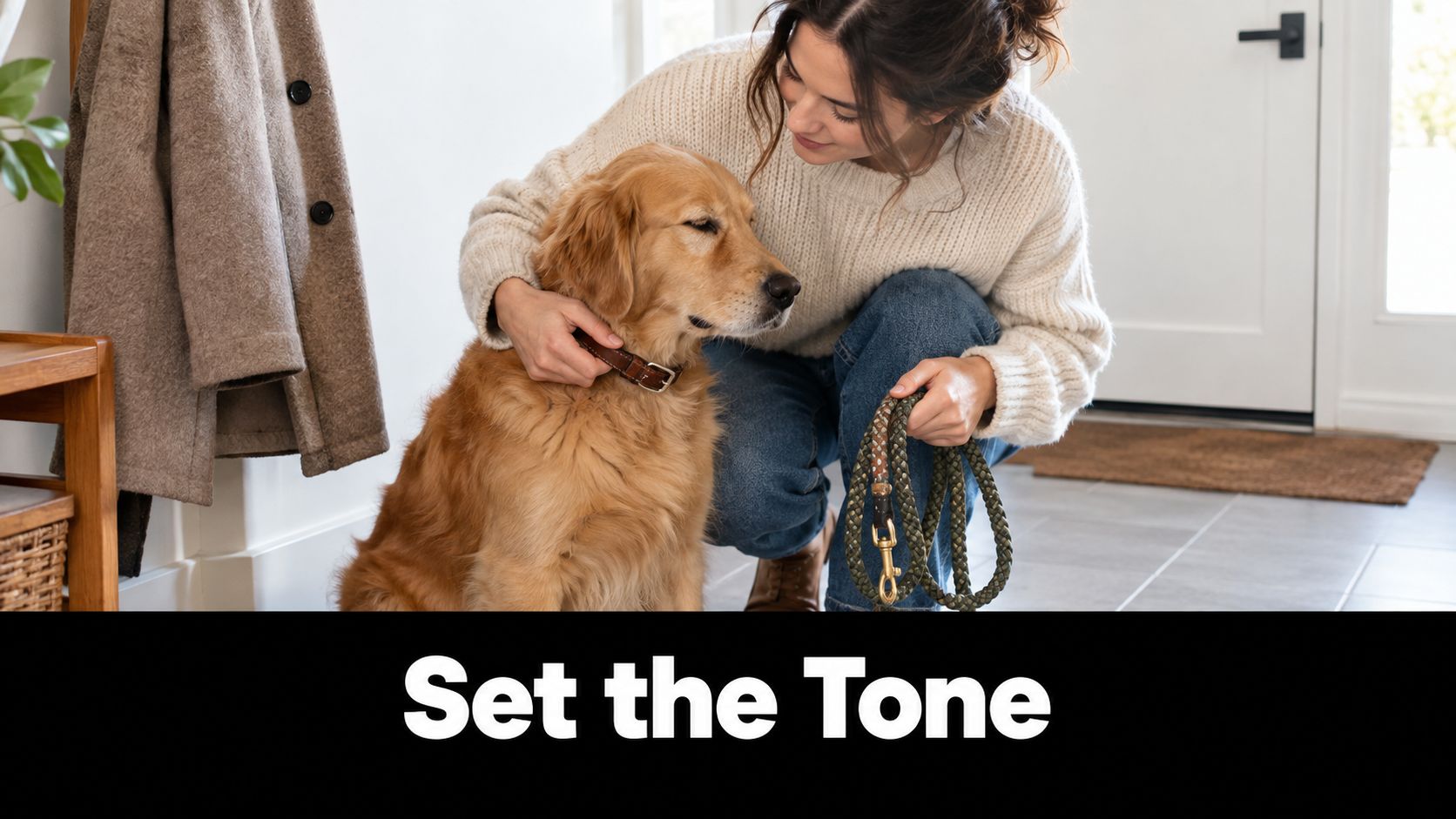
A sleepy dog waits in the tiled entryway while you reach for the leash, check the weather, and wonder whether that handsome coat will stay put once the walk begins. The brass clasp feels substantial in your hand, the treat pouch clicks against the bench, and one glance at the harness tells you whether the morning will be easy or full of rubbing, shifting, and readjusting.
That small ritual is where dog owner accessories prove their worth. They sit at the meeting point between canine comfort, daily safety, and the visual language of your home. We've spent 25+ years working with tactile materials in a Seattle studio, and our opinion is simple: start with the dog, then let the style follow.
A Morning Walk That Sets the Tone
The collar goes over the sleepy pup's head. It's soft against the fur, but not floppy. The leash has enough substance to feel steady without dragging at the wrist. A washable wool coat rustles as the dog turns toward the door, and the fabric settles across the shoulders instead of riding up behind the neck.
That difference matters before the first paw touches the pavement. A poorly placed harness can pinch. A loose coat can catch on a branch or shift beneath a leash. A rigid clasp can make a small dog feel as though the whole walk is being managed by hardware.
Practical rule: If you're adjusting an accessory repeatedly before leaving the house, it probably needs a better fit or a simpler design.
Once outside, the household divides its attention. The dog needs freedom to sniff, turn, sit, and move naturally. The owner needs a leash that feels balanced, a pocket that keeps treats dry, and enough confidence in the gear to stop thinking about it every few steps.
This is why we don't treat dog owner accessories as decorative extras. A coat changes how a dog handles rain and wind. A bed affects where the dog rests and how that corner of the room feels. A leash becomes part of the owner's clothing, especially in a city where a walk begins at the front door and continues through errands, cafés, and damp sidewalks.
The scale of the category is substantial. The American Veterinary Medical Association's pet ownership statistics report approximately 59.8 million U.S. households owned at least one dog in 2024, representing 45.5% of households, with an estimated dog population of 89.7 million. That broad base supports practical purchases such as collars, leashes, beds, coats, travel items, and toys, not just novelty pieces.
At home, the right accessory also helps contain the aftermath of the walk. A washable mat near the door, a coat that dries without holding moisture, and a dedicated towel keep mud from becoming a household-wide event. For homes with outdoor runs or frequently wet paws, this guide to durable turf for dog owners offers useful context on creating a cleaner, more forgiving surface.
Our local studio works in small batches because materials deserve attention at the cutting table. A velvety collar lining, a hand-sewn closure, or a reversible coat panel should feel intentional in the hand and quiet in the room. That's the standard we bring to every recommendation.
Two Wardrobes One Household
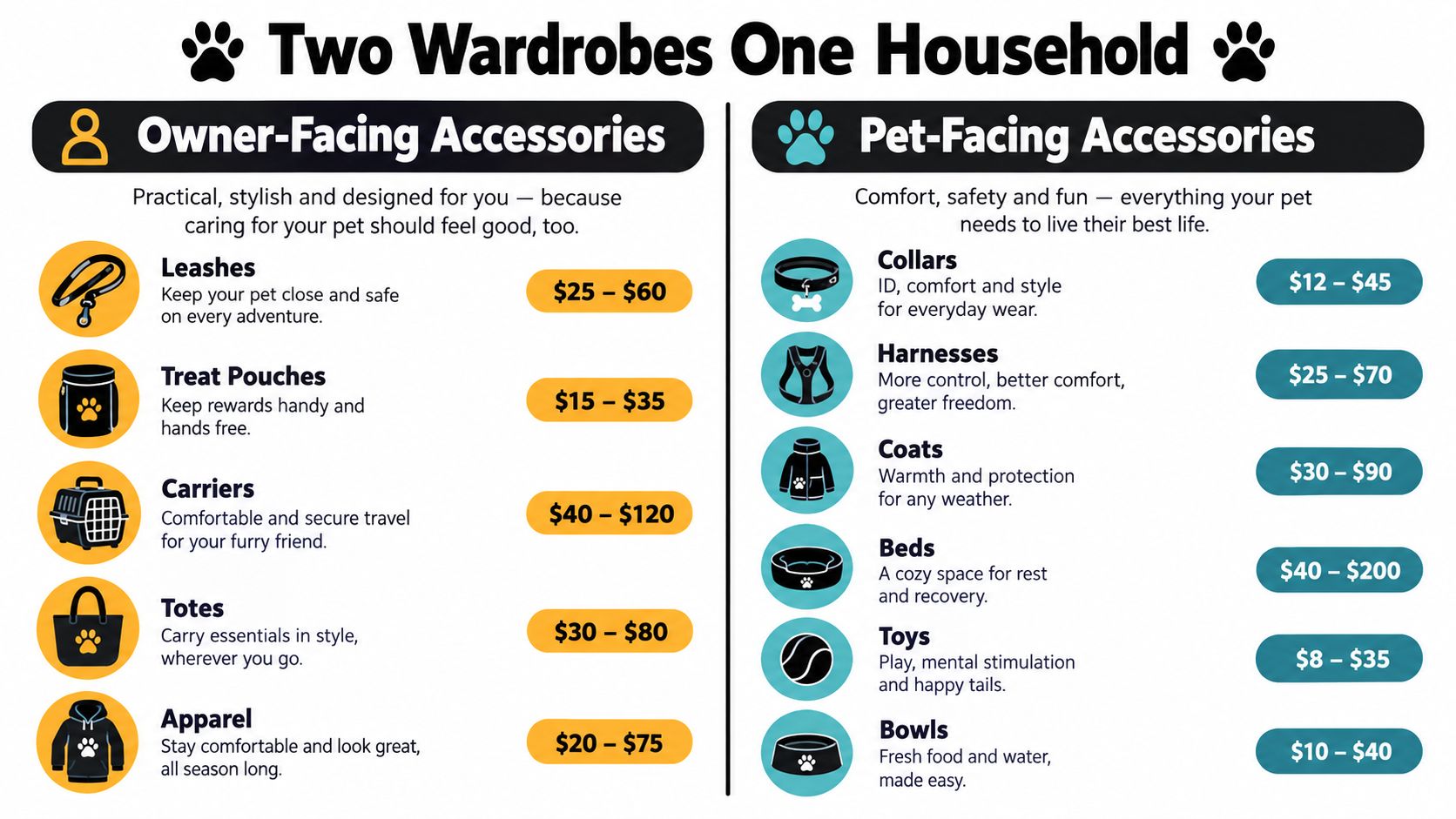
A dog household has two wardrobes, and each one has a job. The owner-facing side includes leashes, treat pouches, carriers, totes, and outerwear. The pet-facing side includes collars, harnesses, coats, beds, toys, and bowls.
The mistake is to judge either wardrobe only by appearance.
The owner-facing side
A leash should feel balanced from handle to clip. Bridle leather has a smooth, substantial hand-feel that softens with use. Waxed canvas feels drier and more utilitarian, with a surface that suits rainy walks and casual clothing. A leash that sits comfortably in the hand helps the owner respond to movement without gripping too tightly or carrying unnecessary weight across the shoulder.
A structured carrier does more than look polished. It gives a senior dog a stable base, limits unwanted shifting, and makes transitions through stations, shops, or waiting rooms easier. A soft tote can be lovely, but it should still support the dog's body and keep openings secure.
Treat pouches need a clean interior, a reliable closure, and a position that doesn't swing into the dog's face. Apparel should layer comfortably over the owner's clothing without turning the walk into a battle with sleeves, straps, or wet fabric.
The pet-facing side
A collar is appropriate for some dogs and not for others. A flat collar may suit a dog that doesn't pull, while a harness may be more suitable for a dog whose breathing, neck, or pulling behavior makes collar pressure a concern. Beds need enough support for the dog's body, a surface that doesn't trap unwanted heat, and a base that won't slide across the floor during a sleepy turn.
Raised beds can improve airflow and make it easier for some dogs to settle, while a plush bolster bed creates a protected, nest-like edge. The correct choice depends on the dog's age, mobility, coat, and resting habits, not on the room's color palette alone.
The spending environment also deserves honesty. AVMA reporting based on its 2024 survey found that dog-owning households spent more than $1,700 per dog-owning household in 2024, excluding adoption and purchase costs. Veterinary care averaged $580 for dog-owning households, while veterinary care represented about one-third of total pet spending across pet owners, leaving the remaining share for nonveterinary needs such as food, medication, and toys. The AVMA spending report shows that accessories sit within an established household budget rather than an isolated impulse category.
For a thoughtful look at how clothing can combine comfort, fit, and visual polish, explore our guide to luxury pet clothing. It's a useful reference before adding another pretty layer to the dog's wardrobe.
The best household feels edited. Choose the leash that you reach for, the coat that stays in place, and the bed that supports real rest. A small-batch accessory earns its place through repeated use.
Measuring the Dog Before Measuring the Style
Fit is the first style decision. Before choosing a rich tone, plush collar, or reversible print, measure the dog standing naturally on a level surface.
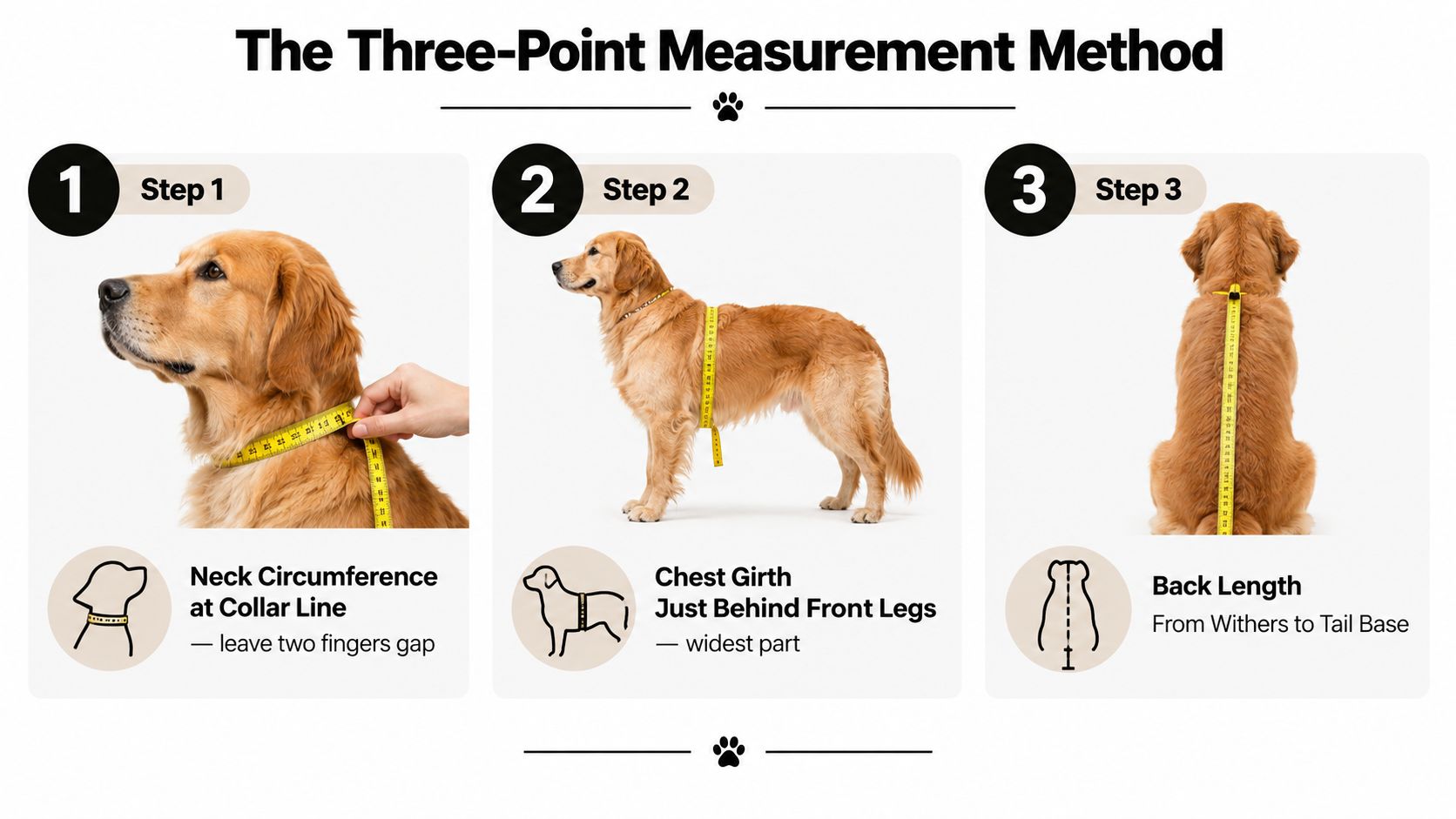
Use three measurements:
- Neck circumference: Measure at the base of the neck, where the collar or coat neckline will sit. Keep the tape close to the coat without compressing it.
- Chest girth: Measure around the widest part of the chest, just behind the front legs. This is often the measurement that exposes a poor fit.
- Back length: Measure from the neck base or withers to the tail base. Don't measure to the tip of the tail unless the product's chart specifically asks for it.
A collar should allow roughly a two-finger gap between the collar and the dog's neck. That space should remain comfortable without allowing the collar to slip over the head. Thick coats, seasonal shedding, and added layers can all change the fit, so measure the dog in the condition in which the accessory will be worn.
Read the sizing chart by the largest relevant measurement, then check the garment's adjustment range. Deep-chested and barrel-chested dogs may need more chest room even when their back length appears small. Breed labels are a starting point, not a measurement system.
The movement test
A coat should stay clear of the shoulders and allow a full sitting motion. Watch the dog walk in a straight line, turn, lie down, and rise. Look for shortened strides, reluctance to move, a shifting neckline, rubbing behind the forelegs, or a coat that lifts when the dog bends.
A harness needs the same scrutiny. It should avoid the trachea and shoulder joint, leave room for unrestricted forelimb extension, and remain stable during turns. A 2025 study of 66 domestic dogs found that harness design affected stride length, body-weight distribution, and estimated limb and joint angles, but the effects varied across breeds and harness types. The peer-reviewed gait study supports an individualized approach rather than a universal “best” harness.
A separate veterinary review also found no single restraint device suited every dog. Non-tightening front-clip harnesses may help balance comfort and pulling reduction, while tightening harnesses, martingale collars, and head collars call for more caution. Collar use can also increase intraocular pressure in some short-nosed and long-nosed dogs during walking, as discussed in this review of canine restraint devices.
Breathing and movement outrank branding. Our guide to measuring a dog for a coat is a practical place to begin before ordering a winter layer.
If the dog pulls away, pants unusually, scratches at the garment, or moves differently after fitting, remove the accessory and reassess. A beautiful piece that interferes with gait doesn't belong in the wardrobe.
Why Faux Fur Belongs in the Pet Aisle
High-end faux fur has a useful place in pet accessories because it can offer warmth, softness, visual richness, and an ethical alternative to animal fur. We prefer vegan fur, washable linings, and carefully chosen pile because the material should work for the dog, the household, and the values of the person buying it.
The useful comparison isn't just “soft or not soft.” Look at warmth-to-weight, shoulder drape, laundering, surface behavior, and material disclosure.
| Attribute | Standard Faux Fur | Vegan Fur | Tissavel-Style Pile |
|---|---|---|---|
| Hand-feel | Plush and velvety, with varied pile depending on construction | Soft, lightweight, and suitable for cruelty-free designs | Dense, silky, and especially rich to the touch |
| Drape | Can range from structured to fluid | Often light and flexible | Typically substantial while remaining graceful across the shoulders |
| Care | Depends on the backing and lining, so follow the garment instructions | Usually selected for practical, repeatable care | Requires careful laundering to preserve pile character |
| Visual effect | Classic, textural, and easy to coordinate with home décor | Clean, modern, and adaptable | Architectural, luxurious, and deeply tactile |
| Best use | Reversible coats, collars, blankets, and soft furnishings | Lightweight layers and lining systems | Statement collars, plush beds, and premium outer panels |
Thermoregulation depends on the dog and the conditions, not on fabric thickness alone. Small dogs, short-coated dogs, older dogs, dogs with low body fat, and dogs that aren't acclimatized to cold may need more protection. Wet and windy weather increases heat loss, while an active dog may need a lighter layer than a dog standing still.
A useful coat has three coordinated elements: a weather-resistant outer shell, removable insulation, and a soft lining. That modular approach is more practical than one fixed-weight garment because the dog's activity and the weather change throughout the day. The canine thermoregulation guide offers a helpful explanation of those variables.
Surface texture also matters. Pile height, stitch density, and the relationship between the fur and its backing influence matting and wear. A woven cotton lining can reduce static and help the coat glide over the dog's own coat, while a removable insert can serve in a stroller or crate when the outer layer isn't needed.
Real fur remains available in this category, but our small-batch studio chooses high-end faux fur and vegan fur for practical and ethical reasons. The material avoids animal fur while offering a plush appearance, and it's a thoughtful choice around children, guests, and households that prefer an animal-free textile. Read our guide to the best faux fur for pet hair resistance before selecting a pile.
Material honesty matters. The Federal Trade Commission's textile labeling guidance explains that covered textile and wool products generally need fiber content, country of origin, and manufacturer or responsible marketer information. Ethical luxury should be tactile, but it should also be accurately labeled.
Matching Your Pet to Your Living Room
A coordinated pet aesthetic isn't a gimmick. The dog bed lives in the room, the leash hangs by the door, and the coat may sit over a chair between walks. Those objects contribute to the interior whether you planned the palette or not.
Start with two shared tones and one shared texture. That rule keeps the result intentional without turning the dog into a costume.
Stone oak and heathered oat
Against a stone-oak floor, a heathered oat bed and a natural rope leash feel settled rather than staged. The warm neutrals echo the floor, while the woven texture keeps the room from becoming flat. A plush throw can soften the harder lines without creating a slippery landing for an older dog.
Deep green and forest tones
A deep green velvet sofa pairs beautifully with a forest-toned coat and a classic collar. The colors don't need to match exactly. Let the velvet carry the saturated depth, then repeat that depth in the dog's outer layer while keeping the leash quieter.
A cognac leather tote or merino scarf can add the owner's wardrobe to the composition. That small echo creates continuity without producing a matching set that feels overly precious.
Minimal white and cream
A minimalist white room benefits from one substantial texture. A cream faux fur lounger can become the warm anchor, especially when the dog's coat has darker markings that give the pale setting contrast. Keep the surrounding accessories simple, with smooth leather or a clean canvas handle instead of several competing patterns.
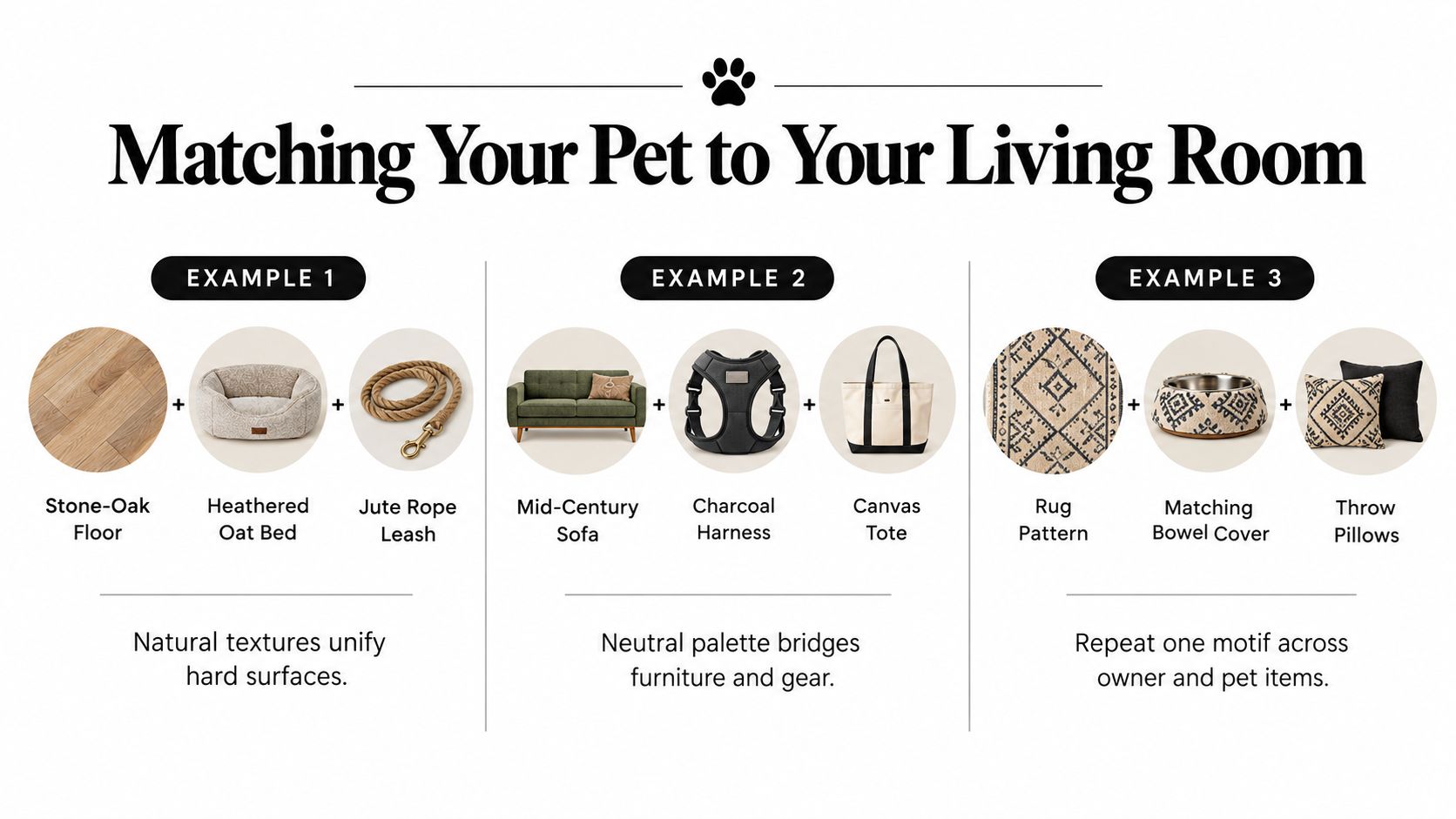
Texture often does more work than color. Bouclé reads soft and domestic. A flat mat feels practical. Smooth leather introduces structure. Faux fur adds a velvety, almost luminous surface that changes as the light moves across it.
The caution is important for senior dogs. Slippery indoor fabrics can make standing, turning, and settling harder on compromised joints. Choose a bed with a stable base and place it where the dog won't need to launch across polished flooring.
For a room that needs softness without visual clutter, our guide to luxury faux fur dog blankets offers ideas for using plush layers as both comfort and décor. We're fond of pieces that look at home on the sofa but still belong to the dog.
Buying Less and Buying Better
A craftsperson's buying framework begins with service life, not novelty. Before purchasing another seasonal piece, ask four questions:
- Longevity: Will the construction hold up through repeated walks, washing, and changing weather?
- Repairability: Can a lining, closure, strap, or seam be repaired instead of discarding the whole piece?
- Multi-season use: Can a removable liner or reversible panel extend the accessory into another season?
- Daily relevance: Will you reach for it often, or will it remain attractive and untouched?
Cost-per-use is more revealing than the price on the tag. A seasonal jacket worn only a handful of times may be less responsible than a modular coat that becomes part of the weekly routine for years. You don't need a spreadsheet to understand the principle. Count likely uses, consider maintenance, and be honest about whether the dog will tolerate the piece.
Economic pressure makes that discipline more important. A 2025 report citing APPA survey results said 32% of U.S. pet owners spent less in 2025, up from 22% in 2024, while half reported no change in spending. Research summarized by GlobalPETS also reported that 85% of surveyed pet owners in France, Canada, the United States, and the United Kingdom felt rising living costs had strained their finances. The GlobalPETS report on pet ownership and spending gives useful context for choosing durable, repairable pieces over constant replacement.
Gifts with a point of view
A well-made accessory can carry meaning without becoming wasteful.
- For a new puppy parent: Choose a practical starter piece with room for adjustment and clear care instructions.
- For a senior dog's final season: Commission a soft, personal item that honors the dog's comfort and the household's memories.
- For a housewarming gift: Pair a useful bed or blanket with tones drawn from the recipient's interior.
- For the person who owns everything: Look for a bespoke textile, custom fit, or repairable detail they wouldn't find in a standard shop.
Travel deserves the same restraint. Before packing a carrier, mat, or coat, compare the dog's actual needs with this guide to top pet moving accessories from Precious Pets Transport Services, LLC. The right travel kit is compact, washable, and familiar to the dog.
Buying less doesn't mean accepting less beauty. It means asking beauty to work harder.
The Bespoke Touch and Where to Begin
Custom work is the natural endpoint of everything that comes before it. Once you've considered gait, breathing, climate, material, room palette, and repairability, a bespoke piece stops feeling extravagant. It becomes the cleanest way to solve a real problem.
At our local Seattle studio, the intake begins with information, not assumptions. Share the dog's neck, chest, and back measurements, along with photos that show proportions from the side and front. Tell us whether the dog pulls, turns sharply, dislikes overhead garments, overheats easily, or needs extra softness against thinning skin.
Swatches help complete the picture. A sample from the owner's merino scarf, cognac leather tote, or sofa can guide the tone and texture without forcing a match. The result might be a reversible coat, a lined collar, a bolster bed, or a small accessory that ties the dog's corner to the rest of the room.
Bespoke work is especially useful for bodies that standard sizing handles poorly. A barrel-chested sighthound, narrow-waisted terrier, small brachycephalic dog, or senior with changing mobility may need adjustments that a breed label can't provide. Custom sizing also makes room for seasonal coat changes and layers.
Ask about lead times, deposits, materials, and alteration policies before work begins. A careful studio should explain what can be adjusted, how the item should be washed, and which parts can be repaired. Our approach is rooted in your fabric, our expertise, with hand-sewn details, small-batch production, and cruelty-free luxury built around the individual wearer.
You can begin with one piece. The custom pet accessories guide is a sensible starting point for gathering measurements, photos, and inspiration. A single well-resolved coat or bed can teach you what your dog likes, what your home needs, and which materials deserve a larger place in the household.
Leigh Young's design legacy has always centered on tactile choices, careful construction, and the character of a material. After 25+ years of design experience, our Seattle studio still treats every commission as a conversation between the hand, the eye, and the life the piece will enter.
Join The Crowd for 15% off and thoughtful notes from our Seattle studio, then visit Pandemonium Millinery to explore hand-sewn faux fur accessories, pet essentials, and bespoke pieces made with your dog's comfort and your home's character in mind.


