



The most popular advice about cruelty free luxury bags is also the least useful: choose anything labeled “vegan” and assume the ethical decision is finished. A label can tell you what a product avoids, but it may not tell you how it feels in the hand, how its coating will age, whether its handles can be repaired, or what happens when the bag wears out.
After more than 25 years of design experience, we've learned that luxury is found in the details people can touch. A velvety high-end faux fur, a silky luxury textile, a carefully balanced silhouette, and hand-sewn stress points can say more about responsible design than a broad marketing phrase. For shoppers who want an ethical alternative without giving up warmth, structure, and character, the key question is simple: what is the bag made from, how was it constructed, and how long can it remain part of your life?
Why Cruelty-Free Luxury Requires More Than a Label
Animal-free design has moved well beyond a specialist conversation. A 2024 YouGov survey commissioned by FOUR PAWS found that 65% of adults across 12 international markets were aware of animal-cruelty issues in fashion, while 72% believed fashion brands should be responsible for animal-welfare standards throughout their supply chains. The survey also found that 27% had decided to avoid animal-based fashion products altogether. These figures support a clear conclusion: cruelty-free positioning reflects a meaningful purchasing concern, not a decorative phrase. Read the full FOUR PAWS and YouGov survey.
Yet animal-free doesn't automatically mean luxurious, durable, or environmentally gentle. A coated synthetic leather may avoid animal hide while relying on fossil-based polyurethane or PVC, and its surface can eventually peel, crack, or become difficult to repair. A carefully selected textile construction can offer a different experience, particularly when the maker discloses its fiber content, backing, finish, and care requirements.
Luxury begins with the hand
In our local Seattle studio, we assess a material before we ever cut it. We look for a substantial but not cumbersome hand, a rich-toned surface that responds naturally to light, and enough resilience to hold an architectural shape. A premium Tissavel textile, for example, has a plush, tactile character that behaves differently from a thin plastic coating. It can bring softness and visual depth to a bag without pretending to be animal leather.
That distinction matters because the eye can be persuaded by a photograph. The hand is harder to fool. Run your fingers over the surface, flex a corner, inspect the underside, and look at where the handles meet the body. A luxury bag should feel intentional at every point, including the places no one ever sees.
Practical rule: “Vegan” describes an ethical boundary. It doesn't, by itself, describe construction quality.
The luxury sector's history reinforces this shift. Calvin Klein discontinued fur in 1994, Ralph Lauren followed in 2006, and Stella McCartney launched in 2001 with an animal-fur-free identity. Gucci announced a fur ban in 2017, followed by Burberry, Prada, and Versace in subsequent years. In 2021, Kering committed to a fur ban across its major fashion houses, including Balenciaga, Saint Laurent, and Alexander McQueen. Vogue's overview of fashion's fur-free shift places these decisions within a longer industry transformation.
For an ethical luxury shopper, the lesson isn't to accept any substitute without questions. It's to judge the complete object, from fiber and adhesive to seam finish and repair policy. Our cruelty-free certification guide offers another useful starting point, particularly for separating animal-free claims from broader labor and environmental claims.
How to Verify Genuine Ethical Luxury Claims
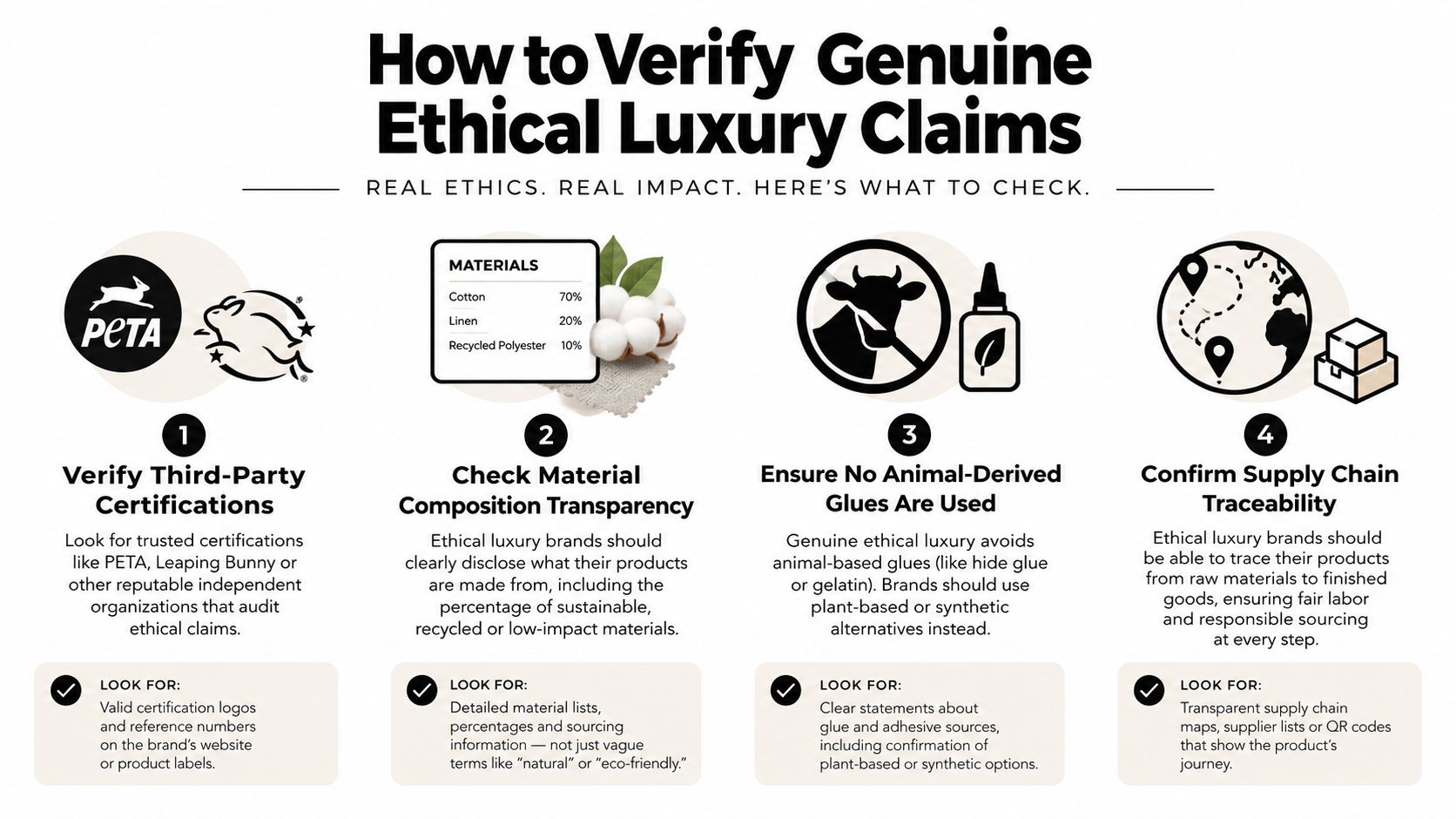
A responsible purchase starts with evidence you can understand. You don't need a laboratory in your home, but you do need more information than a hangtag with the word “vegan.”
Ask for the material passport
Start with the bag's composition. Look for the face fabric, backing, lining, thread, trim, closures, adhesives, and percentage of recycled or bio-based content where applicable. “Vegan leather” is too broad to tell you whether the surface is polyurethane, PVC, a plant-derived composite, or a textile with a coating.
A small studio should also be able to tell you where the bag was made, whether production is in-house or subcontracted, and which components may be replaced. Local manufacturing can improve traceability, but it doesn't prove a product has a lower environmental impact by itself. The useful evidence is specific information, not an attractive origin story.
Examine the construction
A premium bag should reveal thoughtful engineering in its stress points. Check whether handles are stitched and reinforced, whether straps can be replaced, and whether the lining can be reached for repair. Inspect corners for clean binding, examine the reverse side of seams, and ask how the material responds to abrasion, moisture, and repeated flexing.
A high-end textile construction may have a different set of strengths from coated leather alternatives. The important comparison isn't which material sounds most fashionable. It's whether the chosen material suits the job, whether the design protects vulnerable areas, and whether the maker is honest about limitations.
The United States Federal Trade Commission provides a useful example of why accurate material language matters. Under the Fur Products Labeling Act, products containing animal fur must identify the material and animal origin in a legible and conspicuous way. An animal-free luxury bag should likewise describe high-end faux fur or another textile accurately, without wording or styling that could mislead a customer into thinking it contains animal fur. See the FTC guidance on fur labeling.
Separate the claims
Ethical purchasing becomes easier when you divide the word “responsible” into individual questions:
- Animal welfare: Does the product avoid animal-derived fibers, fur, leather, feathers, down, and animal-derived glues?
- Material composition: Does the brand name the face, backing, lining, finish, and hardware?
- Labor and origin: Does the maker disclose the country or studio of manufacture and relevant subcontracting?
- Durability: Are there physical tests, repair options, or clear care instructions?
- End of use: Can parts be replaced, separated, repaired, or responsibly handled when the bag is no longer wearable?
Third-party certifications can help, but they don't answer every question for every material and trim. A certificate may support an animal-free claim while saying little about abrasion resistance or disposal. Our guide to cruelty-free luxury brands expands on the difference between certification, documentation, and brand language.
The European Union is developing textile requirements under its 2025–2030 Ecodesign Working Plan, including a Digital Product Passport intended to make product information accessible and comparable across a product's lifecycle. The passport is expected to make information available online through a product-level data carrier such as a QR code. Learn about the European Union's Digital Product Passport for textiles and apparel.
That direction points toward a more useful definition of luxury. A bag becomes more valuable when its story is verifiable, its limitations are stated plainly, and its construction gives the owner a practical reason to keep using it.
The Environmental Science of Durable Construction
A cruelty-free bag still uses resources. The ethical question therefore shouldn't stop at animal origin. It should include the full life of the object, from raw-material extraction and manufacturing through transport, use, repair, recycling, and disposal.
Life-cycle assessment, or LCA, evaluates those stages across categories such as climate change, water use, toxicity, eutrophication, and resource depletion. One comparative LCA found that bovine leather had the highest overall impact among the materials studied, driven largely by carbon footprint, toxicity potential, and water use. Polyurethane-based leather ranked lower overall in that comparison, but remained dependent on non-renewable feedstocks and energy-intensive processing. Review the comparative LCA research.
That result doesn't turn every coated alternative into a poor choice. It does show why “vegan” and “sustainable” shouldn't be treated as interchangeable. A lower-impact decision may involve recycled or bio-based inputs, less intensive coatings, a repairable design, and a service life that justifies the resources used to make the bag.
Longevity changes the calculation
A bag that fails early needs to be replaced. The next purchase carries its own material, manufacturing, packaging, and transport impacts, so durability becomes an environmental specification rather than a sentimental bonus.
Independent research on bio-based leather substitutes found that improving durability to match the replacement interval of animal leather can reduce water-scarcity and climate impacts by approximately 25–70%. Read the research on durability and bio-based leather substitutes. The finding is especially relevant to luxury accessories, where the design should invite repeated use rather than occasional display.
Test the places that fail first
In a working studio, durability is not assessed by appearance alone. A polished surface can still hide weak construction. For a luxury bag, useful benchmarks include:
- Seam and tear resistance: Load-bearing panels and strap attachments need reinforcement where weight concentrates.
- Abrasion resistance: Corners, handles, and lower edges should withstand contact with clothing, furniture, and travel surfaces.
- Flex-crack resistance: Coated surfaces need testing at folds and bends, not only on a flat sample.
- Colorfastness: Rich tones should resist transfer under rubbing and moisture.
- Hardware cycles: Zippers, clasps, rings, and closures should operate smoothly through repeated use.
The same logic informs our small-batch work. Reinforced stress points, replaceable straps, stitched handles, and accessible linings can extend the useful life of a bag. Bespoke sizing can help too. A bag that sits comfortably on the shoulder or fits the owner's daily needs is more likely to be carried often, rather than abandoned in a wardrobe.
A durable cruelty-free bag doesn't claim that material substitution solves everything. It reduces harm by making the finished object worth keeping.
The small-batch production guide explores why careful quantities and hands-on inspection matter. The central principle is straightforward: craftsmanship is ethical when it protects the life of the product, not merely when it adds a handmade story to the product page.
The Value of Local Artisan Craftsmanship
A material can be carefully selected and still be poorly used. A local studio earns its value through the decisions made after the roll of fabric arrives, including how the pattern is placed, where seams are reinforced, and whether a maker notices a flaw before the bag leaves the worktable.
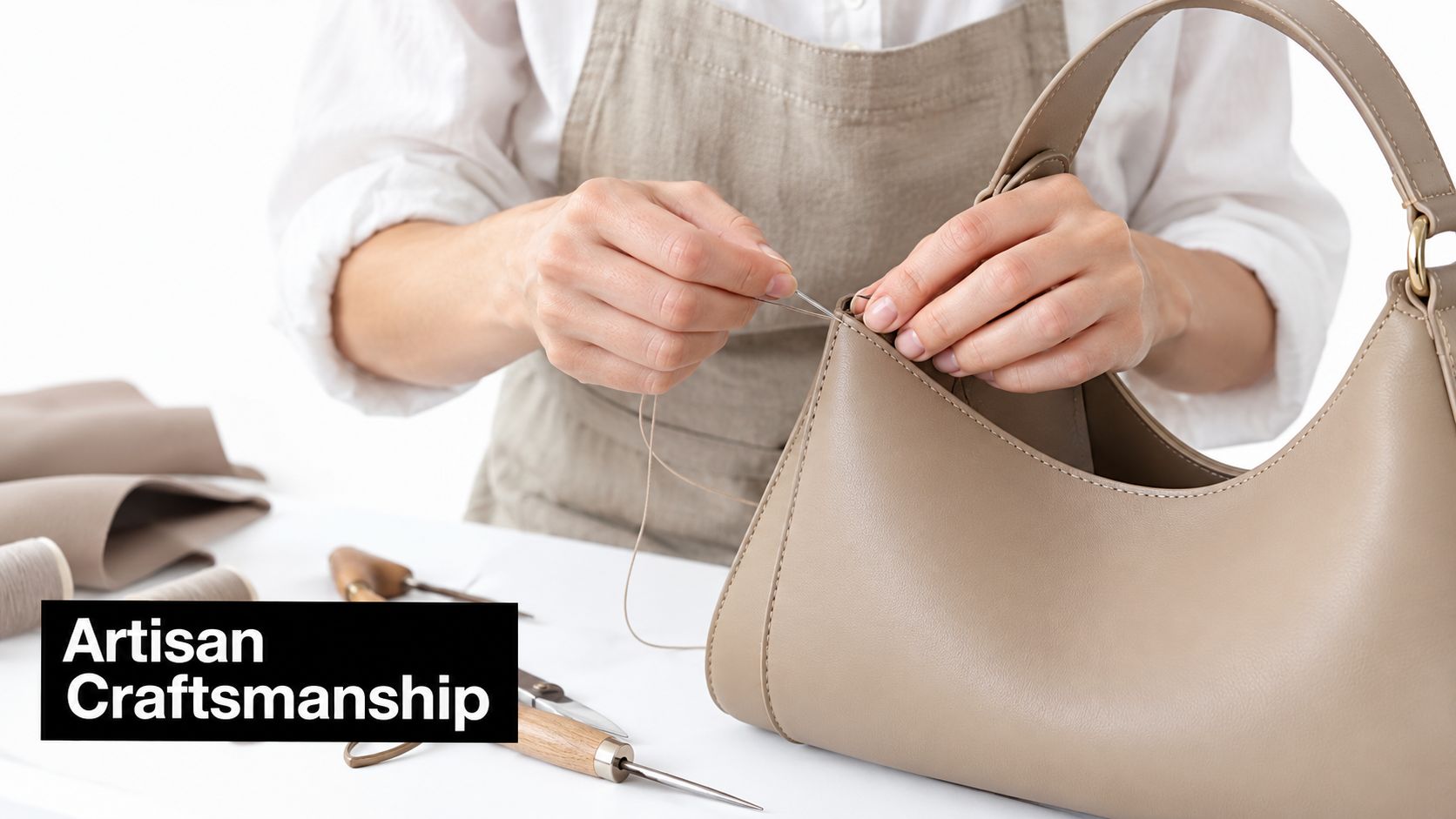
At our Seattle studio, small-batch production keeps those decisions close to the people making the piece. Leigh Young has more than 25 years of design experience, and that long view shows up in practical ways: a handle is positioned for balance, a plush textile is oriented so the nap reads consistently, and a difficult fit is adjusted before it becomes the customer's problem.
The human scale of quality control
Large-scale production can produce excellent goods, but a customer shouldn't assume that volume alone guarantees consistency. A small artisan team can inspect the material, catch irregularities, and make adjustments while the work is still in progress. That doesn't eliminate every flaw, and it doesn't automatically make a product sustainable. It gives the maker a closer relationship with the object.
That closeness also supports customization. Our custom sizing and “your fabric, our expertise” services allow a customer to discuss proportions, fabric choices, and specific adjustments rather than accepting a fixed shape that doesn't suit their wardrobe or body. For people with specific shoulder, sleeve, or fit requirements, that can be the difference between a beautiful accessory and one that remains useful.
The broader waste context makes fit and longevity more than matters of taste. The United States Environmental Protection Agency estimated that Americans generated 17 million tons of textiles in 2018, with only 14.7% recycled. Review the EPA's textile material data. Customization doesn't make every textile recyclable, but a better-fitting and better-loved piece has a stronger chance of staying in use.
Seattle craftsmanship and ethical luxury
Local production also creates a more direct conversation about limitations. A customer can ask whether a strap contains animal-derived material, whether a lining can be replaced, or whether a particular Tissavel textile is suitable for regular rain. Those answers should be part of the buying decision, not hidden behind a vague sustainability claim.
The most convincing ethical luxury is therefore tangible. It's a hand-sewn finish that doesn't twist, a lining that remains accessible for repair, a structured base that protects the bag, and a maker who can explain why one textile works better than another. Our perspective on supporting local business comes from that direct relationship between customer, material, and maker.
For anyone shopping for cruelty free luxury bags, local craftsmanship isn't a moral shortcut. It's an opportunity to ask better questions and receive answers grounded in the actual object.
Styling and Caring for Premium Faux Textiles
High-end faux fur and luxury textiles reward considerate care. Their appeal comes from the surface, the drape, and the way the fibers catch light, so storage and cleaning should protect those qualities rather than flatten them.
Synthetic textiles need particular attention during laundering. The European Commission estimates that around 60% of clothing fibers are synthetic, and reports that as much as 40,000 tonnes of synthetic fibers may be released annually through washing-machine effluent, with the greatest release occurring during the first 5 to 10 washes. Read the European Commission's assessment of synthetic fiber release.
Clean less, brush gently
For a faux-fur bag, start with spot cleaning rather than immersion. Blot moisture with a clean towel, use a mild product only when the care label permits it, and avoid aggressive rubbing that can disturb the pile or create a shiny patch. Let the piece dry naturally away from direct heat, then use a soft brush to restore the nap once it's completely dry.
Tissavel and other premium faux textiles should never be treated as indestructible. Their plush, silky surface benefits from gentle handling, especially around corners and openings where repeated friction can change the texture.
- For daily dust: Shake the bag gently outdoors or use a soft garment brush.
- For rain: Blot rather than wiping, then allow the bag to dry in its natural shape.
- For storage: Keep it upright or lightly supported, away from compression that can flatten the pile.
- For hardware: Wipe metal closures with a dry, soft cloth and keep lotions or moisture away from moving parts.
- For long-term care: Follow the maker's instructions before using steam, detergent, or professional cleaning.
Our faux-fur cleaning guide includes more detailed handling advice for plush surfaces. If a bag includes a leather-free watch or wrist detail, a separate guide to premium watch straps can help you compare material and care considerations without assuming that every strap has the same maintenance needs.
Wear beautifully, not cautiously
Care shouldn't turn an accessory into a museum object. A weather-resistant, cozy bag should accompany a commute, dinner, or weekend trip, provided you protect it from avoidable strain. Don't overload a soft handle, don't leave a damp bag compressed in a car, and don't store it while the fibers are wet.
The most effective care practice is extended use. Choose a silhouette that works with your wardrobe, repair small problems early, and ask whether a worn handle or lining can be replaced before the entire bag becomes unusable. That approach respects the labor and resources already invested in the piece.
Curated Collections for the Ethical Connoisseur
Ethical luxury becomes easier to understand when you can hold the finished object in mind. Our Prague shoulder bag demonstrates how a structured silhouette can carry the tactile presence of faux fur and upholstery-inspired textiles, while the Fractal Collection brings shimmering, vibrant pattern into a more architectural wardrobe.
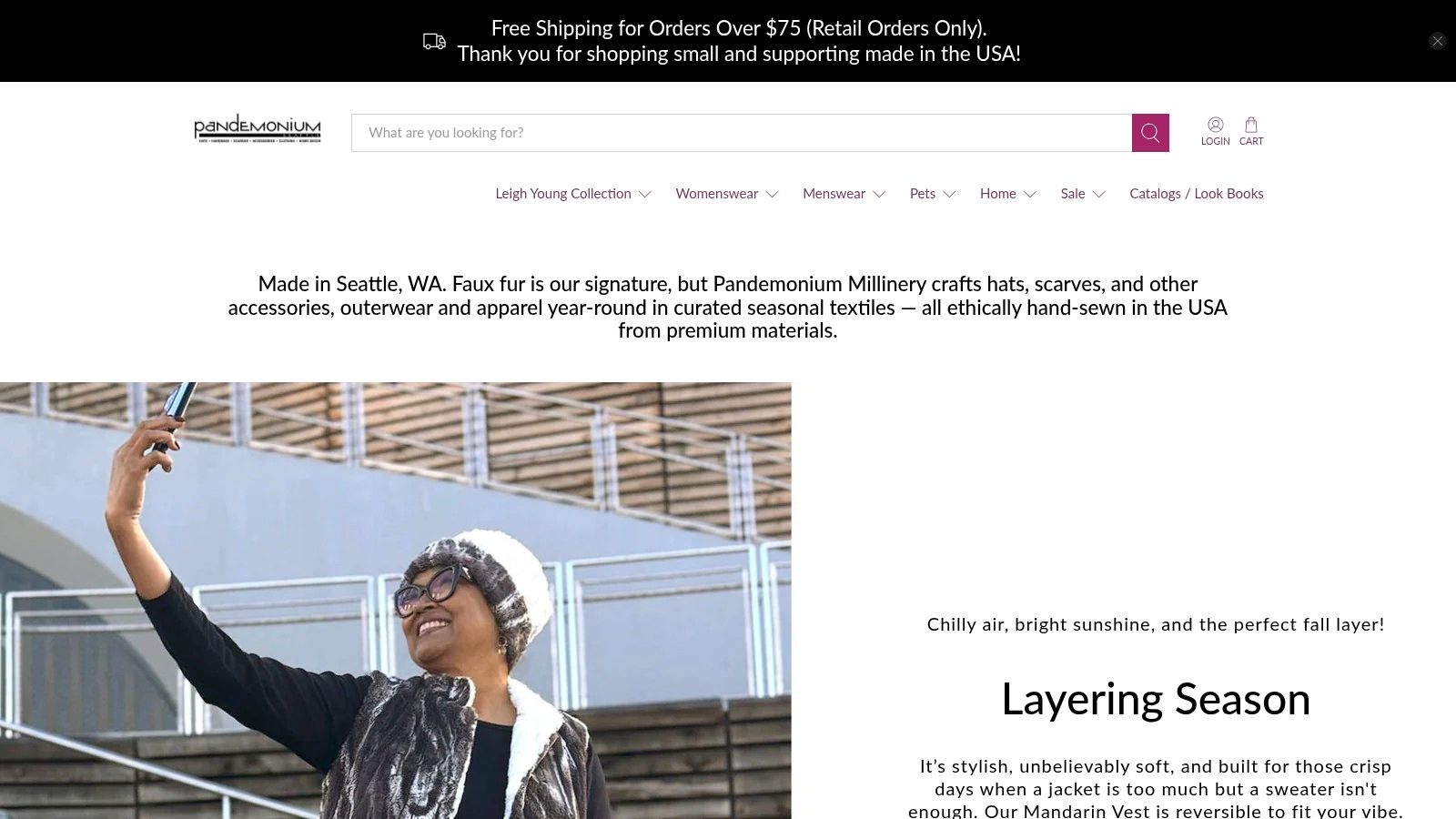
A velvet-lined accessory can feel weightless against the hand while still appearing substantial on the shoulder. For a quieter palette, the Cozy Cable Collection offers a classic, plush texture that suits cold-climate dressing without relying on animal materials. These pieces are produced in small batches, and bespoke requests can include custom sizing, made-to-measure adjustments, and “your fabric, our expertise” services.
Our team also encourages customers to ask about components before ordering. Some handbag styles may include real leather components, while selected straps and handles can have faux alternatives. That detail matters, and transparent communication is part of the luxury experience.
The following video offers a closer look at the visual language and making spirit behind the studio's work.
Cruelty free luxury bags should feel good in the hand, hold their shape in daily use, and come with enough information for the owner to care for them properly. That's the standard we continue to pursue through Seattle craftsmanship, high-end faux fur, and more than 25 years of design experience shaped by Leigh Young's legacy.
Join The Crowd, our email list, for 15% off and thoughtful notes from our Seattle studio, then visit Pandemonium Millinery to explore small-batch faux-fur handbags, bespoke services, and the Fractal Collection. Choose the piece whose material, construction, and tactile character you'll be glad to carry for years.


