



The 7 a.m. platform is where a winter scarf earns its keep. Rain has darkened your coat collar, wind is finding the gap beneath your chin, and the beautiful scarf you bought last year lies flat instead of sealing in warmth. After more than 25 years of Seattle design experience, our team at Pandemonium has learned a simple lesson: the right scarf isn't chosen by color alone. It's fitted to your commute, your coat, your face, and the way you move through winter.
A custom winter scarf should feel cozy, plush, weather-resistant, and intentional. At our local Seattle studio, we approach every small-batch piece as a practical luxury textile, with cruelty-free materials, careful construction, and adjustments that make sense for real bodies and real mornings.
What Makes a Winter Scarf Truly Custom
Customization goes well beyond adding initials. A custom winter scarf is a collaboration between wearer and artisan, beginning with the conditions the scarf must handle and ending with a piece that sits correctly on the body.
Start with the outer fabric. High-end faux fur offers a velvety surface, visual volume, and a strong wind-blocking presence. A heavyweight knit brings breathable warmth and an easy, classic drape. Woven wool creates a more architectural silhouette, especially when paired with a soft lining that keeps the fabric comfortable against the neck.
The lining deserves equal attention. Velvet feels silky and substantial, fleece adds practical insulation, and brushed cotton gives a softer, quieter finish. A lining can also change how the scarf slides beneath a coat collar. That small decision often matters more than decorative embroidery.
Build the scarf around the wearer
Our team considers four fit decisions before discussing trim:
- Length: A petite wearer who prefers a neat loop needs something different from a tall commuter who wants an oversized wrap.
- Width: A narrow scarf keeps the face open, while a wider version creates a shawl-like barrier over the upper chest.
- Thickness: Loft is useful in wind, but excess bulk can make a coat uncomfortable.
- Finish: Hand-sewn edges, closures, and small-batch hardware affect both appearance and daily function.
Made-to-order work also gives buyers a clearer connection to provenance. You can ask who made the piece, which fibers and textiles were selected, and whether the construction reflects an ethical alternative to animal fur. That transparency is central to cruelty-free luxury, particularly for shoppers who want the richness of fur without using animal product.
Our Seattle studio produces in small batches rather than treating personalization as a printed afterthought. We explain that distinction in our guide to small-batch production versus mass-market fashion, where the focus is on the maker, the process, and the value of thoughtful construction.
Practical rule: If a seller asks only for your preferred color and monogram, you're buying personalization. If they ask about your coat, climate, proportions, and wrapping habits, you're beginning a custom design.
Choosing Fabrics That Actually Keep You Warm
Fabric choice should follow your commute, not a generic warmth promise. A ferry ride through wet wind demands a different construction from a dry, sharply cold walk between a train station and an office.
Faux fur is our first choice when the priority is plush loft and a strong visual frame around the face. Its raised pile helps create a cozy barrier against moving air, and high-end versions can look rich-toned rather than theatrical. The trade-off is care. The pile may need gentle refluffing, and it can lose its polished direction when compressed beneath a bag strap or coat.
Merino and alpaca knits offer a more fluid answer. Dense knitwear breathes well, folds easily, and drapes naturally over a peacoat or trench. Wool has a practical advantage in damp cold because it can retain insulation when moisture is present, while acrylic is lower-maintenance and often more affordable but can lose insulating performance more quickly when wet, as discussed in this comparison of wool and acrylic scarves for wet climates.
Cashmere is especially appealing for lightweight luxury. An independent comparison reports that cashmere can provide about eight times the insulation of sheep's wool by weight, with thermal conductivity of around 0.07 W/m·K, compared with about 0.15 W/m·K for acrylic. The same comparison modeled cashmere scarves at roughly 4 ounces, versus 7.5 ounces for acrylic, which supports a warmer-feeling accessory without unnecessary bulk. See the cashmere and acrylic warmth comparison for the underlying figures.
Match texture to the coat
Velvet-lined wool sits between the two. The wool exterior gives structure and weather resistance, while velvet or fleece at the neck adds a silky, plush sensation. This combination suits office coats particularly well because it looks polished indoors and still closes the collar gap outdoors.
For readers building a broader cold-weather wardrobe, Grainmark Leather's winter gear guide offers useful context on coordinating tactile outerwear, including hand protection and shearling-inspired textures.
| Fabric Type | Warmth | Drape | Care | Best For |
|---|---|---|---|---|
| High-end faux fur | Plush and wind-resistant | Sculptural, substantial | Refluff gently, protect from compression | Wet commutes, statement dressing, cruelty-free luxury |
| Merino or alpaca knit | Breathable, steady warmth | Fluid and classic | Cool hand wash, dry flat | Daily layering, office coats, travel |
| Cashmere | High warmth for its weight | Silky and weightless | Delicate handling and storage | Lightweight premium scarves |
| Wool with velvet lining | Cozy, structured, collar-sealing | Architectural but comfortable | Spot-clean lining, follow textile care | Windy city commutes and polished workwear |
We're particular about pile direction, backing, and hand feel. Our guide to recognizing high-quality faux fur explains why surface appearance alone isn't enough when you're selecting a luxury textile.
Measuring for Length, Width, and Drape
A scarf should be measured like a garment, not guessed like a decorative accessory. Begin with the way you want to wear it most often, because a scarf designed for a single loop won't behave like an oversized shawl collar.
Height and styling preference establish the first range. Shorter loop wraps suit petite proportions and coats with clean lines. A mid-length scarf works well beneath a raised collar, while a generous wrap gives a taller wearer enough fabric to create a soft shawl effect without pulling across the shoulders.
Width changes the visual relationship between scarf and face. A narrower design leaves more of the jawline and coat visible, which can feel lighter on a smaller frame. A wider scarf creates more warmth around the cheeks and upper chest, but it needs enough length to avoid looking crowded when wrapped.
A practical commuter reference
| Height / Style | Length (inches) | Width (inches) | Drape Result |
|---|---|---|---|
| Petite, neat loop wrap | 50 to 60 | 6 to 8 | Compact and tidy |
| Average height, under-collar layering | 65 to 75 | 8 to 10 | Balanced and easy to tuck |
| Tall, relaxed city wrap | 80 to 90 | 10 to 12 | Long, fluid movement |
| Tall, oversized shawl effect | 90 to 100 | 12 to 16 | Substantial shoulder coverage |
These are starting points, not universal rules. A bulky knit or faux fur construction may need additional length to complete the same wrap, while a sleek woven textile can use less fabric and still drape beautifully.
Hold a measuring tape around your neck while wearing your usual coat. Test the planned wrap, then sit, walk, and raise your arms. If the scarf rides into your chin, it's too short or too bulky for that style. If the ends swing into your bag or bicycle strap, reduce length or choose a closure.
Fit conversations become easier when you send a maker your height, coat collar height, neck comfort preferences, and one photograph showing your usual winter styling. Custom fit matters because mass-customized apparel can produce substantial prediction errors. A defense-text measurement study recorded an average of 7.5 test short-size predictions that were four or more size increments away from the optimum fitted size, a useful reminder that personal adjustments can materially improve fit outcomes. The Defense Technical Information Center measurement study provides that finding.
Personalization Options Worth the Upgrade
The best upgrades improve how a scarf wears. Decoration comes second.
For longevity, we rank tone-on-tone hand embroidery above loud surface printing. A restrained monogram at the lower-left corner or an asymmetric end remains personal without dominating the fabric. Metallic thread can look striking at first, but its shimmer often feels tied to a particular moment in fashion. On velvet and knit, hand-sewn lettering also respects the tactile character of the textile.
Choose details by daily use
- Whipstitched edges: Add artisanal definition and help a simple woven scarf hold its shape.
- Picot finishing: Creates a delicate edge for gifting, especially on lighter knits.
- Contrast satin binding: Gives a clean architectural border without adding much bulk.
- Pom-poms and tassels: Photograph beautifully, but can snag on commuter bags and textured wool coats.
- Horn-look buttons: Turn a long scarf into a more structured collar and suit self-purchase pieces that need styling flexibility.
- Leather loops: Keep the drape relaxed while giving the wearer a dependable fastening point.
- Hidden magnetic snaps: Make a stole easier to position and can convert it into a shawl collar in seconds.
Placement deserves precise language. Tell the artisan whether you want the monogram at the nape, on the lower-left corner, or along an asymmetric edge. If the scarf is a gift, understated placement is usually safer than a large central mark.
A hand-sewn monogram works particularly well on high-end faux fur accessories because the detail can remain quiet against a rich pile. We show related ideas in our guide to monogrammed faux fur accessories.
For a present with a hidden surprise, a candle with a hidden jewelry ring offers a different kind of reveal. It's a useful reference when you're thinking about gifting experience, presentation, and the pleasure of discovering a thoughtful detail.
| Option | Best On | Ages Well? | Gifting vs. Self |
|---|---|---|---|
| Tone-on-tone hand embroidery | Velvet, faux fur backing, smooth wool | Yes | Excellent for both |
| Metallic embroidery | Formal woven textiles | Less consistently | Better for a specific occasion |
| Whipstitched edge | Wool and sturdy knits | Yes | Strong gift choice |
| Tassel or pom-pom trim | Relaxed knits and statement pieces | Depends on wear | Fun for gifting |
| Hidden magnetic snap | Long stoles and plush constructions | Yes, if carefully placed | Especially useful for self-purchase |
| Leather loop | Flexible wraps | Yes | Best for practical daily wear |
Our team calls this service your fabric, our expertise. You bring the tactile instinct and lifestyle need, and we help turn it into a proportion, closure, and finish that you'll keep reaching for.
Styling and Caring for Your Scarf Season After Season
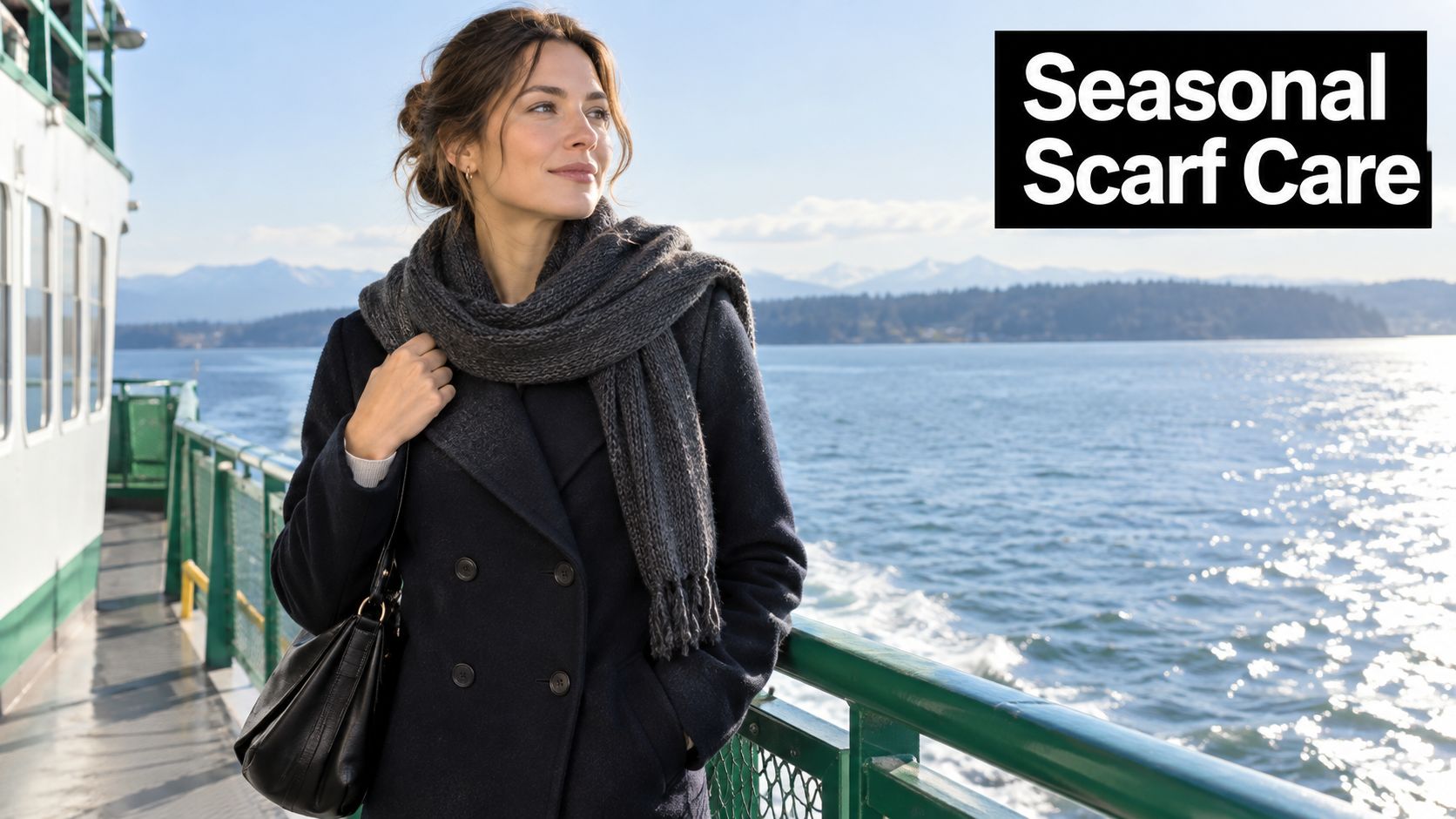
A ferry-riding teacher wraps a knit stole in a European loop over her wool peacoat. The fold sits close to her neck, the ends fall evenly, and the breathable knit keeps the look composed while she crosses the water.
A bike-commuting developer chooses a faux fur muffler with a hidden snap. He secures it before fastening his helmet strap, keeping the plush edge close without allowing loose ends to interfere with movement. A downtown lawyer takes a velvet-lined scarf to client lunch, tossing it over one shoulder so the lining flashes against a dark coat.
The styling rule is simple. Use a scarf's volume deliberately. A substantial wrap looks polished against a clean, well-fitted coat, while a more textured coat benefits from a smoother scarf that creates contrast instead of competing with the surface.
Give each textile its own care ritual
Faux fur needs air and gentle handling. Brush it weekly with a wide-tooth pet comb, working in the direction of the pile to restore loft without pulling at the backing. Never crush it beneath heavy objects for long storage.
Knits respond best to patience. After a cool hand wash, press out excess water without twisting and dry the scarf flat on a clean towel. Hanging wet knitwear can distort the length, especially when the design has a generous width.
Velvet linings should be spot-cleaned rather than machine laundered. Protecting the face fabric preserves the silky hand and prevents the lining from becoming flattened or dull.
Storage rule: Use a breathable cotton bag with cedar blocks nearby. Don't seal a custom scarf in plastic, and don't put it away while damp.
At the end of the season, give the scarf a five-minute inspection. Refluff faux fur, check closures, remove surface lint from knits, and air the piece before storage. This small ritual protects the shape and helps a carefully made accessory remain part of your wardrobe for many winters.
For a visual look at the tactile styling possibilities, explore Pandemonium's faux fur scarf collection.
A scarf can also be styled as a belted shoulder wrap indoors, worn loosely over one shoulder for a client meeting, or secured close to the neck for a windier commute. Our winter scarf styling video offers a useful visual reference.
Ordering, Pricing, and Gifting the Right Way
A custom order goes smoothly when the buyer arrives with useful information. Send your height, usual coat collar height, neck circumference if you know it, and one reference photograph. Add whether wool feels scratchy, whether you prefer a snap or loop, and whether you want the scarf to sit beneath or over your coat collar.
Start with a focused consultation
The fabric and lining combination usually determines the price tier. High-end faux fur, velvet, dense wool, embroidery, and specialty closures each affect labor and material selection. Ask for a clear quotation that separates the textile, customization, and finishing work.
Many boutique makers use a 50 percent deposit to begin cutting, with the balance due on completion. Confirm that arrangement before approving the design, and ask what happens if the chosen fabric becomes unavailable. Order planning also matters. Custom work can take three to six weeks, depending on embroidery and faux fur sourcing, so gifting requires more lead time than an off-the-rack purchase.
For December, we recommend ordering eight to ten weeks ahead. That leaves room for consultation, textile selection, construction, and any fit adjustment without turning a thoughtful gift into a rushed parcel.
Make the gift useful, not generic
A monogrammed muslin pouch is often more elegant than branded packaging. Include a fit-and-fabric card describing the textile, lining, care method, and measurements. That card gives the recipient a practical reference and makes it easier to reorder a matching piece later.
Order-minimum anxiety deserves a direct question. Some custom scarf sellers accept a single piece, while others require minimums of 50 or 100 to 150 pieces, depending on design complexity, according to supplier FAQ guidance from Logo Softwear's custom scarf information. If you're commissioning one bespoke accessory, ask about single-piece availability before investing time in a detailed design conversation.
Our custom apparel gifting guide offers further ideas for presenting made-to-order pieces with care.
What to do if the drape isn't right
A finished scarf should be assessed with the coat and clothing you intended to wear. Try the planned wrap while standing, sitting, walking, and turning your head. If it pulls, rides upward, feels too dense beneath the collar, or leaves too much exposed skin, photograph the issue and describe the movement rather than saying it feels wrong.
At Pandemonium, custom sizing, alternate fabrics, and length adjustments may be available on request, depending on the design. Our Seattle studio, founded by Leigh Young and shaped by 25+ years of design experience, approaches customization as a conversation between your lifestyle and our millinery expertise. For shoppers who want cruelty-free luxury, faux fur can also offer an animal-free alternative, though it remains important to ask about fiber content and care.
The wider scarves and shawls category gives this kind of careful work room to grow. The global market reached USD 26.22 billion in 2025 and is projected to reach USD 56.37 billion by 2034, implying a 9.12% CAGR over that forecast period, according to Fortune Business Insights' scarves and shawls market outlook. Asia Pacific held the largest regional share at 37.92% in 2025, while scarves alone were expected to generate USD 14.63 billion in 2025. Those figures support our view that a custom winter scarf belongs in the realm of premium apparel, not as an afterthought at the checkout counter.
Join The Crowd, our email list, for 15% off and seasonal notes from our Seattle studio. Then visit Pandemonium Millinery to explore custom winter scarves, hand-sewn faux fur accessories, and small-batch pieces made with your fabric and our expertise.


